
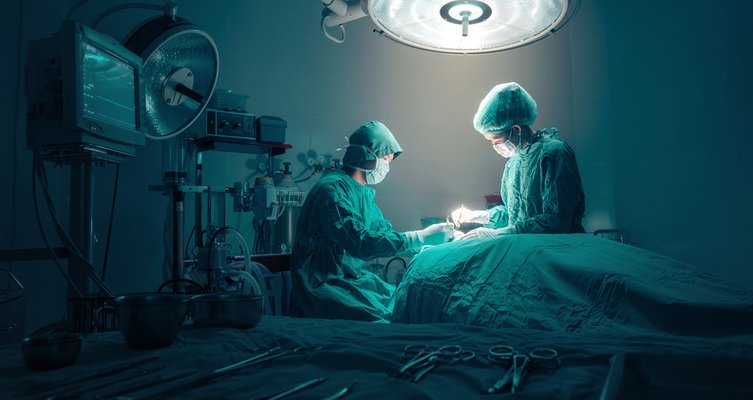


Doctors at the All India Institute of Medical Sciences (AIIMS) in New Delhi have performed India’s first open fetal surgery to repair a severe spinal defect in an unborn baby. The AIIMS fetal surgery was carried out on 12 November, when the mother was 25 weeks pregnant, and lasted six hours.
The operation repaired a lumbosacral myelomeningocele, the most severe form of spina bifida, in which the spinal cord and its coverings push through an opening in the spine. The defect was leaking cerebrospinal fluid, the fluid that surrounds the brain and spinal cord.
AIIMS fetal surgery took six hours
More than 30 clinicians and nurses took part in the procedure at the AIIMS Neurosciences Centre, using high-end microscopy and continuous ultrasound guidance. The AIIMS fetal surgery team had spent more than five weeks preparing, with detailed fetal imaging, counselling for the family, anaesthetic planning and surgical simulation.
Professor Deepak Gupta led the neurosurgical part of the operation. He is president of the Indian Society for Pediatric Neurosurgery. Professors Neena Malhotra and K. Aparna Sharma led the maternal-fetal medicine and obstetric teams, while anaesthesia, plastic surgery and neonatology teams also took part.
The AIIMS fetal surgery was provided free of cost to the family under the Government of India’s Janani Shishu Suraksha Karyakram (JSSK), a scheme that covers care for pregnant women and newborns.
Spina bifida occurs when the spine and spinal cord do not form fully in the early weeks of pregnancy. In myelomeningocele, the most severe form, the spinal cord and its coverings push out through an opening in the back, and the exposed tissue can be damaged before birth.
Doctors advise women planning a pregnancy to take folic acid, which lowers the risk of neural tube defects, the group of conditions that includes spina bifida.
What AIIMS fetal surgery can and cannot do
Myelomeningocele is an open neural tube defect. In most cases in India, surgeons repair it only after the baby is born. The AIIMS fetal surgery aimed to limit damage to the spinal cord and nerves while the baby was still developing, and to reduce the fluid leak that can harm the brain.
Professor Gupta said the achievement showed new capability in fetal medicine and paediatric neurosurgery in India. He also stressed that the procedure is not a cure. The child will still need long-term care and monitoring from several specialists after birth.
The main international evidence for operating before birth comes from the Management of Myelomeningocele Study, known as the MOMS trial, published in the New England Journal of Medicine in 2011. In that trial, 40 per cent of children treated before birth needed a shunt placed by 12 months of age, compared with 82 per cent of those treated after birth.
The MOMS trial, which ran in the United States, compared children who had surgery before birth with those treated after birth. It found that prenatal surgery cut the need for a shunt to drain fluid from the brain, and improved motor outcomes at 30 months, although it also raised the risk of preterm birth.
AIIMS New Delhi is India’s leading public hospital and medical research institute, and its neurosciences centre handles complex brain and spine cases from across the country. The institute said the fetal surgery team drew on specialists from neurosurgery, obstetrics, anaesthesia, plastic surgery and neonatology.
AIIMS fetal surgery follows years of planning
The possibility of performing fetal spinal surgery was first discussed at AIIMS about 14 years ago, according to reports of the announcement. The AIIMS fetal surgery marked a shift in how selected cases of the condition can be managed in India.
Open fetal surgery carries risks for both mother and baby, including preterm labour, complications from scarring on the uterus and risks to the fetus. Doctors select only a small number of cases for the procedure, after detailed imaging and counselling.
After the AIIMS fetal surgery, the mother and baby will need specialist monitoring through the rest of the pregnancy, delivery and the newborn period. AIIMS did not announce the expected delivery date or further details of the baby’s progress after the operation.
The institute described the operation as India’s first open fetal repair of the condition. The AIIMS fetal surgery team said the mother and baby would remain under specialist care, and that the case would guide how similar cases are handled in future.