


What the China export curbs would cover
Beijing has proposed sweeping controls on the export of 40 cutting-edge technologies spanning artificial intelligence, biomedicine and solar manufacturing, with 14 facing outright export bans and a further 26 requiring government licences. The China export curbs were published for public comment on Friday by the Ministry of Commerce and the Ministry of Science and Technology, in a draft formally titled Announcement No. 48 that represents one of the most far-reaching revisions to the country’s technology export regime in recent years. Officials said the proposal would tighten oversight of technology transfers underpinning the overseas expansion of Chinese companies, while preserving exemptions and streamlined approvals for much international collaboration in AI.
AI technologies caught in the net
The proposal lists 23 artificial intelligence technologies, including foundation models, intelligent agents, computing clusters and information-processing technologies, described as the fundamental building blocks of the country’s AI industry. The 40 technologies break down into 23 AI technologies, 12 solar technologies and five biomedicine technologies. Under the China export curbs, AI-driven tools capable of generating and mutating malicious code would face a complete export prohibition. Explaining the AI controls, a commerce ministry spokesperson said such tools could be used to target critical infrastructure, defence systems and core government networks if acquired by malicious actors, and that China’s objective was to establish security safeguards, prevent misuse and ensure AI remains under human control. The ministry stressed that most AI technologies would continue to be freely exportable, with only a defined set of sensitive capabilities brought under control. The draft makes clear that the China export curbs are aimed at frontier capabilities with potential military or intelligence applications, rather than routine commercial software or consumer-facing AI services.
Solar manufacturing at the centre of the controls
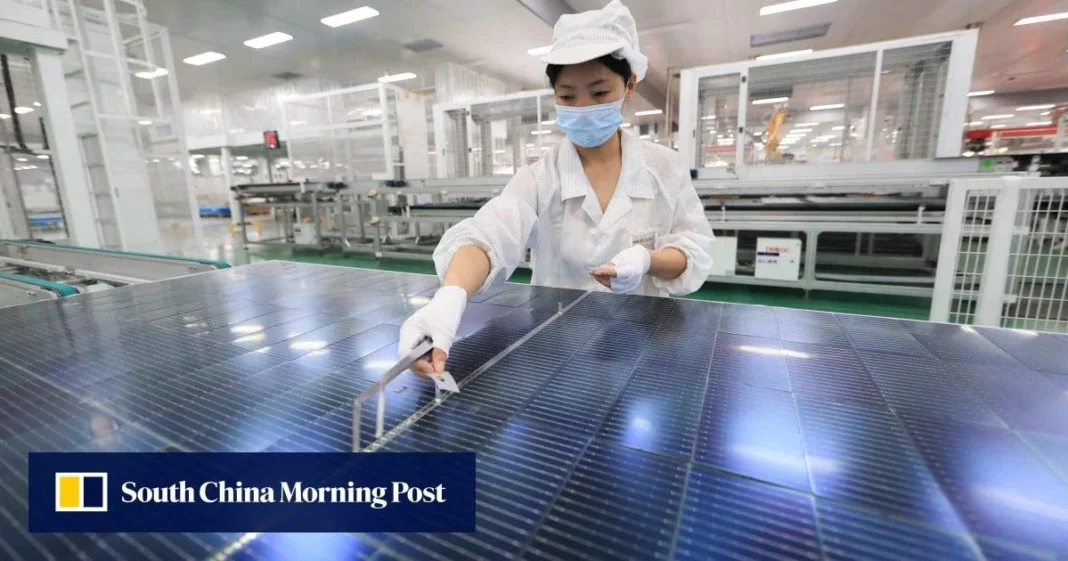
A number of technologies related to the manufacture of solar cells have been listed for either a complete export ban or restricted exports. Proposed outright prohibitions include manufacturing technologies for perovskite and tandem solar-cell modules, the next-generation designs at the frontier of photovoltaic efficiency. A further set of polysilicon engineering technologies used to make solar cells would require export licences where they involve production lines with annual output capacities of at least 30,000 tonnes. The biomedicine portion of the list targets selected platforms related to cell and gene therapy. Beijing said the move reflected the fact that photovoltaic technologies are increasingly being used in aerospace, defence, unmanned systems and other sensitive sectors, raising the national-security implications of technology exports, while noting that only a limited set of technologies would be regulated and other photovoltaic technologies would remain freely exportable. Taken together, the solar provisions illustrate how the China export curbs target manufacturing know-how at the top of the value chain, where Chinese firms currently hold a commanding global position.
Why Beijing says the China export curbs are needed
Officials framed the proposal as necessary to safeguard national security and interests, insisting the revision was routine and did not target any specific country, region or entity. The draft also seeks to reassure international partners: open-source AI projects and overseas chip fabrication activities would be eligible for facilitation measures, while technologies already in the public domain through open-source publication or academic papers would generally be exempt. The ministry said China remained committed to building an open-source AI innovation ecosystem, signalling that the controls are aimed at sensitive transfers rather than everyday commercial engagement. Analysts noted that the controls on next-generation solar manufacturing technologies could nevertheless affect efforts by countries such as India to reduce their dependence on China as they seek to move up the solar value chain, since the draft reaches beyond equipment to the underlying manufacturing methods. Trade analysts say the China export curbs could raise costs or slow technology acquisition for countries trying to localise advanced photovoltaic production, although Beijing insists most solar exports will stay unrestricted. The proposal is open for public comment until November 15, while interim pre-export registration management is being applied immediately, requiring exporters to register covered transfers while the ministries gather feedback. Exporters and foreign buyers are already poring over the text of the China export curbs to assess which operations fall within scope. Industry groups and trading partners are expected to study the China export curbs closely in the coming weeks, with formal responses likely before the consultation closes. Whatever the final shape of the rules, the proposed China export curbs signal Beijing’s determination to keep its most sensitive know-how, from advanced AI models to next-generation solar manufacturing, firmly within regulatory reach, confirming that control over frontier technology has become a central instrument of statecraft with consequences far beyond China’s borders.