
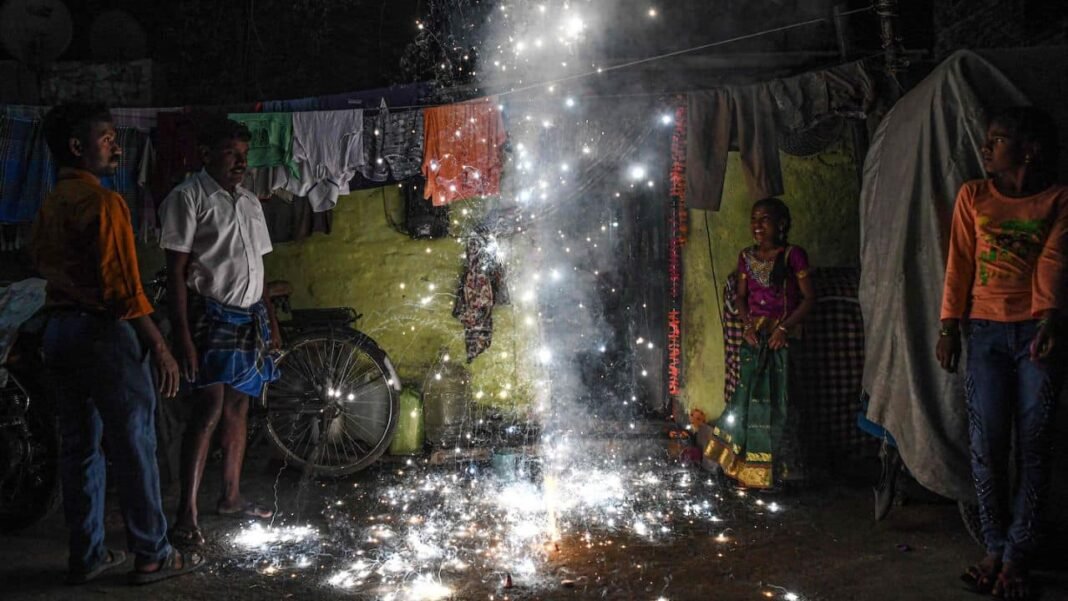


The Supreme Court has allowed green crackers in Delhi-NCR for two days around Diwali, in a limited relaxation of the complete firecracker ban. The order, dated 29 October and made available on 2 November 2026, permits bursting only on 7 and 8 November. Diwali falls on 8 November this year, and the full ban returns on 9 November.
A bench of Justices M. M. Sundresh and Prasanna B. Varale passed the order. The bench said bursting firecrackers during Diwali is a religious practice, but one that causes severe air and noise pollution and creates solid waste when left unregulated. Children, older people and people with disabilities are among the most vulnerable, the court noted, at a time when Delhi’s air had already slipped into the very poor category.
The permission covers only green crackers. Only green crackers approved by the Council of Scientific and Industrial Research and National Environmental Engineering Research Institute, known as CSIR-NEERI, may be used. Firecrackers containing barium, and green crackers without that certification, remain prohibited. The court directed authorities to stop conventional firecrackers entering the market under the label of green products.
Manufacturers holding valid CSIR-NEERI certification and Petroleum and Explosives Safety Organisation licences may manufacture only those products uploaded on the CSIR-NEERI website, between 2 and 6 November. Traders whose licences had been cancelled had those licences temporarily restored, so they could sell green crackers between 4 and 6 November at designated locations only.
Green crackers: hours and dates for bursting
Bursting green crackers is allowed between 6 am and 7 am and again between 8 pm and 10 pm on each of the two permitted days. That gives three hours per day, and no bursting is permitted outside those windows. Sale is not allowed online, and sale at places other than the designated locations is prohibited. Police are to inspect sale points and enforce the limits.
The court also required traders and manufacturers to furnish monetary security in a substantial amount, to be set by the authorities. District collectors and commissioners, working with district police chiefs, must identify the designated sale locations in each district of Delhi-NCR. The aim is a narrow, supervised exception to a ban that remains the rule for the rest of the year.
The case comes from the long-running Delhi air pollution writ petition, Arjun Gopal and others against Union of India and others, heard with a 2026 suo motu writ petition. The court allowed intervention applications by the Delhi Fireworks Shopkeepers Association and the Federation of Fireworks Traders. The order is broadly in line with last year’s order, which allowed a similar relaxation for Diwali.
Green crackers: no-cracker zones near hospitals
No firecrackers may be burst within 300 metres of hospitals, nursing homes, primary and district health centres, old-age homes, educational institutions and notified silence zones. Those areas are to be declared no-cracker zones, marked on the ground and published, so residents know where the rule applies. The protection for hospitals and health centres is a central part of the order, given the health effects of smoke and noise on patients.
Pollution control boards must prepare daily air quality reports for three periods: the pre-Diwali period of 2 to 6 November, the festival days of 7 and 8 November, and the post-Diwali period of 9 to 30 November. The Central Pollution Control Board must prepare those reports in consultation with state pollution control boards. The reports will show whether air quality worsened during the relaxation and by how much.
Authorities must file compliance affidavits by 14 December, covering enforcement, designated sale locations, prosecutions, air quality trends and post-Diwali hospital admissions. The matter will next be heard on 16 December. That timetable means the court will review the actual record of the two days, rather than relying on assurances given in advance.
What residents should check before Diwali
Residents should buy only green crackers carrying the required certification and QR codes, and only from designated locations during the sale window. They should check the marked no-cracker zones near their homes, schools and hospitals before 7 November. Bursting outside the two daily windows, or inside a no-cracker zone, breaches the order even if the product itself is approved.
People with asthma, heart disease or other breathing problems should plan for the two days in advance, since smoke levels can rise sharply in the evening window. Keeping prescribed inhalers at hand, and staying indoors during that window where possible, are practical steps.
After 8 November, the position returns to a complete ban. From 9 November, no green crackers may be burst in Delhi-NCR under this order. The court will then receive the compliance affidavits in December and decide what further directions, if any, are needed on enforcement and on air quality monitoring for the rest of the winter.