
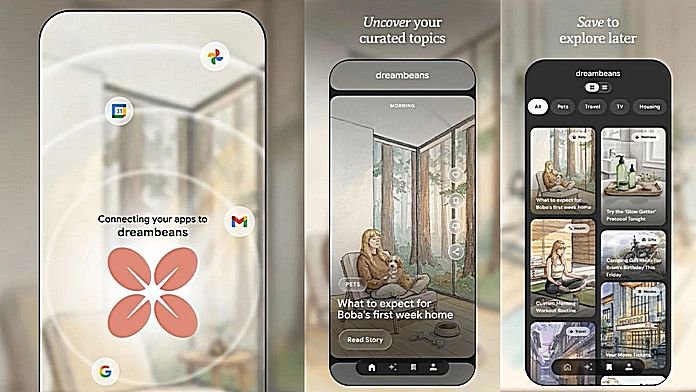


Google Dreambeans India launch arrived on Tuesday, 3 November 2026, bringing the company’s experimental AI app to users aged 18 and above across the country. The Google Dreambeans India launch makes India the first international market to receive access to Dreambeans, which Google introduced in June and rolled out to users in the United States before expanding it to all eligible US users aged 18 and above.
Dreambeans is part of the Google Labs experiment and is available on Android and iOS. In a press note, Google described Dreambeans as an experimental app that can help users discover information relevant to their interests without having to scroll through feeds or enter prompts. Instead, it uses information from Google apps selected by users to generate personalised collections of stories each day.
The stories can cover a range of subjects, including the places users might want to explore, arts and crafts, upcoming local events and reminders. Under the Google Dreambeans India launch, users can open individual stories to learn more, bookmark them for later, or share them with others. The company also accepts user feedback to help improve the stories generated by the app.
What the Google Dreambeans India launch includes
Google Dreambeans India launch supports 14 languages, including English, Hindi, Bengali, Telugu, Marathi, Tamil, Urdu, Gujarati, Kannada, Malayalam, Odia, Punjabi, Assamese and Nepali. Google has revealed that users can select only one language at a time for their generated stories, so a story is generated in the single language the user has chosen even when the underlying information comes from several services.
Dreambeans draws on information from connected Google services, including Calendar, Gemini, Gmail, Photos, Search and YouTube. The app is designed to proactively surface relevant content rather than wait for users to ask questions. There is also a feature that can animate images in select stories using Google’s Veo video-generation model, which turns still story images into short moving visuals.
Google chose India as the first market outside the United States because of strong interest from Indian users seeking access to the app and the widespread use of its services in the country. Product manager Gozde Oznur told reporters at a press briefing that India stood out for its high overlap of users across Gemini, Gmail and Google Photos, a combination that gives Dreambeans more connected material to work with than in most markets.
How Google Dreambeans India handles personal data
The Google Dreambeans India launch runs on Google’s Personal Intelligence technology, which reaches into accounts that can hold sensitive material. Users connect the services they want the app to use, and they can change those connections or delete their Dreambeans data. The app is available to personal Gmail account holders, and its generated stories are visible only to the account holder.
The Hindu reported that opt-ins made in Dreambeans do not change choices made in Gemini or AI Mode, keeping the app’s permissions separate from other Google products. Google also acknowledges that the app can hallucinate and sometimes produce incorrect stories, with a thumbs-down tap offered as the correction mechanism. That admission matters because the stories draw on personal material: an error in a story about a user’s own calendar or photos is easier to spot than an error in a general article, but it still needs a simple way to flag it.
US downloads give a sense of the app’s scale so far. Sensor Tower estimates shared with TechCrunch put US downloads at nearly 55,000 since Dreambeans debuted in June, after a September peak. The India release therefore arrives while the product is still small, and its reception among Indian users will test whether daily personal stories work as a format beyond the US audience that tried it first.
Google Dreambeans India and the wider AI app race
The Google Dreambeans India launch sits beside a second Google move in India this week: a pilot Discover tab inside Google Pay that brings AI virtual try-on and visual search to a small group of users. Both releases use personal data and AI generation to shape what a user sees without a typed query, and both are limited in scope while Google gathers feedback.
For now, the Google Dreambeans India launch remains an experiment rather than a finished product. Google has not announced a date for wider availability beyond the 18 and above audience in India and the United States, and the company is exploring ways to move beyond personalised stories and recommendations toward helping users act on the app’s suggestions. That direction remains exploratory, and the India release is the first test of the format in a market where most users do not use English as a primary language.