
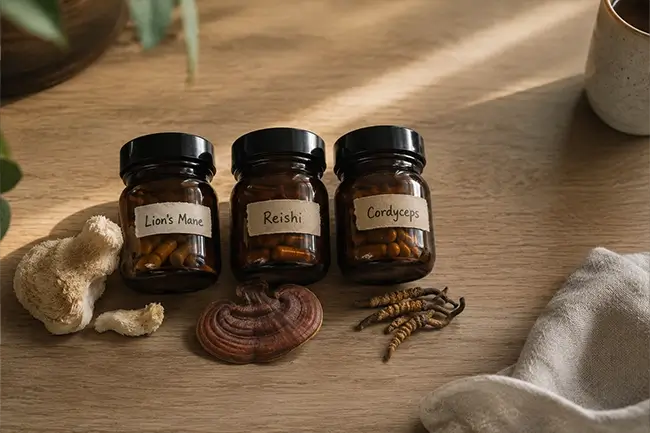


Mushroom supplements are sold as a simple route to better memory, stronger immunity and more energy. Lion’s mane, reishi and turkey tail powders and capsules fill health food shops and social media feeds, where sellers say the fungi can slow aging and sharpen focus. A new NPR report asks what the research actually supports. The answer is more restrained than the marketing.
Julie Daoust grew up in the French Alps, where she foraged for mushrooms as a child. She earned a doctorate in chemistry and now works as vice president of science and innovation at Monterey Nutra, which grows mushrooms and sells fungal extracts. Daoust says certain fungi may have particular uses. Lion’s mane, a soft fungus that hangs like a chandelier, may aid cognition. Reishi and turkey tail, which grow as hard brown scales on rotting trees, could support immune health.
What sellers say mushroom supplements can do
On social media, influencers and advertisers go further, promising that medicinal mushrooms taken as supplements can slow aging and improve energy, focus and immune health. The products are often described as functional mushrooms, a term with no legal definition. Companies can say a product supports the body’s structure or function, but they cannot claim it treats or prevents a disease.
Mushroom supplements and the missing trials
The clinical evidence behind mushroom supplements is thin. Abby Langer, a registered dietitian based in Toronto, told NPR that strong trials proving the claimed effects and their safety are largely lacking. “In my opinion, I don’t think that there’s much evidence for functional mushrooms as of now,” she said. Langer also warned that mushrooms absorb and concentrate what is in the soil where they grow, both useful compounds and contaminants, so buyers should be careful about the source.
Langer added that long use in traditional medicine does not settle the question. “Just because something has been used for a long time doesn’t mean that it’s safe, that it’s effective, that the dosing has been established,” she said. “There are a lot of unknowns.” She still allows that the evidence base for mushroom supplements is growing. “The clinical research on specific functional mushroom products is young,” she said, “but it’s accumulating fast and already includes some impressive results.”
Eating mushrooms has clearer support than taking mushroom supplements in pill form. Mushrooms are a good source of vitamin D2 and antioxidants. Their cell walls contain beta-glucan, which has been linked to gut health, including a lower risk of Crohn’s disease, and to immune response. Research on mushrooms and thinking skills has been mixed.
What the turkey tail research shows
The strongest results so far for mushroom supplements involve PSK, a purified extract from turkey tail studied in Japan. A meta-analysis looked at 8,009 patients in eight randomized controlled trials who had surgery to remove a gastric tumor and, in almost all cases, chemotherapy. Patients who also received PSK had a 12 percent lower risk of death. Santhosshi Narayanan, an integrative oncologist at MD Anderson Cancer Center, said researchers take the finding seriously. “This is not something that we brush off,” she said.
Narayanan cautioned against reading too much into it. The result does not mean that PSK, or any mushroom on its own, cures cancer. “It just shows to us that we need to pay attention to these natural products,” she said. She added that much remains unknown, especially for patients outside Japan whose genes or treatment plans differ and who might face side effects. “We need to do more research and understand how we can use it,” she said. “Like which people, which type of patients benefit from which type of mushroom, because that itself is a whole science.”
Narayanan and her colleagues surveyed 2,349 studies on medicinal mushrooms and cancer, and only 39 were strong enough to include in their 2023 analysis of mushroom supplements and cancer. Of those, 31 showed benefits, including better quality of life, fewer side effects from chemotherapy and better control of inflammation and spread of disease. Six studies found no advantage and two found worse outcomes. The authors could not draw firm conclusions about how mushrooms affect the immune system in cancer.
Mushroom supplements: what to do first
For now, Narayanan does not see enough evidence to support routine use of mushroom supplements in cancer care. Langer suggests starting with diet before adding a supplement. “Take a closer look at what you’re eating, how you’re eating, when you’re eating,” she said, “and see if there’s any tweaks that you need to make.” More fiber or protein, less alcohol, fewer sugary drinks and fewer skipped meals can all help, she said. “There’s so many things that people can potentially improve on,” Langer said, “before adding something else that’s promised to be this panacea for everything that ails you.”