
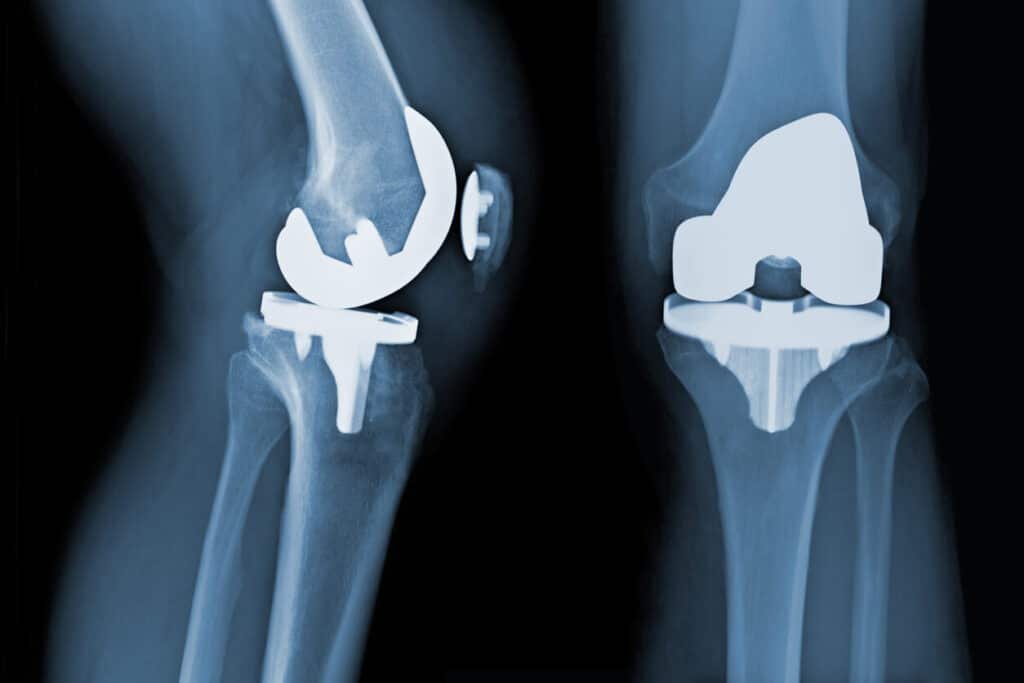


Steve Russak, 70, woke from knee replacement surgery last year to find he had received one of the new smart knee implants, a device he says he never asked for. Zimmer Biomet then texted four times about an app he did not understand, and a company representative called to offer help. “I said, ‘What? I don’t know what you’re talking about,'” Russak told KFF Health News.
Russak had not received an ordinary replacement of bone and cartilage. He had been given a Persona IQ, one of the smart knee implants now on the market, with a battery, sensors and a transmitter that, if he authorized it, would send data about his gait and range of motion to his clinicians. He is suing his doctor, Zimmer and Canary Medical, which helped develop the smart knee implants. His lawsuit calls the knee an “unauthorized implantation” and says Zimmer’s own patient materials gave him the right to opt out of data collection or decline the knee altogether.
Why smart knee implants are drawing lawsuits
Russak said he does not want smart knee implants collecting his data, citing his privacy. The implant has already caused problems: he could not get an MRI because of compatibility issues. The case is ongoing, with the next hearing set for December. Russak has dropped fraud and breach of fiduciary duty claims against the doctor, but he is still suing on other grounds, including lack of informed consent. The doctor has yet to respond to the complaint in court. Zimmer and Canary filed responses denying “each and every allegation” in the complaint.
In Contra Costa County, Jodi Murphy filed a similar lawsuit against Zimmer, Canary Medical and her doctor after receiving one of Zimmer’s smart knee implants. Her lawsuit says the doctor and companies acted “without disclosing this device or obtaining Plaintiff’s specific informed consent for its use.” The doctor denied all the allegations. A hearing is set for February.
Zimmer spokesman Troy Kirkpatrick declined to comment on the lawsuits but said “nearly 90 percent” of surveyed patients would choose remote monitoring again. “The transmission of post-operative recovery data requires patient authorization at the time the patient sets up an account,” he said in an emailed statement.
What the data shows about smart knee implants
Zimmer introduced the Persona IQ in 2021 as the “world’s first and only” FDA-approved smart knee. The company sold about $3.3 billion in knee joints last year. Zimmer’s website says the implant lets care teams “monitor and personalize” a patient’s experience, but adds that it is “not intended to support clinical decision-making” and has “not been shown to provide any clinical benefit.”
Kevin Bozic, an orthopedic surgeon in Austin, Texas, reviewed research on smart knee implants at KFF Health News’ request. “None of them compare Persona IQ to a more conventional [knee] implant,” he wrote in an email. He said surgeons he knows are “ambivalent” about the device. In theory, he said, the step counts and range-of-motion data could help care. In practice, he said, “it’s a nice-to-have, certainly not a need-to-have.”
Medicare pays to monitor the devices
Both Medicare and private insurers pay clinicians to review data from smart knee implants and other connected devices. In 2024, nearly one million Medicare beneficiaries received remote patient monitoring. Medicare paid providers $536 million for the service, more than double what it paid three years earlier.
Medicare has proposed pulling back on some payments after the inspector general warned of fraud risks in remote monitoring. About 43 percent of patients in 2024 did not receive the full set of services the program defines. Makers of smart knee implants also benefited from a Medicare new-technology add-on payment. The extra payment for Persona IQ lapsed in fall 2024.
Sanket Dhruva, a cardiologist and digital health researcher at the University of California, San Francisco, said the field needs more rigorous data. “We’re getting all this data, is this helping our patients recover better? That’s what we really care about,” he said. “In general, the field is in need of much more rigorous data.” Kate Black, a health data privacy lawyer not involved in either case, said consent standards for an implanted device “should be quite high,” because unlike a wearable product, an implant stays in the body for years. “Every step you take, they know every step you take,” Russak said.