
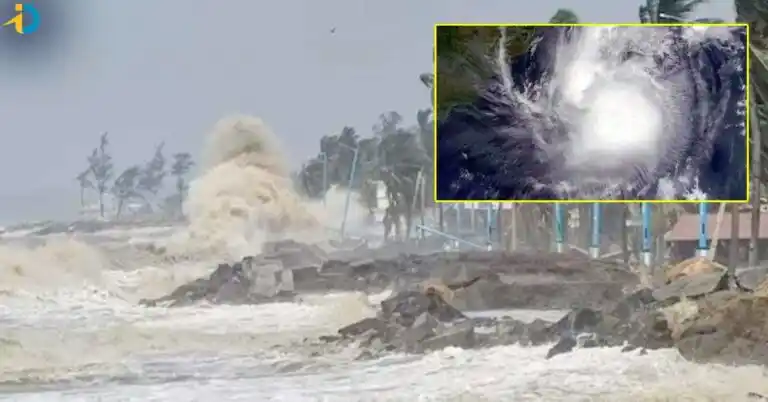


Murasu aftermath in Andhra Pradesh left at least two people dead and standing crops damaged across 52,459 hectares, after the cyclone crossed the coast near Ongole on 3 November. Murasu aftermath figures reported on 4 November put preliminary losses at Rs 3.44 billion, with more than 12,000 people moved into relief camps. The storm had weakened to a deep depression by the night of 3 November, but heavy rain continued in coastal districts on 4 November.
The storm crossed the coast between 3.30 am and 8.30 am on 3 November, with winds of 110 to 120 kilometres an hour at landfall, according to the India Meteorological Department. The landfall took place between Nellore and Narsapur, close to Ongole in Prakasam district. By 8.30 pm on 3 November, the system had weakened into a deep depression centred about 70 kilometres west-southwest of Vijayawada, with sustained winds of 55 to 65 kilometres an hour gusting to 75.
Both deaths were in Bapatla district, where a man aged 25 and a woman aged 65 died in separate building collapses, according to Prakhar Jain, managing director of the state disaster management authority. Jain put the number of people sheltering in relief centres at 12,230, across Guntur, Bapatla and Palnadu, the three worst affected districts. Officials also reported 312 houses damaged and power transmission lines brought down.
Murasu aftermath for crops and farmers
A first damage estimate given by Chief Minister N. Chandrababu Naidu to Union Home Minister Amit Shah put total damage at Rs 343.95 crore across eight state departments. About 94 per cent of that total, Rs 324.22 crore, was in farming. Crops on 50,473 hectares in 465 villages across seven districts were damaged, and 45,900 hectares of that area was paddy. The estimate said 69,828 farmers were affected.
The Murasu aftermath figures reported by other outlets were close to that estimate, with standing crops damaged across 52,459 hectares. The difference reflects the way early estimates are compiled from district reports, and the totals are expected to change as field teams complete their surveys. Paddy formed the largest share of the damaged area, which matters for farmers in the coastal districts who had planted the crop for the current season.
In the Murasu aftermath, rainfall was heaviest inland. A gauge at Konanki in Bapatla district recorded 182.25 millimetres in five and a half hours, the highest in the state. Eighteen gauges across five districts passed 100 millimetres. That rain, rather than wind alone, caused much of the damage to crops and to low lying areas in the days after landfall.
Murasu aftermath and the weakening storm
The India Meteorological Department said the deep depression would weaken further into a depression by the morning of 4 November. Its track took it north-northwestwards towards Telangana, where it was around 110 kilometres from both Nalgonda and Khammam on the night of 3 November. By 2.30 am on 4 November, the department called the system a deep depression over coastal Andhra Pradesh and adjoining east Telangana, about 60 kilometres west of Vijayawada.
Heavy to very heavy rain remained likely at isolated places in coastal Andhra Pradesh on 4 November, according to the department. Fishermen were advised to stay off the Andhra coast until the morning of 4 November. The red cyclone warning for Andhra Pradesh was lifted as the system weakened, but flash flood risk remained low to moderate in a smaller list of districts, including Anakapalli, Bapatla, Konaseema, East Godavari, Guntur, Kakinada, Krishna, NTR, Visakhapatnam, West Godavari and Yanam.
In the Murasu aftermath, Naidu reviewed the response from a government monitoring centre, and the administration opened a messaging helpline for residents to report power failures, fallen trees and flooding. Relief camps were operating in the worst affected districts, with 480 schools used as relief camps in one report of the response.
What remains after the Murasu aftermath
The immediate task in the Murasu aftermath for the state administration is restoration. Power lines brought down by the storm need repair, roads blocked by fallen trees need clearing, and damaged houses need assessment. Farmers whose crops were damaged will need surveys completed before any assistance can be worked out, and the early damage estimate will be revised as those surveys come in.
Murasu was the second cyclone to form over the Bay of Bengal within days, following Arnab. It brought heavy rain to Prakasam and Palnadu, districts that had until then been parched, according to reports of the storm.
For residents in coastal Andhra Pradesh, the change in the Murasu aftermath on 4 November is in the wind, which has eased from cyclone strength to depression strength. The rain has not yet cleared entirely, and the department’s forecast for 4 November still warned of heavy to very heavy rain at isolated places in coastal Andhra Pradesh.