
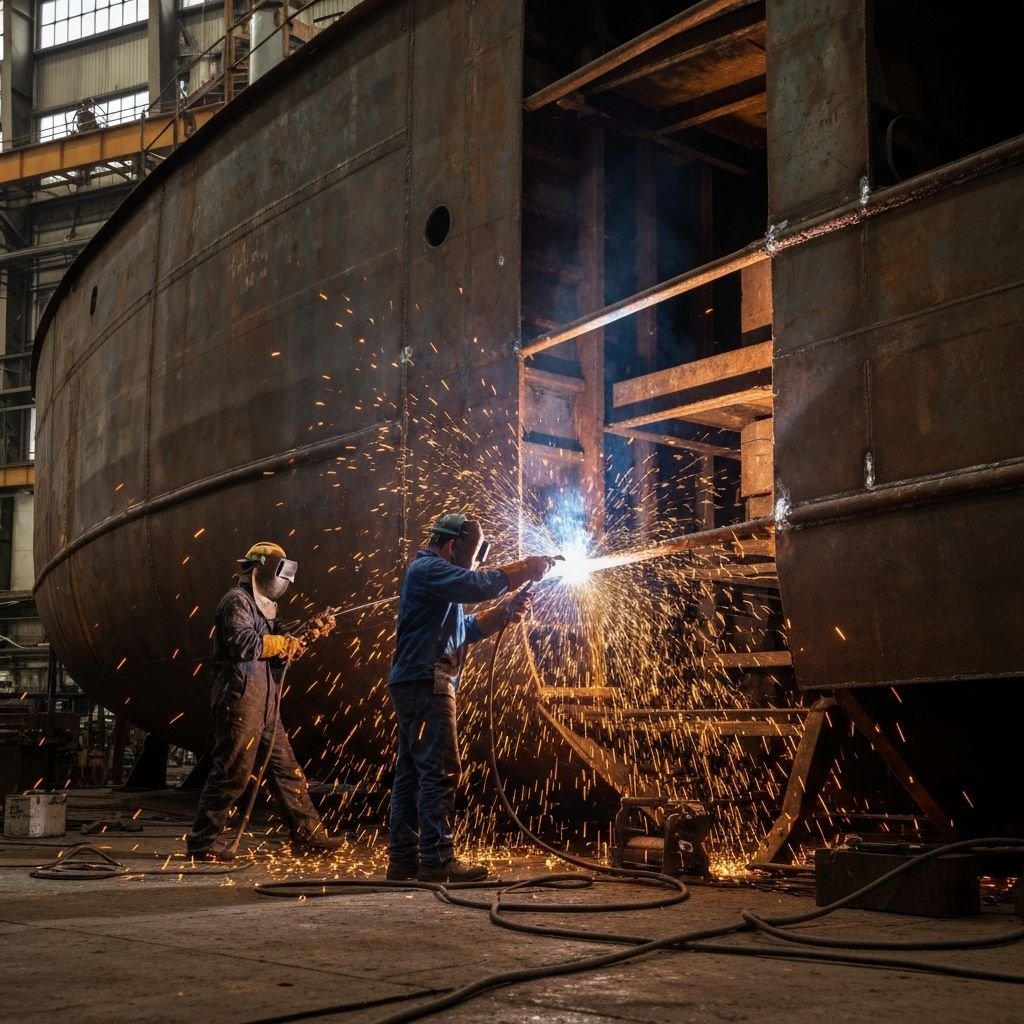


India’s first indigenously designed and built hybrid laser arc welding system has been unveiled in Kochi, in a joint project between Cochin Shipyard and SFO Technologies. The hybrid laser arc welding system, known as HLAW, was shown at the opening of a new Advanced Laser Engineering Centre and welding research facility at NeST Hitek Park in Kalamassery on 11 November. It brings together laser welding, conventional arc welding, robotics and automation, and runs on a high-power fibre laser source developed in-house by SFO Technologies.
Hybrid laser arc welding: how the system works
Hybrid laser arc welding pairs a laser beam with an electric arc in the same weld pool. The laser gives deep penetration and speed, while the arc adds filler metal and bridges gaps between plates. The combination is designed to weld faster, reach deeper into thick steel, distort the metal less and produce more consistent welds than either method on its own. SFO Technologies built the high-power fibre laser at the heart of the system, and Cochin Shipyard brought the welding requirements of shipbuilding, where long seams and thick plates are routine.
The hybrid laser arc welding system was developed jointly by SFO Technologies, the flagship company of the NeST Group, and Cochin Shipyard Limited, known as CSL. The facility was inaugurated by Jose V. J., chairman and managing director of CSL, and Dr N. Jehangir, chairman and managing director of SFO Technologies. The centre will carry out research, testing, validation and commercialisation of laser technologies, and the companies say it will help position Kochi as a centre for industrial innovation.
Hybrid laser arc welding and shipbuilding
Shipbuilding is the first use in view. Welding sits at the centre of building a vessel, with kilometres of seams joining steel plates into hulls and decks. The hybrid laser arc welding system is designed to lift productivity on that work, improving weld quality and repeatability across ships built in the same yard. The companies say the same system can serve defence, heavy engineering, railways and energy, and the fabrication of large tanks and railway wagons, where welding speed and structural consistency matter.
The hybrid laser arc welding development is also about reducing imports. India has bought laser welding platforms from abroad, and a locally designed system cuts that dependence while building domestic skill in high-end industrial technology. The centre’s work supports the government’s Atmanirbhar Bharat programme, which backs home-grown manufacturing in strategic sectors. For Cochin Shipyard, a faster and more reliable welding process feeds directly into the cost and delivery time of the vessels it builds.
What the companies said
Dr N. Jehangir described the unveiling as a proud moment for the company and for Indian manufacturing. “By developing the high-power fiber laser source in-house and integrating it with advanced welding, robotics and automation, we have demonstrated that high-end manufacturing technologies can be conceived, engineered and built in India,” he said. Jose V. J. said the partnership showed how engineering innovation could meet real industrial needs. “Cochin Shipyard’s collaboration with SFO Technologies has enabled the joint development of a technology that is relevant to shipbuilding and other manufacturing industries,” he said.
The companies have not released technical figures for the system, and no comparative production trials or cost-per-weld benchmarks have been published. Hybrid welding itself is already used internationally, so the claim here is a locally engineered system rather than the invention of the process. The centre’s research, testing and validation work will decide how far the system goes beyond the demonstration stage, and whether shipyards and factories adopt it for everyday production. The work is still at an early stage.
The Advanced Laser Engineering Centre and Hybrid Laser Arc Welding R&D Facility is now open at NeST Hitek Park in Kalamassery, an industrial area near Kochi in Kerala. Its first task is to test and validate the system, and to turn a research project into a welding platform that Indian industry can buy and use.