
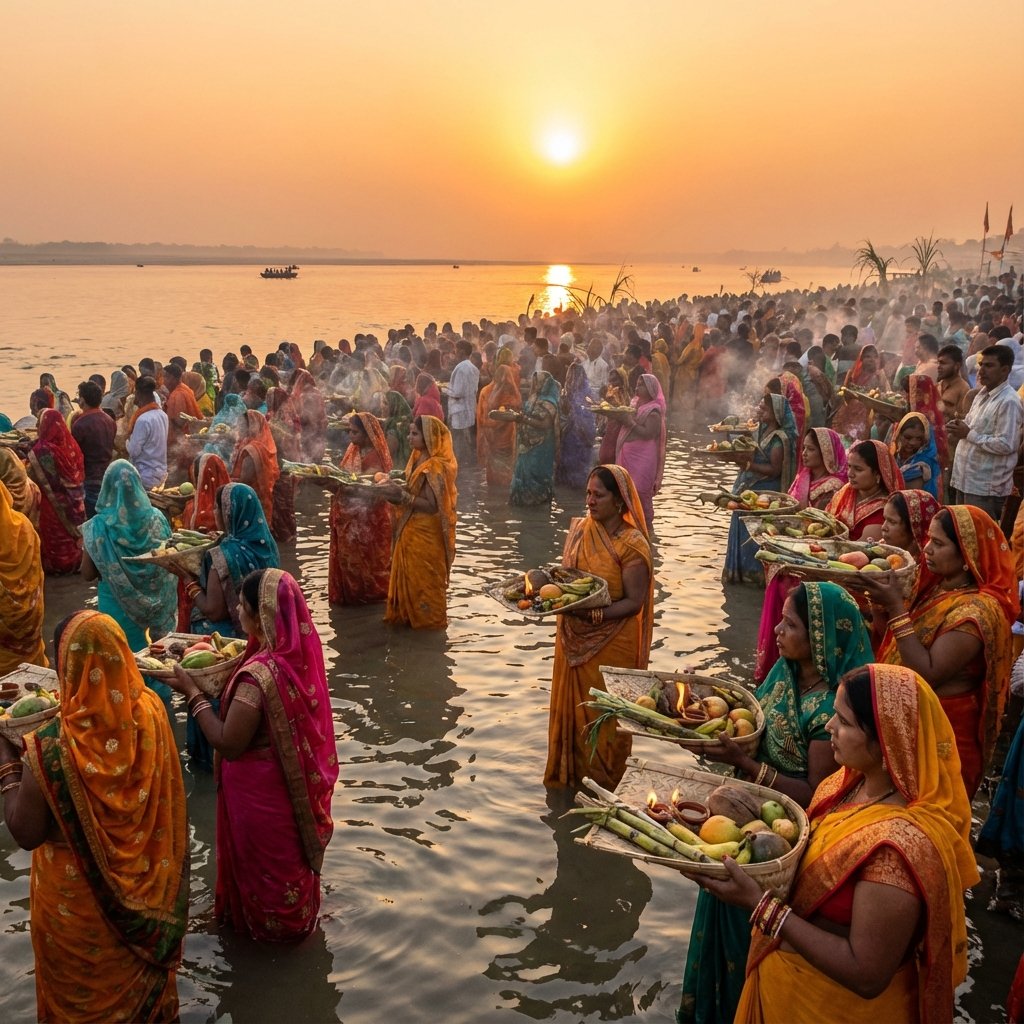


Chhath Puja 2026 ran from November 13 to 16, and the festival concluded on the morning of Monday, November 16, with Usha Arghya, when devotees offered prayers to the rising sun at dawn. The four-day festival is dedicated to Surya, the Sun God, and Chhathi Maiya, and it is celebrated mainly in Bihar, Jharkhand and eastern Uttar Pradesh, as well as in Nepal’s Terai-Madhesh and Mithila regions. Devotees thank the Sun for sustaining life and pray for the health, prosperity and well-being of their families and the long life of their children. The morning prayers ended a rigorous 36-hour nirjala fast, taken without water.
Devotees stood waist-deep in rivers, ponds and water bodies, offering arghya, water and milk, to the sun from bamboo baskets called soops, carrying thekua, fruit and sugarcane. The four days were Nahay Khay on November 13, when devotees took a holy bath in rivers and ate a traditional meal of boiled rice, chana dal and bottle gourd; Kharna on November 14; Sandhya Arghya, the evening offerings to the setting sun, on November 15; and Usha Arghya, the morning offerings to the rising sun, on November 16.
Chhath draws lakhs to river ghats
In Patna, large crowds gathered at ghats along the Ganga, including Digha Ghat, Collectorate Ghat and Gandhi Ghat. Around five lakh devotees were estimated to have visited Digha Ghat alone on Sunday for Sandhya Arghya. Chhath was celebrated at more than 10,000 ghats across Bihar. Sunrise in Patna was at 6.07 am on Monday. In Lakhisarai, the festival concluded at 7.05 am with arghya at 212 ghats along the Kiul River. Large crowds also gathered on the banks of the Son River in Koilwar and at Konhara Ghat in Vaishali. In Gaya, thousands gathered along the Falgu River and at ghats including Kendui, Pita Maheshwar, Polytechnic, Kirani, Jharkhande and Rai Vindeshwari.
Traditional foods and offerings include thekua, fruits and sugarcane, and devotees sing folk songs dedicated to Chhathi Maiya. There is no idol worship in Chhath. The worship is of natural elements: light, air, water and earth. Chhath is described as an ancient Hindu Vedic festival, and its rituals are observed over three nights and four days, including holy bathing, fasting, standing in water and offering prasada and arghya to the rising and setting sun.
Chhath across Delhi, Varanasi and beyond
In Delhi-NCR, devotees gathered at ghats including Mandawali in East Delhi, Sonia Vihar Ghat, Kalindi Kunj Ghat on the Yamuna, Noida Sector 21 Stadium and Faridabad. In Uttar Pradesh, large numbers reached the Ganga ghats of Varanasi. In Ayodhya, devotees offered arghya on the banks of the Saryu, and in Gorakhpur devotees performed rituals at Bhim Sarovar and Gorakhnath Temple. Devotees also gathered in Chandigarh, Kolkata and Ayodhya, and in Navi Mumbai’s Ulwe, Sector 9, where women carrying soop baskets with thekua, fruit and sugarcane waded into the water at a ghat on Sunday evening.
Prime Minister Narendra Modi posted on X on November 16: “Today, the four-day ritual of the grand festival of Chhath concluded with the offering of prayers to the rising sun.” Bihar Chief Minister Samrat Chaudhary offered morning arghya at a ghat in Munger and visited a ghat in Patna with his family. Bharatiya Janata Party national president Nitin Nabin carried a daura on his head in Patna as his wife Deepmala performed the rituals. In Delhi, BJP MP Manoj Tiwari offered morning arghya at Sonia Vihar Ghat. In Samastipur, cricketer Vaibhav Suryavanshi’s mother offered prayers to the rising sun. Uttarakhand Chief Minister Pushkar Singh Dhami offered arghya at Bais Pul Chhath Ghat on the Sharda River in Khatima.
What the festival means for devotees
It is a festival of thanks and prayer, and the devotees who stood in the rivers on Monday morning had fasted for a day and a half before the final offering. The festival brings families to the ghats together, and the soop baskets, the thekua and the songs are part of a ritual that has been observed for generations in Bihar and the neighbouring regions. The morning of November 16 closed the four days, and the ghats along the Ganga and its tributaries emptied as the devotees went home.