
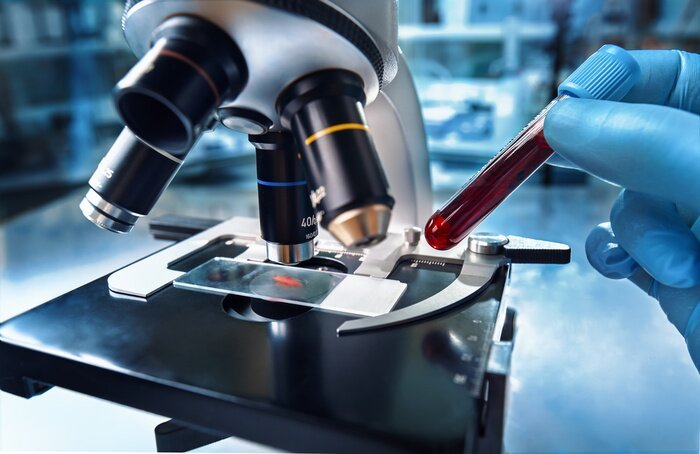


Researchers at the University of Notre Dame have developed a blood test that can screen for four deadly diseases in an hour, using only a small amount of blood. The test can identify pancreatic cancer, glioblastoma, colorectal cancer and Alzheimer's disease. The patent pending technology was developed by a team led by Hsueh-Chia Chang, the Bayer Corporation Professor of Engineering in the Department of Chemical and Biomolecular Engineering at Notre Dame.
The blood test was tested in a blind setting using 87 plasma samples from patients who were either healthy or had been diagnosed with one of the four diseases. The test was found to be 90 to 99 percent accurate for detecting the presence or absence of each disease type. The study was funded by the National Institutes of Health and published in Nature Biomedical Engineering.
How the blood test works
The test works by detecting exosomes in the blood, small particles that carry proteins which can give an early indication of disease. When a person develops cancer, the body is more likely to leak exosomes from cancerous tissue into the bloodstream. The Chang Lab created immunojanus particles to catch those markers. The particles are spheres one micron in diameter, about 70 times smaller than a human hair, and they are named after Janus, the two faced Roman god of beginnings, transitions and time.
One half of each particle is affixed with antibodies and the other half is fluorescent. The antibodies lock onto the disease specific proteins found on the surface of exosomes, in a similar way to how white blood cells find infected cells in the body. To run a test, 10 microliters of blood is diluted with a saline solution and mixed with the particles for 10 to 60 minutes, allowing them to disperse through the mixture. The sample is then analysed under a microscope. The blood test reads those markers without breaking the exosomes apart.
Blood test accuracy in blind testing
When the mixture is viewed under the microscope, the particles look like stars twinkling in the night sky. Chang and his lab designed a computer program to analyse the movement of the particles using Brownian motion, the random and erratic movement of microscopic particles suspended in fluid. When a particle captures an exosome, the extra mass causes drag, which changes how the particle moves and slows its visible blink. The program reads that change to tell whether a disease marker is present.
Chang said the blood test is both sensitive and selective. He said the lab can detect a single exosome on a particle from the blinking frequency, and that other small molecules do not produce a signal. Current detection methods break down exosomes to reach the proteins inside, which mixes disease markers with other proteins in a blood sample and can lead to false positives and negatives. The new method reads the markers on the surface of whole exosomes instead.
What the blood test could be used for
The long term goal is to develop the blood test into an annual screening test, expanding the number of cancers and diseases it can detect. Chang said the first use he expects to be approved is therapy management, to help doctors understand whether a drug is working for a patient or whether the treatment plan needs to change. In a separate test, researchers used samples from healthy patients and those diagnosed with colorectal cancer to distinguish between healthy, pre-metastatic and metastatic cancer. Their tests were 95 percent accurate, and the accuracy rose to more than 97 percent when paired with an additional blood testing strategy.
Chang said the team hopes the test can help patients know when they need to switch to a new drug. The researchers would like to see the technology used in doctors offices, clinics and hospitals during annual check-ups, when patients are already having blood drawn for glucose, cholesterol and other screenings. Since one test needs only 10 microliters of blood, up to 500 diseases could be analysed from a standard blood draw, if markers for those diseases are found.