
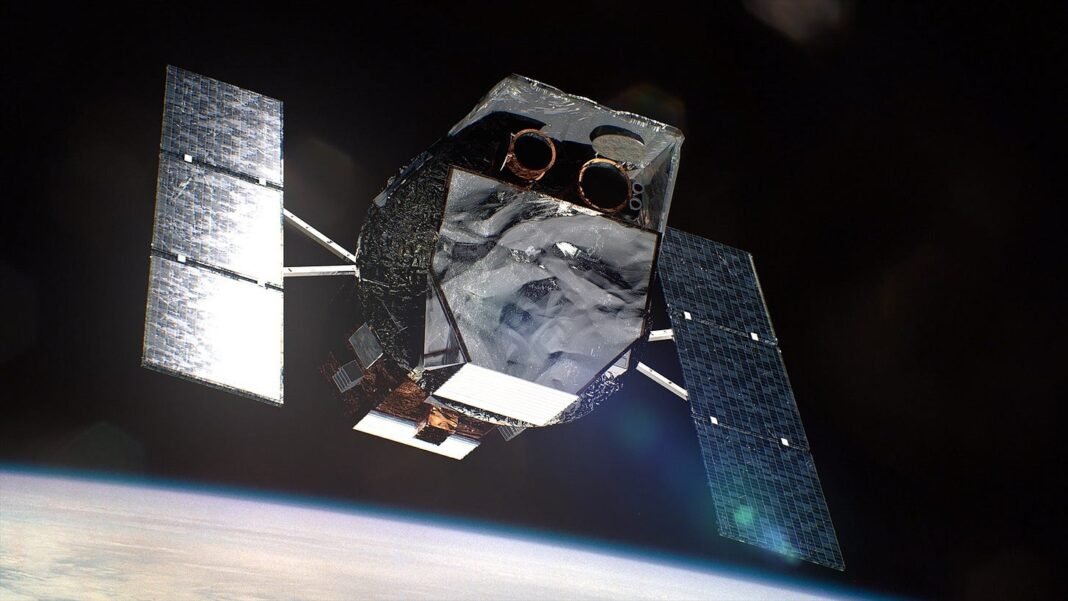


The Swift Observatory fell back to Earth over northern Sumatra in Indonesia on 4 November, ending a mission that lasted nearly 22 years. The spacecraft re-entered the atmosphere at about 7:39 am Eastern time, or 1239 GMT, moving at about 22 times the speed of sound.
The United States Space Force confirmed the re-entry. It placed the event about 200 miles north of the equator, over the northern part of Sumatra, an island in western Indonesia.
Swift Observatory re-entry confirmed
NASA had expected most of the spacecraft to burn up during its passage through the atmosphere. The agency said some fragments could survive the fall, but no damage or injuries had been reported after the event.
Re-entry is the stage of a flight when a spacecraft drops low enough for the air to slow it sharply. Friction with the atmosphere heats the structure, and most parts break apart before they reach the ground. Larger or denser pieces can survive, which is why agencies give an estimate of the risk before a known re-entry.
The spacecraft weighed about 3,200 pounds, or 1,452 kilograms, and the mission cost about $500 million. It carried three telescopes built to study gamma-ray bursts, brief and powerful flashes of high energy radiation from distant parts of the universe.
Swift Observatory mission history
The Swift Observatory launched on 20 November 2004 from Cape Canaveral on a Delta 2 rocket. It was designed to last two years, but it kept working for close to 22 years, far beyond its planned life.
A mission that lasts far beyond its planned life is not unusual in spaceflight, but each extra year adds to the record of observations. In this case, the added years turned a two year plan into a mission that ran for nearly 22 years, and the spacecraft stayed in service until October 2026.
Gamma-ray bursts are short flashes of gamma rays, the most energetic form of light. They come from distant sources, and they fade fast, so a telescope built to study them must react quickly when one appears. The Swift Observatory carried three telescopes for that work.
Why the Swift Observatory came down
The spacecraft had no engine to raise its orbit. Solar activity swelled the upper atmosphere, and the thicker air increased drag on the spacecraft, pulling it lower over time.
Drag is the force that slows an object moving through air. In low orbit, even thin air has an effect over months and years, and when the upper atmosphere swells, the effect grows stronger. Without an engine to push back up, a spacecraft in that position loses height bit by bit until re-entry follows.
Less than three months before re-entry, a rescue spacecraft failed in an attempt to boost the Swift Observatory to a higher orbit. The attempt did not succeed, and the spacecraft stayed on its path down.
The Swift Observatory ceased operations on 20 October. Its final observation came that day, from an altitude of about 171 miles above Earth.
Risk from falling debris
NASA had put the risk of harm from falling debris at about one in 2,100. That estimate covered the chance that a person could be harmed by surviving fragments from the spacecraft.
Estimates of that kind are given before a re-entry so that the public has a clear sense of the scale of the risk. A figure of one in 2,100 describes a low chance, and it sits beside the expectation that most of the spacecraft would burn up.
The Swift Observatory began as a two year mission, and its long life meant it observed the sky for far longer than planned. That extra time is part of why the end of the mission drew attention, even though the re-entry itself followed the usual pattern for a spacecraft with no engine left to lift it.
Ground tracking of a decaying orbit gives a window for re-entry rather than a fixed minute, and confirmation follows once sensors record the event. In this case, the United States Space Force gave the time and place for the Swift Observatory, and NASA gave the expectation on debris and the report that no damage or injuries had followed.
No damage or injuries were reported after the re-entry over northern Sumatra. Its last observation was made on 20 October, from about 171 miles up, and the spacecraft then fell silent before its return to Earth on 4 November.