
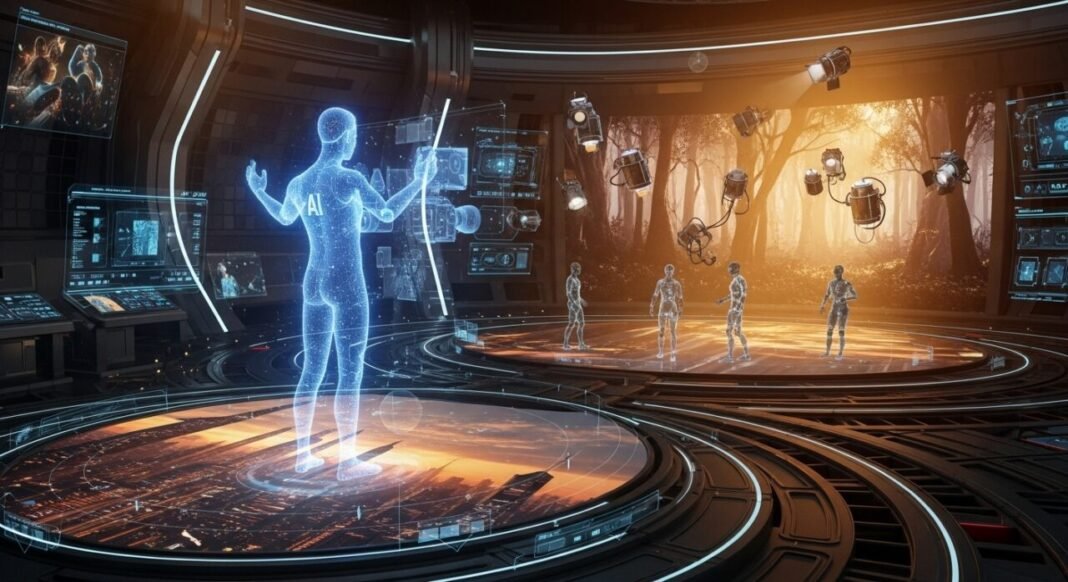


An AI series The Arc production has become one of the clearest examples yet of how generative AI could reshape screen production. The 83-minute science-fiction series was completed in just three and a half weeks at a cost of $38,000 in compute credits — a fraction of what even the leanest traditional production would spend.
The project, highlighted in this week’s industry coverage of the rapidly evolving AI production landscape, demonstrates a capability that was effectively science fiction itself just two years ago: the generation of coherent, feature-length narrative video by small teams wielding AI tools rather than the hundreds of crew members a conventional shoot requires.
AI Series The Arc: What $38,000 Buys
To put the numbers in perspective, $38,000 would barely cover a single day of shooting on a modest Hollywood production. Craft services alone on a traditional set can run into the thousands per day; a full crew’s daily payroll dwarfs the entire budget of The Arc. The AI series The Arc compressed the economics of screen production by orders of magnitude, trading cameras, sets, locations and extras for GPU time and creative direction.
The three-and-a-half-week timeline is equally startling. A conventional 83-minute production — roughly feature length — would typically spend months in pre-production, weeks shooting and months more in post. The Arc’s creators moved from concept to finished series in less time than most productions spend in casting.
What the budget figures do not capture is the human labor involved. AI-generated productions still require writers to shape stories, directors to guide the visual language, and editors to assemble coherent narratives from generated material. The $38,000 represents compute credits — the cost of running the models — not the absence of human creativity. The roles change; they do not disappear.
Why the Industry Is Watching
The AI series The Arc arrives at a moment of acute anxiety in Hollywood about what generative video means for working filmmakers. The technology’s progress has been breathtakingly fast: from glitchy, dreamlike clips to coherent scenes with consistent characters and plausible physics in barely two years. Each new demonstration project resets expectations about what is possible — and what is economical.
For independent creators, the implications are thrilling. The Arc suggests a near future in which a talented small team can produce screen content at a scale previously reserved for studios, potentially democratizing a medium that has always been gated by capital. The history of every production technology, from 16mm film to digital video to YouTube, suggests that lowering costs expands who gets to tell stories.
For the industry’s workforce, the implications are more threatening. If an 83-minute series can be made for $38,000 in credits, the economic logic that sustains large crews, location shoots and extended post-production schedules comes under direct pressure. Labor unions have already made AI a central battleground, and projects like The Arc will feature prominently in the next round of negotiations.
The Questions The Arc Cannot Answer
Cost and speed, however, are not the same as quality — and quality, ultimately, is what audiences pay for. The AI series The Arc demonstrates what the technology can do; it does not yet demonstrate that audiences will embrace AI-generated storytelling with the same enthusiasm they bring to human-made film and television.
Early reactions to AI-generated narrative content have been mixed. Viewers often report an uncanny quality — performances that feel slightly hollow, emotional beats that do not quite land. Whether those limitations are inherent to the technology or simply reflect its immaturity is the central open question. The Arc’s creators are betting on immaturity: that each model generation closes the gap a little further.
There are also unresolved questions about training data, copyright and compensation that no production budget can paper over. The models that generated The Arc were trained on vast corpora of existing creative work, and the legal frameworks governing that training remain contested in courts around the world.
For now, The Arc stands as a milestone: proof that the economics of screen production have fundamentally changed. Whether that change produces a renaissance of independent storytelling or a race to the bottom in production values will depend on choices the industry has only begun to confront.