
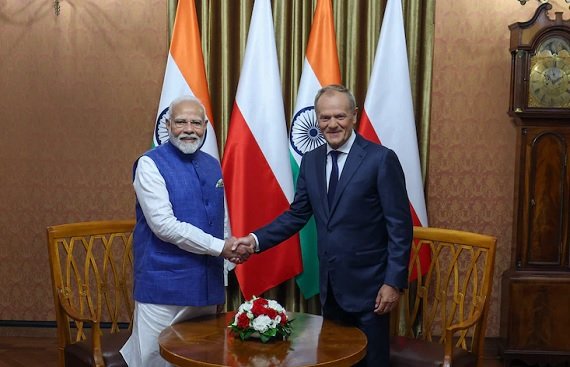


India Poland ties took a step forward on October 22, when Prime Minister Narendra Modi and Polish Prime Minister Donald Tusk held talks in New Delhi and agreed to deepen cooperation in defence, space and nuclear energy. The two leaders also set a trade target: doubling annual bilateral trade from its current $6 billion level by 2030.
The understanding was reported in the Economic Times breaking-news live blog on October 23. Tusk’s trip also included a visit to Bengaluru, though the reports available did not say what the Bengaluru stop involved or whom he met there.
The New Delhi talks were the central event of the visit. The India Poland meeting brought the two prime ministers together for a discussion that ranged from security to commerce, and the outcomes were carried as a single set of pledges in the reporting.
India Poland trade target: doubling to $12 billion
The headline economic pledge of the India Poland meeting was the doubling target. Two-way trade between the countries now stands at $6 billion a year, and the leaders agreed to take it to about $12 billion by 2030.
The five-year window to 2030 gives the India Poland trade relationship a fixed deadline to work against. Whether the target is met will depend on the sector-level steps the two sides take next, none of which were detailed in the reporting.
The reports did not specify which sectors would drive the increase. They did not mention new trade agreements, tariff changes or investment programmes tied to the target. The doubling goal was presented as a shared pledge by both governments.
Trade targets of this kind are usually followed by working-level talks on market access and investment. None of those follow-up steps appeared in the reports of the India Poland discussions.
The $6 billion starting figure is the annual level cited in the reporting. Doubling it means adding roughly $6 billion in two-way trade over the remainder of the decade, an arithmetic the reports left unstated but which follows from the numbers given.
A doubling target also implies sustained growth across the five years. The reports did not break the goal into yearly milestones, and no interim review dates were mentioned.
Defence, space and nuclear energy on the India Poland agenda
The second strand of the India Poland announcements covered three strategic areas. The leaders agreed to deepen ties in defence, space and nuclear energy, according to the live blog.
On defence, the language in the reports spoke of expanded cooperation rather than any named deal. No equipment, joint exercise or timeline was mentioned in the summaries available.
Space was named as a second area for closer work, and nuclear energy as the third. The available reports gave no further detail on projects, agencies or formats in either field.
The pattern across all three areas was the same: an agreed direction from the India Poland talks without published specifics. The reporting carried the areas as headings, and the detail of what each would involve was left for later.
That leaves the shape of the cooperation open. The reports did not say whether the defence strand would cover procurement, joint production or training, or whether the space and nuclear strands would involve government agencies, research bodies or industry. Each of those questions remains unanswered in the public record of the meeting.
Announcements of this type often precede detailed inter-governmental talks. The summaries gave no date for such follow-up discussions and named no officials tasked with carrying them forward.
Tusk’s Bengaluru stop
Beyond New Delhi, Tusk travelled to Bengaluru as part of the same trip. The Economic Times live blog listed the Bengaluru visit without describing its schedule or outcomes.
The trip therefore had two legs: the formal talks in the capital and the Bengaluru stop. Only the New Delhi leg produced the announcements carried in the reports, and the Bengaluru portion of the itinerary was noted without elaboration.
The October 22 talks set the India Poland agenda for the years to 2030. For now, the record of the meeting is the trade target and the three cooperation areas; the detail of how each will be pursued has yet to be reported.