
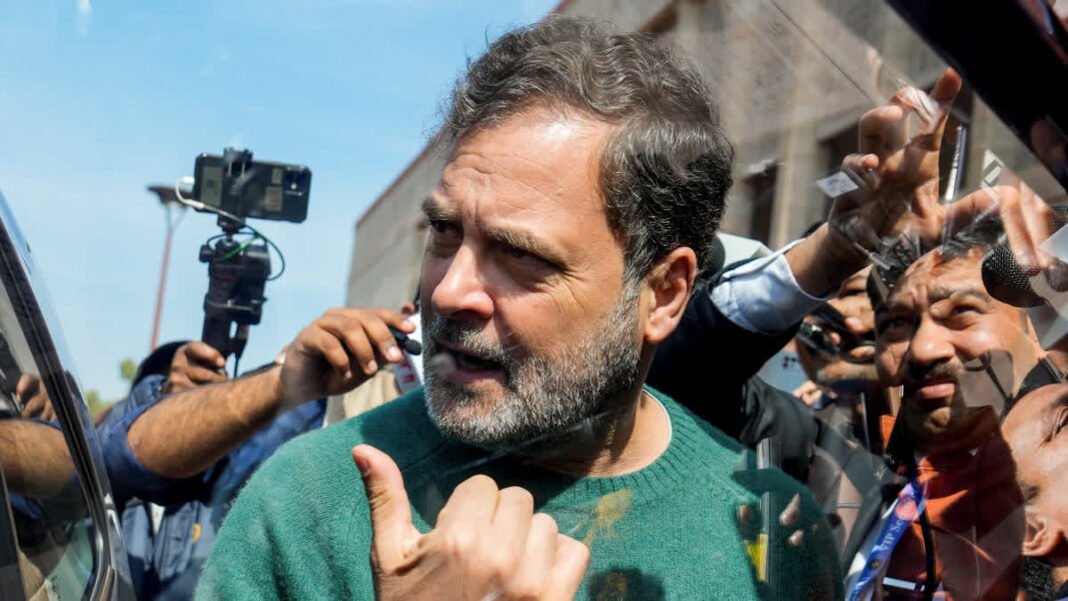


The BJP on October 22 accused the Congress of an “anarchy and regime change plot” and called Congress leader Rahul Gandhi a “gaddar”, or traitor. The charge was reported by Mathrubhumi English in its school-assembly headlines for October 23.
The BJP cited a media report on alleged links between riots in France and recent protests in India. The party said the report exposed the plot it was alleging against the Congress.
The use of “gaddar” against Rahul Gandhi marked the sharpest language in the exchange. The word, meaning traitor, was aimed at the Congress leader personally.
Political attacks of this kind often use a single sharp word to set the tone. The summaries did not say where the BJP made the remark, whether at a press conference, in a statement or on social media.
BJP’s charge against Rahul Gandhi
The “gaddar” remark was aimed directly at Rahul Gandhi. The BJP used the word while making its claim about the Congress and the alleged plot.
The reports available did not quote the full BJP statement beyond the words carried in the Mathrubhumi summary. The summary presented the allegation and the remark together, as parts of the same BJP attack.
The charge landed on October 22, and was carried in the next day’s headlines. The timing placed it among the political stories of the day’s news cycle.
The “anarchy and regime change plot” phrase was the BJP’s framing of what it said the media report showed. The summary did not reproduce the report’s own words, so the link between the report and the allegation rests on the BJP’s characterisation.
Regime change is a strong charge in Indian political debate. The summaries did not record any Congress leader using that phrase in reply; the Congress answer stayed on the themes of diversion and desperation.
Rahul Gandhi and the France link claim
At the centre of the BJP’s argument was the alleged connection between the unrest in France and protests in India. The party pointed to a media report as the basis for the claim.
The available reporting did not name the media report or describe what evidence it carried. It did not say which French riots or which Indian protests the report was said to link.
The alleged France-India link was the factual claim under the political charge. Without the media report’s name or contents in the summaries, readers were left with the BJP’s description of it.
The Congress response defended Rahul Gandhi without addressing the France allegation in the words reported. The party’s reply focused on the BJP’s motives rather than on the substance of the media report.
Congress hits back over Rahul Gandhi remark
The Congress rejected the charge. It said Modi’s ecosystem, in what it called “desperation and nervousness”, was trying to “divert, distract and spread lies”, and added that the attempt would not succeed.
The response was directed at the BJP’s allegation about Rahul Gandhi rather than at the media report itself, as far as the available summary showed. The Congress framed the BJP’s attack as a diversionary move.
The words “divert, distract and spread lies” were the Congress’s characterisation of the BJP’s approach. The party paired that with confidence that the attempt would fail.
The Congress reply named no individual BJP leader. It spoke of “Modi’s ecosystem” as the source of the attack, a collective term rather than a personal one.
The phrase “desperation and nervousness” was the Congress’s reading of the BJP’s motives. The summaries did not carry any BJP response to that reading.
Neither side’s account included documentation. The summaries carried claims and counter-claims, and the underlying media report remained undescribed in the material available.
The exchange added a fresh round to the running BJP-Congress argument over Rahul Gandhi. The Mathrubhumi headlines format carries the day’s stories in brief, and the exchange appeared there as a political item, with the two sides’ quoted words forming the whole of the account.