
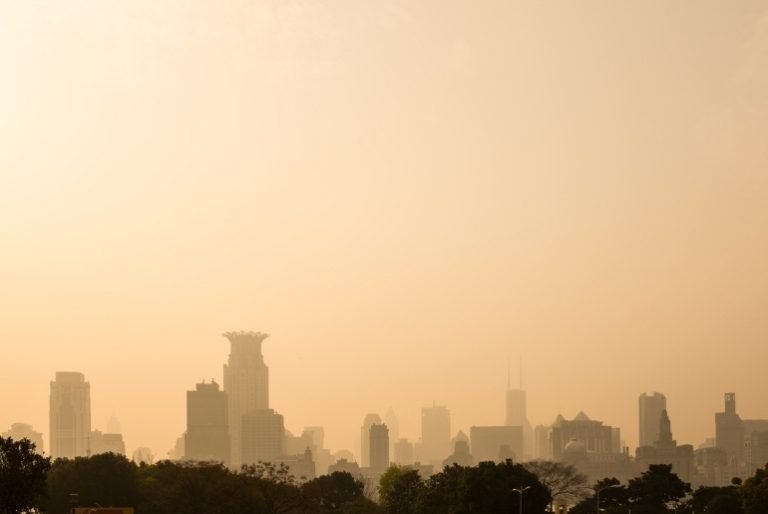


The Commission for Air Quality Management (CAQM) invoked Stage II of the Graded Response Action Plan (GRAP) across Delhi and the entire National Capital Region on November 2, with immediate effect, after Delhi’s daily average Air Quality Index (AQI) rose to 324. The GRAP Stage II decision followed the city’s first very poor reading of the season, and the commission said air quality was likely to stay very poor in the coming days. Stage II applies when Delhi’s AQI is between 301 and 400, and it adds to the Stage I measures already in force since October 21 under the GRAP Stage II regime.
Delhi’s AQI climbed fast over three days. It stood at 60 on Friday after rain washed pollutants out of the air, then rose to 117 in the moderate category on October 31, 261 in the poor category on November 1 and 324 on November 2, according to the Central Pollution Control Board bulletin. Of Delhi’s 59 monitoring stations, data was available for 58 on November 2. Of these, 36 recorded very poor air, while Jahangirpuri was the only station in the severe category, with an AQI of 417. The CAQM sub-committee reviewed the situation with forecasts from the India Meteorological Department and the Indian Institute of Tropical Meteorology before deciding.
GRAP Stage II: why the curbs were imposed
The GRAP Stage II order said unfavourable weather conditions were behind the deterioration, and that forecasts predict air quality will remain very poor in the coming days. Meteorologists warned that northwesterly winds and calm conditions could keep pollutants suspended for seven to 10 days. The forecasting system run by the Indian Institute of Tropical Meteorology warned that Delhi’s AQI could remain very poor from November 3 to November 5. The IMD forecast mainly clear skies in Delhi, with mist likely in the morning on November 3 and 4, and no rain in the next few days.
The timing adds pressure because Diwali falls on November 8, and the Supreme Court has allowed certified green crackers for three hours a day on November 7 and 8 in Delhi-NCR, under an order signed on October 29 and released on November 2. The court order came from Justices M.M. Sundresh and Prasanna B. Varale. The GRAP Stage II curbs are aimed at holding pollution down before the festival adds to the load.
GRAP Stage II: what changes on the ground
Under GRAP Stage II, agencies must carry out mechanical and vacuum sweeping of identified roads daily, along with water sprinkling, preferably at night or in the early morning, with more shifts and machine hours and proper disposal of collected dust. Daily water sprinkling with dust suppressants must take place before peak traffic hours on roads and congestion points. Action at identified pollution hotspots in Delhi-NCR is to be intensified, with remedial steps strengthened for the main source of pollution in each hotspot. Inspections for dust control at construction and demolition sites have been ordered to be intensified.
Authorities have also been told to improve vehicle parking arrangements to discourage private transport use. Resident Welfare Associations must provide electric heaters with proper electricity supply to staff engaged in security, sanitation, horticulture and other services, so they do not burn biomass or municipal solid waste for warmth in winter. The governments of Delhi and the NCR states have been asked to stagger timings of public offices and municipal bodies in Delhi and in Gurugram, Faridabad, Ghaziabad and Gautam Buddha Nagar. Other NCR areas may stagger timings too, and the central government may do the same for its offices.
GRAP Stage II: what it means for residents
Schools and colleges are not closed under GRAP Stage II. Neither the Delhi government, the Uttar Pradesh administration nor district authorities in Gautam Buddh Nagar and Ghaziabad have issued closure orders, and classes continue as normal. Shutdowns enter the picture only at Stage III, for children up to Class 5, and at Stage IV, for classes up to Class 9 and Class 11.
Enforcement is already visible at the borders. Delhi Traffic Police said 7,279 vehicles were checked on November 1 between midnight and 8 pm, with 10 challaned, 714 turned back and 38 impounded. BS6-non-compliant vehicles have been barred from entering the national capital under GRAP Stage II, and traffic police held a coordination meeting with officials from neighbouring districts on November 2 to keep the restrictions working across borders. The CAQM urged citizens to follow the Citizen Charter steps under GRAP Stage II along with those under Stage I: minimise personal vehicle use, prefer public transport or car-pooling, avoid open burning of leaves, garbage or biomass, and cooperate with the implementing agencies. The commission said it will keep reviewing the air quality picture.