
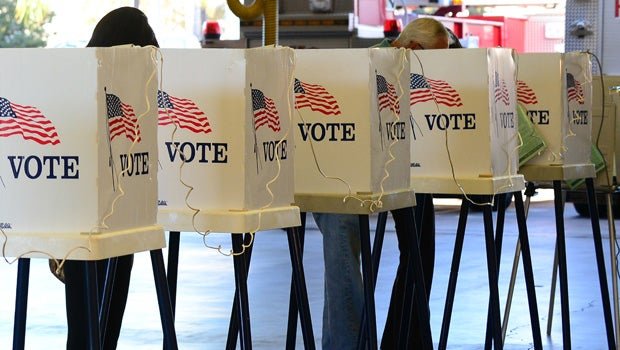


Americans vote on Tuesday, November 3, in midterm elections that will decide control of Congress for the final two years of President Donald Trump’s term. The US midterms put all 435 seats in the House of Representatives and 35 of the 100 Senate seats on the ballot, along with governors in 36 states. Democrats are widely favoured to retake the House but face a greater challenge in the Senate, where Republicans now hold 53 seats. Democrats need a net gain of three seats for a House majority and four seats for a Senate majority, with Vice-President JD Vance able to break a 50-50 Senate tie.
Early voting in the US midterms has already set a record, with 57 million votes cast in person or by mail as of Monday afternoon, up from 45 million in all of the 2022 midterms. A Reuters/Ipsos poll completed on Monday found 46% of registered voters said they would vote for Democrats in congressional elections, compared with 38% who picked Republicans. Trump, 80, campaigned hard for Republicans, holding events in 20 states over the past 32 days, the White House said. His final event was a speech at the reopening of the Lincoln Memorial Reflecting Pool in Washington, where he spent more than 20 minutes discussing the renovation work.
US midterms: what voters are deciding
The US midterms are widely read as a verdict on Trump’s second term. The economy, the war with Iran and immigration are among the prominent issues in the race, according to a Guardian summary of the campaign. A recent AP-NORC poll found only 26% of voters approve of Trump’s handling of the economy.
Loss of control in either chamber would constrain Trump’s ability to pass legislation and empower Democrats to investigate his administration. A Senate majority would also allow Democrats to block his appointees to federal courts, including the Supreme Court. Trump said on his Truth Social platform on Tuesday that he plans to spend more than $400 million to help Republican candidates win the US midterms, and wrote that more than $300 million had already been spent on advertising, voter contact, rallies, telerallies, get-out-the-vote programmes and election integrity work. He offered no detailed breakdown of the spending.
US midterms: the Michigan Senate race
Michigan holds one of the closest Senate races in the US midterms. Democratic candidate Abdul El-Sayed, a physician and former public health official, is attempting to become the first Muslim elected to the Senate, running against Republican Mike Rogers. The race grew more heated over the weekend when US Representative Haley Stevens, who lost the Democratic primary to El-Sayed, switched to backing Rogers. El-Sayed’s campaign said it raised $2.4 million on Sunday, its largest single-day fundraising haul, fuelled by small-dollar donations.
Alabas Farhat, a representative in the Michigan House, said the endorsement would energise Democratic voters, pointing to a surge in early voting in Dearborn, home to a large Arab American population. “She’s ignited a new fire among the base to go out and vote with this betrayal of the party,” Farhat said. El-Sayed, an Egyptian American Muslim born in Michigan, has been targeted by Trump and other Republicans who have questioned his loyalty to the US. El-Sayed has called questions about his loyalty “shameful”. In Sterling Heights, a suburb of Detroit, several voters who supported Rogers voiced anti-Muslim sentiment to reporters.
US midterms: courts and early voting
The courts intervened in election disputes on the eve of the US midterms. The Supreme Court on Monday rejected the Trump administration’s attempt to temporarily block California from counting mail-in ballots from more than 20,000 registered voters who federal officials alleged were likely non-US citizens. California had argued the federal lawsuit would disenfranchise 20,000 voters based on vague accusations and that the process for identifying noncitizens was error-prone. A US judge on Monday also ordered the Trump administration to stop demanding that California segregate ballots cast by people on lists of suspected noncitizens.
The Trump administration also sought to intervene in Alaska, where a federal judge on Sunday dismissed a Justice Department lawsuit seeking to block certification of election results if Republican incumbent Senator Dan S. Sullivan narrowly loses. The department had argued voters may be confused by a challenger named Daniel J. Sullivan Jr. on the same ballot. The senator said on Sunday he would accept the results of Tuesday’s election even as the administration presses a criminal investigation into the issue. Mary Peltola, the Democrat, has denied involvement in recruiting the younger Sullivan, and Sullivan Jr. has denied coordinating with her campaign. Results in the closest US midterms races may take days to settle.