


The United States has lost its measles elimination status after 25 years, the Pan American Health Organization confirmed on Tuesday. The decision ends a designation the country had held since 2000, after the organization found that the disease had spread without interruption for more than 12 months.
PAHO Director Dr. Jarbas Barbosa announced the decision at a media briefing on Tuesday, November 17. Mexico and Bolivia lost their status on the same day. The Americas region, which led the global elimination effort, first lost its verification in November 2025 after Canada re-established endemic transmission.
The scale of the 2026 surge is what makes this year different from every measles year of the past three decades. The Centers for Disease Control and Prevention confirmed 5,412 cases in the United States as of November 12, more than double the 2,290 reported in all of 2025 and far above the 285 cases recorded in 2024. By November 19, the CDC count had risen to 5,838 cases, the highest annual total since 1991.
Measles cases and deaths climb in 2026
Pennsylvania has carried the largest share of the outbreak. The state reported 1,631 cases and eight deaths as of November 20. Wisconsin recorded two deaths and New York its first pediatric death. State health departments have reported 10 associated deaths in 2026, while the CDC has confirmed six using federal death certificate data.
Virginia reported its first measles-associated death of 2026 on Friday, involving a child between 0 and 4 years old who tested positive for measles. The state health department did not disclose additional details, including the child’s vaccination status, citing the family’s privacy. “It puts about 10 per cent of the people who get it in the hospital,” said Dr. William Schaffner, professor of infectious diseases at Vanderbilt University School of Medicine.
Measles does more than cause a rash. It can cause pneumonia, which is the main reason for hospitalization, along with severe dehydration, encephalitis, and death. The disease spreads through the air and can linger in a room after an infected person leaves, which is why it returns first when vaccination rates fall.
Measles spread follows falling vaccination rates
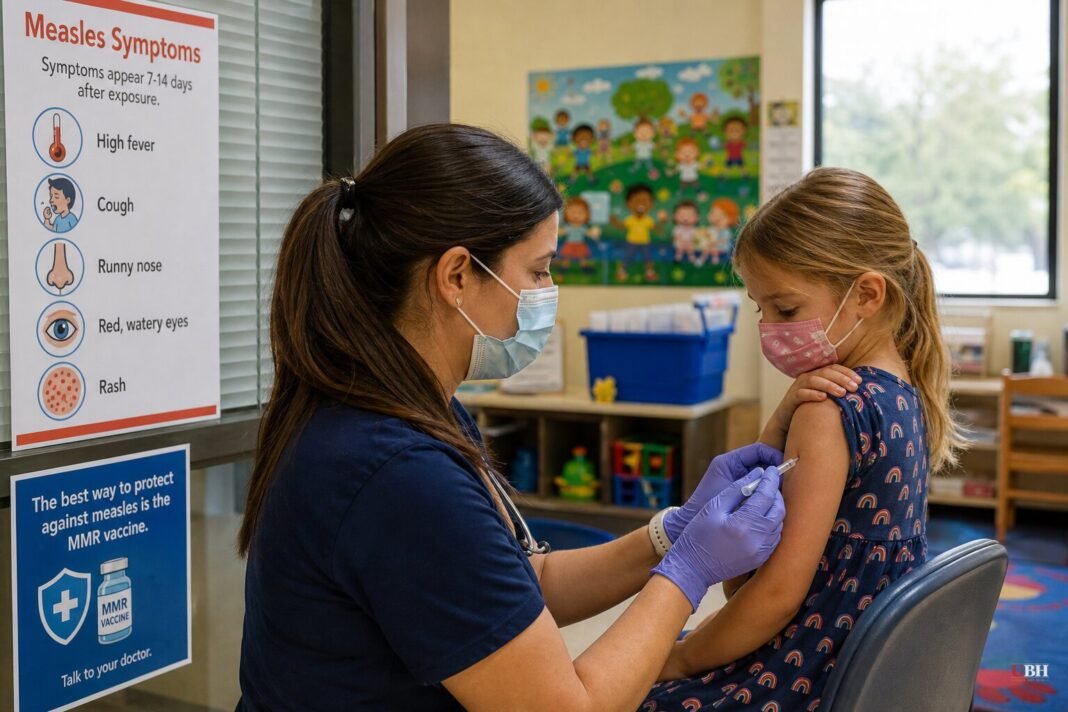
National two-dose MMR coverage among kindergarteners fell to 92.4 percent in the 2025-26 school year, down from 94.7 percent in 2011, according to KFF analysis of CDC data. Coverage varies widely: West Virginia reported 98.9 percent, while Idaho stood at 75.2 percent. Only 10 states met the 95 percent threshold considered necessary for herd immunity. Vaccine exemptions reached an all-time high of 4.2 percent, leaving an estimated 280,000 children unprotected.
A November 2026 survey by the Annenberg Public Policy Center found 17 percent of United States adults believe childhood vaccines cause autism, while 19 percent say they do not know. Extensive research, including reviews by the National Academy of Medicine and the World Health Organization’s Global Advisory Committee on Vaccine Safety, has found no causal link.
Health Secretary Robert F. Kennedy Jr. said on November 17 on X that he continues to recommend MMR vaccination. In a joint statement released the same day, the CDC and national public health partners outlined a plan to stop the outbreaks and regain elimination status, centered on promoting MMR vaccination, expanding vaccine access, and closing protection gaps. The CDC has directed about $100 million to state and local health departments for outbreak prevention and response, funding that runs through most of 2027.
Measles loss may signal wider resurgence
Infectious disease specialists say the disease is the first of several diseases likely to return as vaccination rates decline. Schaffner predicted that cases of rubella and mumps might return in the next several years. Daniel Griffin, an infectious disease physician, described the disease as “the canary in the coal mine” for a wider collapse in public health capacity.
“This resurgence is an early warning signal demonstrating that vaccination, surveillance, and public trust have all eroded and other preventable diseases are likely to follow,” said Dr. Rochelle Walensky, former CDC director. Brazil regained its elimination status in 2024 after losing it in 2019, offering a model for recovery through aggressive contact tracing and vaccination campaigns. The United States must first stop continuous spread for at least 12 months, and specialists say it will take years to regain measles-free status.