
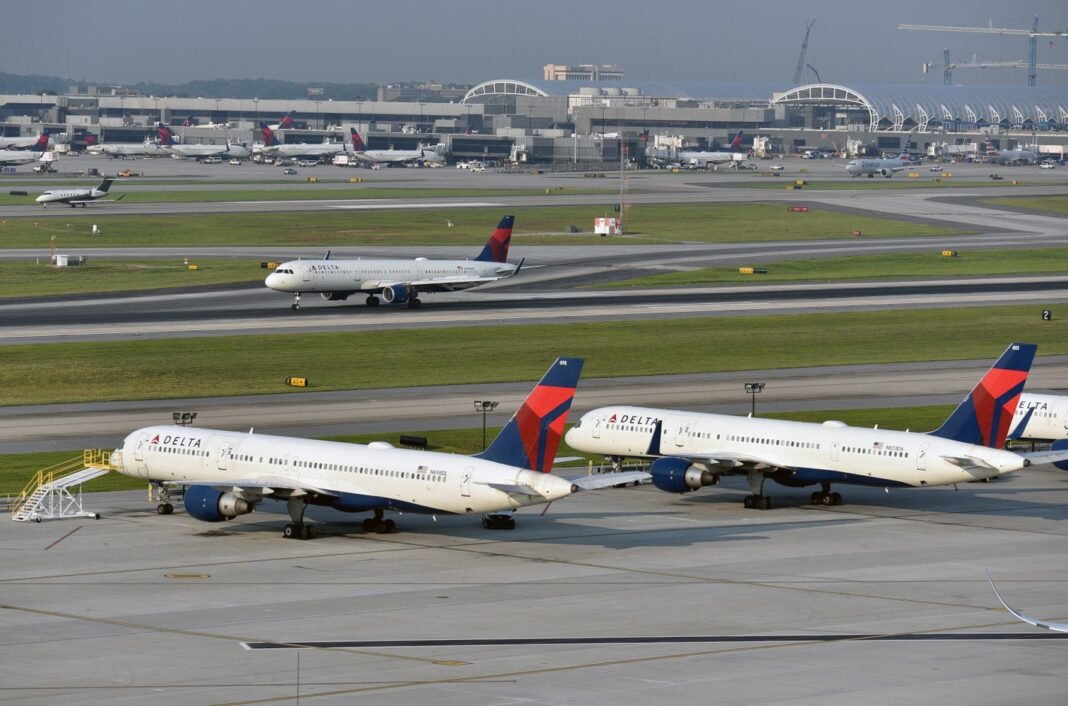


More than 1,600 Delta flights were delayed across the United States on Sunday after a technical failure knocked out the automated system used to calculate aircraft weight and balance. The outage snarled travel just days before the Thanksgiving holiday rush, with the heaviest congestion at the carrier’s main hub, Hartsfield-Jackson Atlanta International Airport.
The outage began on Sunday morning, forcing crews to compute safety-critical load figures manually before planes could be cleared for takeoff. The airline said its teams were using manual workarounds to get flights off the ground while they worked to restore the automation system that ensures an aircraft is not too heavy to fly. Hours later, the airline said the system was working again, though flights were still not back to normal.
The Federal Aviation Administration issued an hour-long ground stop for some flights into Atlanta on Sunday morning. The agency said on X that the delays were not related to FAA air traffic systems, and Delta said the problem was inside its own technology. FlightAware, the flight-tracking site, said about 58 percent of Delta flights were delayed by Sunday evening, and around 2,000 flights were delayed at the peak of the disruption.
Delta delays pile up at Atlanta hub
By 11:30 a.m. Eastern, FlightAware showed 1,010 Delta flights delayed across its network, about 30 percent of its schedule. The number kept rising through the afternoon. CBS News reported more than 1,600 delayed Delta flights as of 3:50 p.m. Eastern, and Delta said 49 percent of its Sunday flights were delayed by more than 15 minutes. More than 40 flights were cancelled.
The airline said about 70 percent of the delays and cancellations noted by FlightAware were connected to the automation issue, and the rest were because of bad weather and air traffic slowdowns in the Northeast. The airline said it was helping passengers who needed hotel rooms or meals, and it hoped to have all the delayed flights in the air by the end of the day. The carrier apologized and said it was rebooking customers on the next best itinerary.
Delta outage follows a week of aviation failures
The outage came at a sensitive moment for United States aviation. It arrived on the first weekend of the busy Thanksgiving travel period, and just days after a pair of other high-profile failures. United Airlines suffered a system outage earlier in the week, and the FAA’s own telecommunications failure on November 13 triggered a nationwide ground stop, the second since the September 11 attacks.
AAA projects nearly 6 million people will take domestic flights for Thanksgiving this week, and 81.5 million Americans will travel at least 50 miles from home between Tuesday, November 24, and Monday, November 30. The Delta failure showed how a single internal system can disrupt that flow, even when air traffic control is working normally.
The airline did not immediately disclose what caused the failure or give a timeline for full recovery when the outage began. The airline said later on Sunday that the automation was restored around 3:30 p.m. Eastern. By then, the backlog of delayed aircraft and passengers took hours to clear, and the effects carried into the evening.
Passengers face a disrupted holiday week
For passengers, the advice from the airline was to check flight status in the Fly Delta app or on its website before heading to the airport. The airline said crews would keep using manual procedures where needed, and it coordinated with air traffic controllers to prevent gridlock on tarmacs and at gates.
The incident adds to a November of technology failures across American aviation, banking, and government systems. For the airline, the test now is whether the manual workarounds and the restored system can hold through the busiest travel week of the year.
The disruption comes as the industry prepares for the Thanksgiving rush, and the timing could not have been worse for travelers. Airlines have spent the year rebuilding schedules after a series of technology failures, and the weekend showed how fragile those schedules can be. The system that failed is one most passengers never hear about, but it decides whether a plane can leave the gate. When it goes down, the whole network feels it within hours.