


India’s ambition to build a $44 billion space economy by 2030 faces funding and business visibility gaps, Arun T Ramchandani, chairman of the Indian Space Association (ISpA), said on Monday. Speaking at the fifth India International Space Conclave in New Delhi, Ramchandani said the India space economy is worth about $9 billion today, less than 2 per cent of the world total.
The global space economy grew 12 per cent last year to $686 billion, Ramchandani said. India holds a small share of that total, and the India space economy must close a wide gap to reach its target. The conclave, held with ISRO and IN-SPACe, has financing as its main theme.
India space economy target means fivefold growth
“Our decadal vision is $44 billion by 2030, including $11 billion in exports. That means roughly fivefold growth in seven years, several times faster than the world economy is growing,” Ramchandani told the gathering. The India space economy would need to grow well above the global market to reach that mark.
Funding gap puts India space economy behind rivals
The Department of Space budget this year is about Rs 13,700 crore, roughly $1.6 billion, and up by 2 per cent on the last allocation, Ramchandani said. On a single day this September, Europe placed orders worth nearly 3 billion euros for satellites for just one constellation, IRS-2. The US Space Force has committed up to $3.2 billion to 12 companies to prototype space-based interceptors.
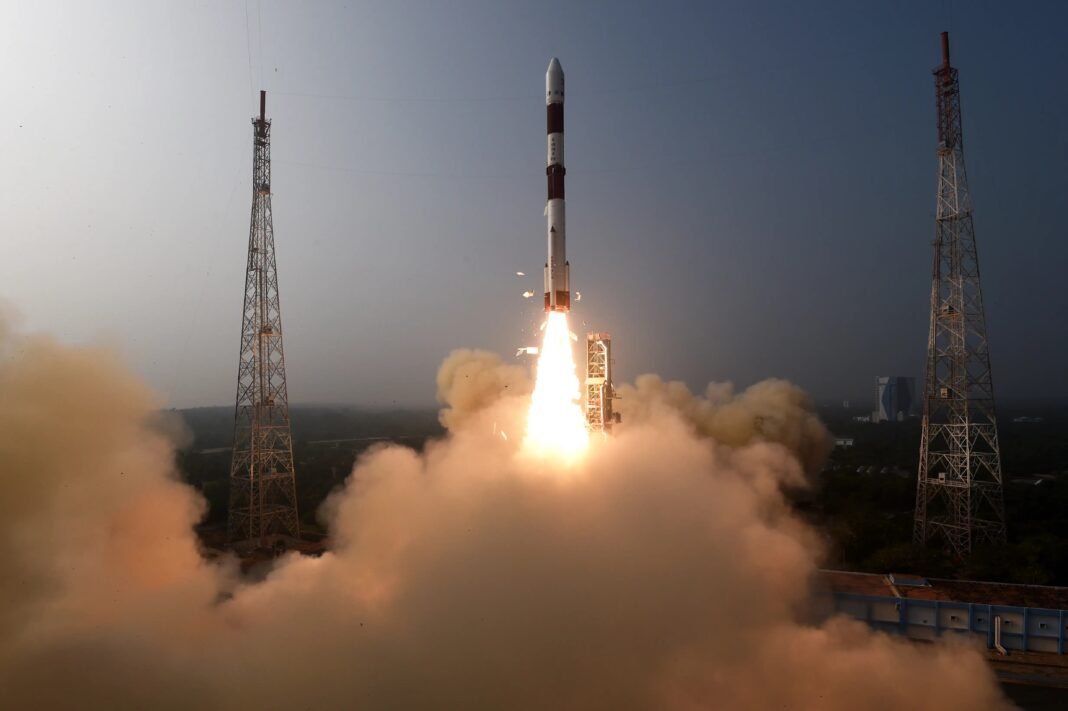
The world attempted more than 320 orbital launches last year, Ramchandani said. For India, the year began with its trusted PSLV workforce challenged by a third-stage failure. The India space economy needs more launches, hardware and orders to close the distance.
The gap is in flow, not talent
“The gap is not in talent. The gap is not in ambition. Vikram-1 proved that. The gap is in flow: a steady, repeatable industrial flow of orders, launches, hardware, and capital that turns a brilliant first into a business,” Ramchandani said. The task now is to move from first flights to steady production, with launch vehicles coming off assembly lines and satellite buses built in batches.
Ramchandani called for the Space Activities Bill to be brought before Parliament at the earliest, saying policy reform opened the sector and policy will now be needed to scale it. Tier 2 and Tier 3 suppliers must deliver qualified space-grade parts on schedule, he said, if the India space economy is to become a reliable industry.
India space economy startups grow, but capital stays thin
Space startups in India have grown from one in 2014 to around 440 today, Ramchandani said. IN-SPACe has granted more than 100 authorisations, and cumulative private investment has grown roughly sixfold since 2021-22 to over $600 million. Even so, investment has not yet reached every company in the India space economy that needs it.
Lieutenant General Anil Kumar Bhatt (retired), the founding director general of ISpA, agreed that finance, not technology and talent alone, will decide how fast the sector grows. He said patient, informed capital that understands long gestation and high risk decides whether a startup becomes a global business. A single launch failure or one anomaly in orbit can wipe out years of work by a young company, he said.
A S Kiran Kumar, former chairman of ISRO and a member of the Space Commission, said India is moving from capability to capacity in space technology, which is only possible when more people get into the business. Young entrepreneurs are already challenging basic ideas about space systems, he said. The India space economy depends on that wider base of firms.
France backs an industrial partnership
French Ambassador to India Thierry Mathou said France and India should move their six-decade space collaboration from institutional agency ties to an operational industrial partnership involving startups, investors and private firms. He outlined a roadmap that combines French technological capabilities with Indian entrepreneurship and manufacturing under the Make in India initiative.
“The next chapter of our space partnership must bring together the full strengths of our respective ecosystems, our space agencies, of course, but also our companies, startups, investors, researchers, and academic institutions,” Mathou said. He welcomed reforms that opened the sector to private rocket makers, satellite manufacturers and data startups, and offered French help for industry collaboration on both sides. Paris has one of Europe’s largest space ecosystems, he said.
The conclave drew delegates from nine countries, with 12 sessions across two days. Mathou also said a joint India-France satellite for monitoring Earth’s surface temperature, TRISHNA, will be launched soon. The satellite, formally the Thermal Infra-Red Imaging Satellite for High-resolution Natural Resource Assessment, is being developed by ISRO and France’s CNES.