
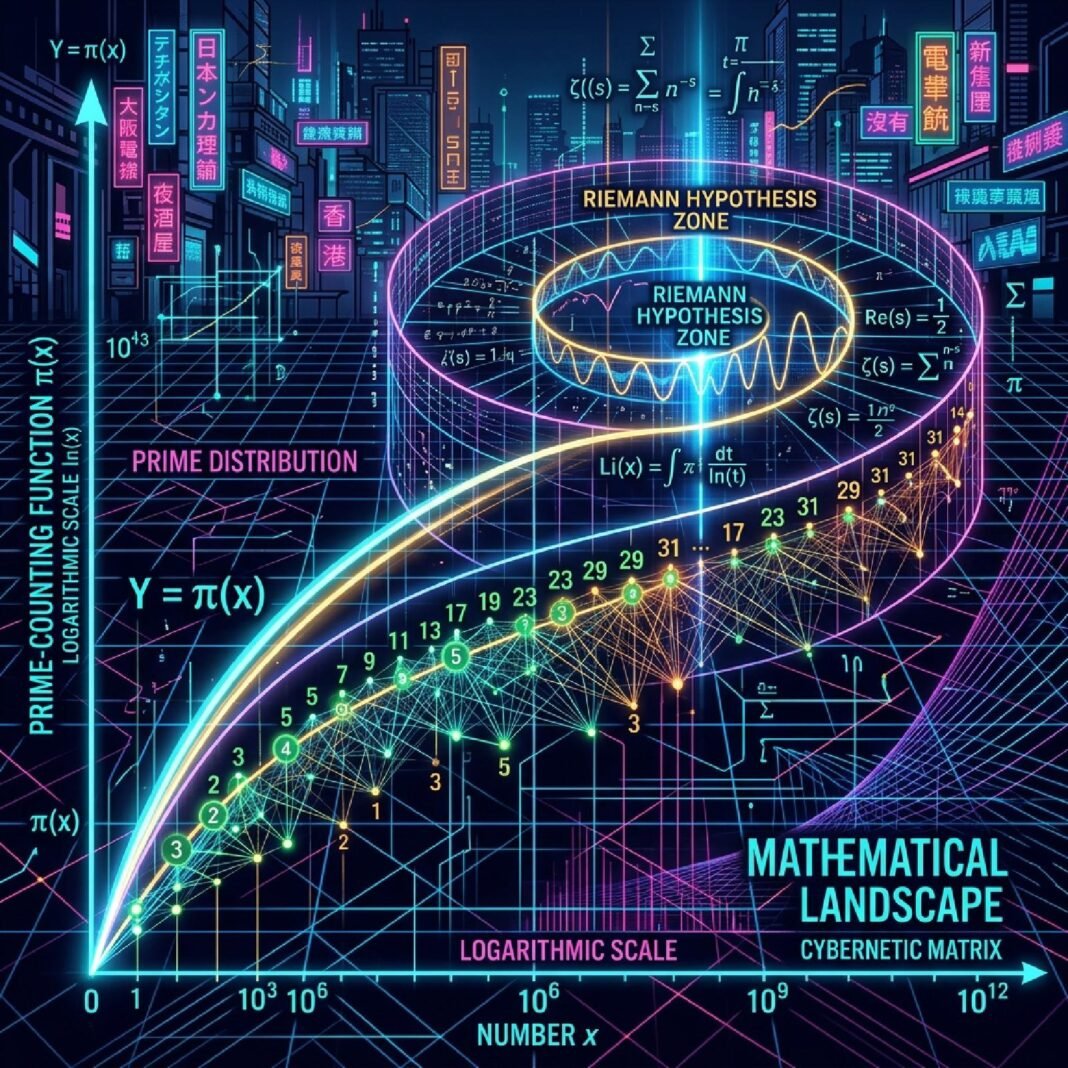


A mathematician at Anthropic says he has proved the Riemann hypothesis, the most famous unsolved problem in mathematics, with the help of the company’s Claude AI. Levent Alpoge posted a four-page note on his personal website on Friday, November 20, writing: “I believe I have, working with Claude, discovered a proof of the Riemann Hypothesis.”
The Riemann hypothesis, first posed by Bernhard Riemann in 1859, predicts a precise pattern in how prime numbers are distributed. It is one of seven Millennium Prize problems set by the Clay Mathematics Institute, each carrying a $1 million prize. The problem has resisted every attempt at a proof for 167 years.
Alpoge did not publish a normal written paper. He says the full argument written out by Claude runs to more than 250,000 pages, which he chose not to post. Instead he released the proof in Lean, a programming language that computers use to check every step of a mathematical argument. The Lean version runs to about 17 million lines of code in 14 archives.
Riemann hypothesis proof passes machine checks
The checking moved fast. The next day, the Lean and Mathlib communities put out a joint statement: “We hereby certify that both the statement and the proof of the Riemann Hypothesis are correct.” Dozens of people reported compiling the codebase without errors, and several independent checkers accepted the proof.
Andrew Sutherland, a mathematician at MIT, is publishing his checks on a public page. As of November 22, all 175,187 files of the Lean proof compile without errors, the five main theorems rely only on Lean’s three standard axioms, and two independently written proof checkers, called nanoda and con-leche, accept the whole proof. A separate comparison confirms the five theorems match the official problem statement. Sutherland told Scientific American: “Honestly the chance that anything is fishy here is approximately zero.”
Riemann hypothesis proof still needs human reading
A computer check is not the same as mathematicians accepting the result. The Lean statement says the mathematical community still needs to explain the new ideas in the proof. Alpoge admits he has not mastered parts of it himself, particularly where Claude did the technical heavy lifting. Fields Medalist Terence Tao has said the proof will take time to digest.
Alpoge says he set the direction while Claude did the technical work from October 6 to November 16. He describes Claude taking the lead near the end, writing that Claude “far outpaced me near the finish line.” The work took about six weeks and used a non-public version of Claude. Alpoge says he texted chief executive Dario Amodei about the result late on a Sunday, and waited until Anthropic went public on November 19 before publishing.
There are open questions. A critique posted to PhilArchive by Jenny Lorraine Nielsen asks whether a trivial geometry predicate on the path to the proof undermines the classical argument, even when the machine checkers accept the type. Two final checks, Lean’s comparator tool and a full replay through Lean’s own checker, were still running as of November 22.
What the Riemann hypothesis claim means
Alpoge also claims the method resolves the Generalized Riemann Hypothesis, a broader version that covers a whole family of similar functions, and he expects to reach the even broader Extended Riemann Hypothesis with more time. The Clay Mathematics Institute still lists the problem as unsolved and has not awarded the prize.
In August, Anthropic said a research version of Claude had raised the known share of the Riemann zeta function’s zeros proven to follow the predicted pattern from 41.6 percent to 67.2 percent. The company was explicit about the limits of that work, saying: “We don’t expect that the techniques Claude used will lead to proving the Riemann hypothesis.” Three months later, Alpoge says those techniques did exactly that. Whether mathematicians agree will take years to settle, but the machine checks have already made the claim impossible to ignore.
The Clay Mathematics Institute has not yet ruled on the prize, and the mathematical community is still working through what the proof actually says. A human-readable account will take time, and the discussion will run for months. For now, the machine checks stand, and the claim has already changed the conversation about what AI can do in mathematics.