
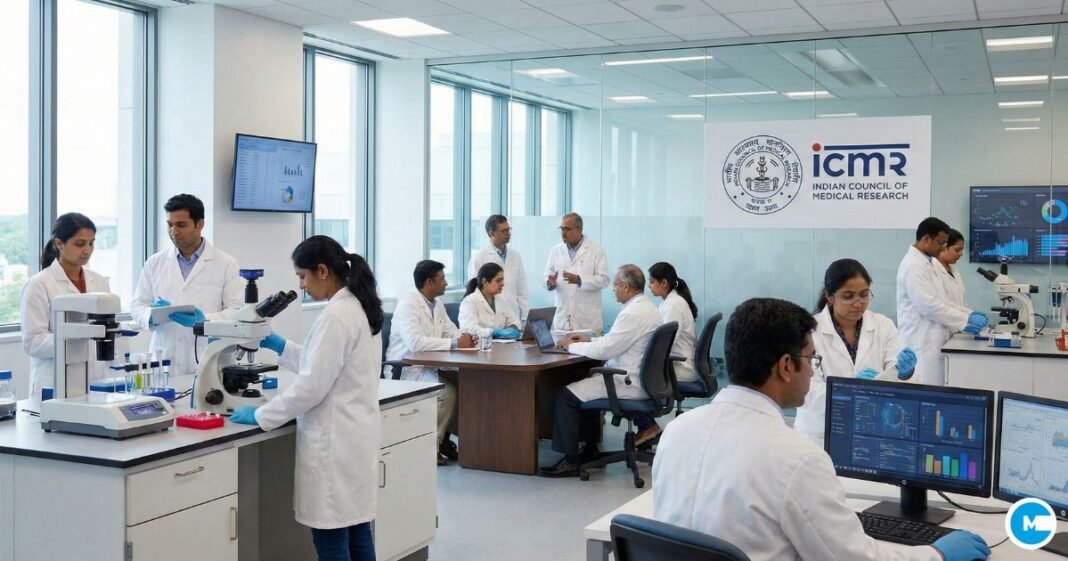


ICMR technology transfer deals have reached 100, the Indian Council of Medical Research said, reaching the mark in under two years through its Medical Innovations Patent Mitra initiative. The milestone was announced at the third Department of Health Research-ICMR Health Research Excellence Summit, which closed on 17 November at Bharat Mandapam in New Delhi.
At the Technology Transfer Ceremony during the summit, ICMR exchanged 20 licensing agreements covering eight technologies with nine Indian companies. That took the cumulative number of ICMR technology transfer deals to 100. The two-day summit, organised by the Department of Health Research and ICMR on 16 and 17 November, brought together more than 600 scientists, researchers, innovators, administrators and policymakers from ICMR institutes, partner institutions, government organisations and academia.
How ICMR technology transfer reached 100 deals
Medical Innovations Patent Mitra is the programme behind the pace of ICMR technology transfer. Launched by Union Health and Family Welfare Minister J P Nadda in March 2025, it helps ICMR institutes move research out of the laboratory and into products that companies can make and sell. The 100 ICMR technology transfer deals cover technologies developed in ICMR institutes and partner institutions, and the licensing agreements signed at the summit hand eight of those technologies to nine Indian firms.
The initiative aims to help the translation of research and indigenous innovations into practical applications through industry partnerships. That work is what turns a laboratory result into a diagnostic kit, a device or a treatment that reaches clinics and hospitals. The summit’s Technology Transfer Ceremony was the point at which the latest batch of agreements changed hands.
The summit also marked 115 years of ICMR’s work in biomedical and health research in India. ICMR, established in 1911 and based in New Delhi, is the country’s apex body for the formulation, coordination and promotion of biomedical research. An Innovation Exhibition at the summit showed 17 indigenous health technologies developed by ICMR institutes and partner institutions.
The Department of Health Research said the summit also gave researchers, industry and policymakers a place to meet and compare notes on what works. ICMR technology transfer was one of the subjects on the table, alongside disease surveillance and the use of research in policy. The meeting drew people from ICMR institutes, partner institutions, government organisations and academia, and the agreements signed there were the concrete result of those conversations.
New initiatives alongside the ICMR technology transfer milestone
Three new initiatives were launched at the summit to strengthen health research, disease surveillance and the use of research evidence in policy. The Department of Health Research’s new Research to Action Vertical will turn research evidence into outputs that government can use in policies and programmes, sitting alongside the ICMR technology transfer work that moves research into products.
A syndromic surveillance network under the department’s Virus Research and Diagnostic Laboratories scheme will set up an early-warning system for outbreaks across 70 Virus Research and Diagnostic Laboratories and Infectious Disease Research and Diagnostic Laboratories. The Dr M K Bhan Young Medical Faculty PhD Portal was also launched as a single digital platform with information for prospective applicants.
The top 100 school students selected through ICMR’s SHINE National Competition were recognised at the summit for their scientific thinking and work on public health. SHINE, or Science and Health Innovation for the NextGen Explorers, is a nationwide programme for students in Classes 9 to 12 from government, government-aided and private schools.
The ministry said the two-day summit closed at Bharat Mandapam after sessions, exhibitions and ceremonies. The Technology Transfer Ceremony was held during the summit, and the three new initiatives were launched alongside it.
The summit is a national platform for recognising excellence in health research and for promoting the translation of scientific evidence into tangible outcomes, the health ministry said. The 100-deal mark, reached in under two years, is the measure the ministry chose to show that ICMR technology transfer is moving research from papers into products.