
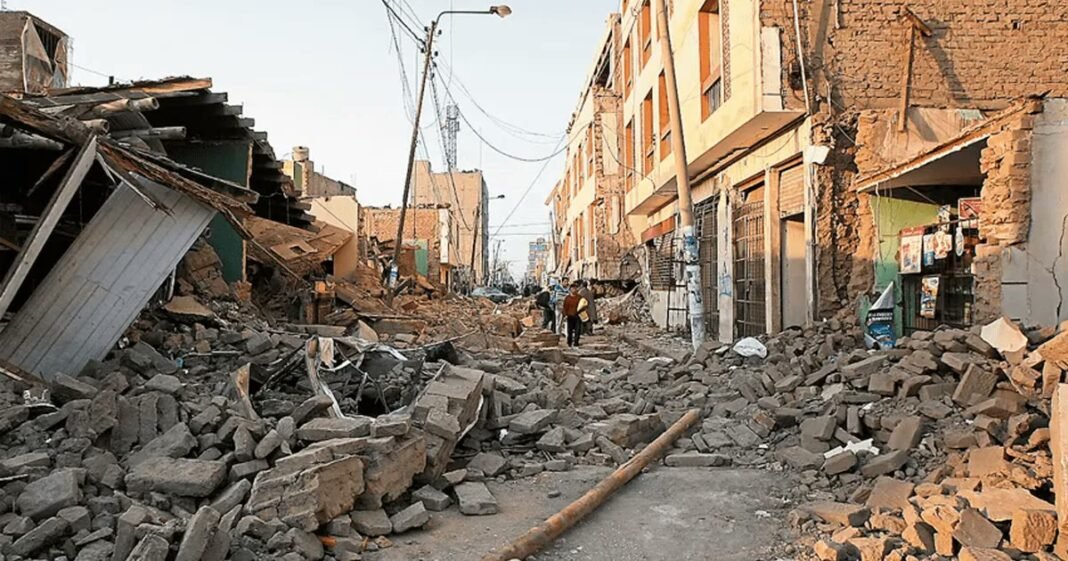


A magnitude 6.8 Peru earthquake struck central Peru on Friday 20 November, the German Research Centre for Geosciences said, sending some residents in the capital, Lima, onto the streets. There were no immediate reports of casualties or significant damage. The quake was felt in Lima, although its centre was in the Andean region of Junin. Peru’s Geophysical Institute put the depth at 129 kilometres.
Peru earthquake strikes the Junin region
The quake struck in the Andean region of Junin, according to Peru’s Geophysical Institute. The United States Geological Survey put the time at 7:09 p.m. local time and the depth at 108 kilometres, a different estimate from the Peruvian institute’s 129 kilometres. The Peru earthquake was centred in Junin, about 320 kilometres east of Lima. Junin province council member Vicente Quispe, based roughly 320 kilometres east of Lima, told local radio station RPP that officials had not received word of damage from the jolt.
Quispe said: “So far, no damage has been reported. This is the first time an earthquake of this magnitude has been felt in this area.” He was speaking to RPP from Junin province. Local officials were still checking for damage in the hours after the tremor, and no deaths had been reported.
Peru earthquake felt in Lima
The Peru earthquake sent residents in Lima outdoors as the shaking hit. Television footage showed lawmakers leaving Congress. People in the capital moved outdoors as a precaution while officials assessed the situation. The tremor was felt across several areas, including the capital, where residents left their homes and gathered in the streets.
The Peru earthquake was reported by NBC News, citing the German Research Centre for Geosciences. The report noted that initial reports indicated no deaths or major destruction. Further details were awaited as officials in Junin and Lima continued to assess the impact.
Peru earthquake risk along the Ring of Fire
The Peru earthquake was deep, at more than 100 kilometres by both estimates. Peru sits along the Pacific Ring of Fire, a heavily faulted region where shifting tectonic plates regularly cause earthquakes, NBC News noted. The country has a long record of strong tremors, and its Geophysical Institute monitors seismic activity across the Andes and the coast.
The difference between the two depth estimates, 129 kilometres from Peru’s Geophysical Institute and 108 kilometres from the United States Geological Survey, is common after a large quake. Agencies use different stations and methods, and their figures are revised as more data arrives. Both put the centre in the same region and the magnitude at 6.8. The two agencies agreed on the magnitude, even though their depth figures differed by 21 kilometres.
Lima is Peru’s capital and largest city, on the Pacific coast west of the Andes. Junin lies inland, in the central highlands. The distance between the two, about 320 kilometres, did not stop the shaking from being felt in the capital. Deep quakes can be felt over a wide area, and Friday’s tremor was felt in Lima strongly enough to send people outdoors.
The Peru earthquake was recorded by Peru’s Geophysical Institute, the body that reports seismic activity in the country. It placed the quake in Junin and gave the depth as 129 kilometres. The German Research Centre for Geosciences, which also reported the event, gave the magnitude as 6.8.
Television images from Lima showed the moment the shaking reached the capital. Lawmakers left the Congress building, and residents stepped out of their homes. In Junin, Quispe said the tremor was the first of its size to be felt in the area. He told RPP that officials in the province had received no reports of damage.
By Friday night, no casualties and no significant damage had been reported. Officials in Junin and in Lima were still gathering reports from across the affected area. The Geophysical Institute’s reading of a magnitude 6.8 quake at a depth of 129 kilometres remained the official Peruvian account of the event. The institute is the authority that issues Peru’s official seismic readings, and its figures were the ones carried in the first reports of the quake.