
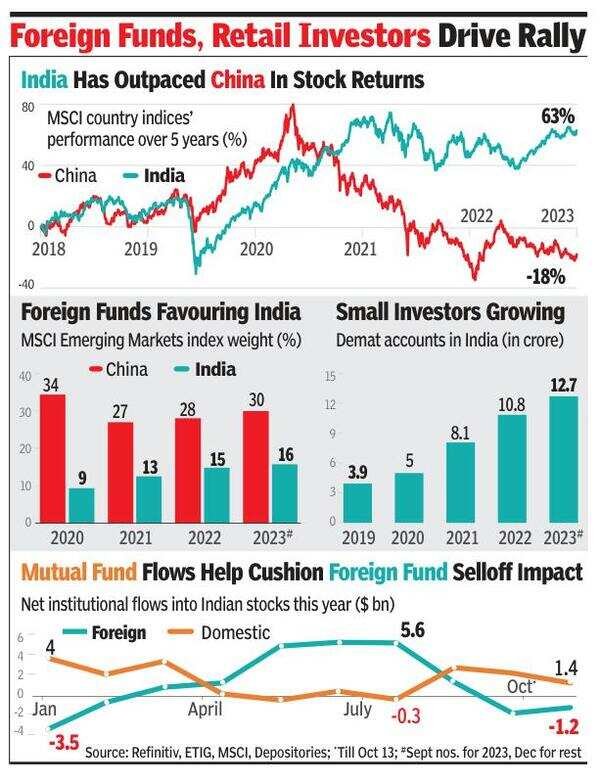


Foreign inflows into Indian shares reached a record Rs 1.22 lakh crore in November, depository data showed, as global money rotated out of artificial intelligence stocks and into a market with far less exposure to that trade. Foreign portfolio investors, or FPIs, were net buyers of Indian equities worth Rs 1.22 lakh crore between 2 and 20 November, according to data from the National Securities Depository Ltd (NSDL), the highest monthly total on record.
The foreign inflows passed the previous monthly record of Rs 60,358 crore set in November 2020. The Times of India, adding exchange data for 20 November, put the month’s total above Rs 1.3 lakh crore after FPIs bought a further Rs 10,308 crore of shares on that day alone. The buying ended two months of heavy selling, with FPIs pulling Rs 34,843 crore out of Indian shares in October and Rs 35,861 crore in September. With the November buying, cumulative FPI outflows from Indian equities in 2026 narrowed to about Rs 1.73 lakh crore, from nearly Rs 3 lakh crore a few weeks earlier.
What drove the foreign inflows
The selloff in global AI-linked stocks was the main trigger. The Nasdaq fell 5.52 per cent on 5 November, and shares in South Korea and Taiwan, the two Asian markets most tied to the AI hardware trade, fell with it. South Korea’s Kospi was down 3.74 per cent and Taiwan’s TAIEX was down 9.24 per cent over the same stretch, while India’s Sensex rose 10.87 per cent in November. India has only a small weight in global AI hardware supply chains, so fund managers looking to cut that exposure found Indian shares an easy place to park money.
Rohan Goyal, investment research analyst at MIRA Money, said falling crude oil prices, easing geopolitical concerns, attractive valuations in some large-cap stocks and clearer visibility on domestic earnings also supported the buying. Crude has fallen more than 22 per cent from its March highs, which helps India as a large oil importer, and softer US Treasury yields added to the case for emerging market shares. The foreign inflows also coincided with a reported proposal from the Securities and Exchange Board of India to scrap long-term capital gains tax for foreign investors, though that proposal has not been confirmed as a cause.
Foreign inflows concentrated in banks and large caps
The foreign inflows were concentrated in a small set of stocks. Financial services drew the largest share of the money, with FPIs putting about Rs 43,102 crore into financial stocks in the first half of November, and 18 of the 24 sectors tracked by depository data recorded net foreign buying. Capital goods and chemicals were among the sectors that saw outflows. Most of the buying went into index heavyweights, where large funds can put large sums to work quickly.
Vedant Gupte, co-founder and chief executive of investment platform Trackk, described the November buying as “a sharp tactical turn, not yet a structural return”. He said falling crude and money rotating out of the crowded Asian AI trade had pushed FPIs to close an extreme underweight position on India, and most of that buying had gone into index heavyweights. Gupte said the foreign inflows were tactical for now.
What the buying means for the rupee
The foreign inflows also lifted the rupee. The currency rose to a seven-month high against the US dollar on 20 November, helped by the scale of the dollar inflows. India’s foreign exchange reserves fell by more than $14 billion to $705.3 billion in the week to 13 November, according to Reserve Bank of India data, their lowest in about three months. The reserves fall came even as foreign money poured into shares.
What happens next for foreign inflows
Whether the buying lasts depends on earnings and crude. Somil Mehta, head of retail research at Mirae Asset Sharekhan, said India’s relatively lower exposure to the global AI trade, its large domestic market and improving corporate earnings were attracting interest. He added that this was a relative safe-haven opportunity, and that India was not fully protected from global volatility. Arun Kailasan, research analyst at Geojit Investments, said the rally reflected a relative reallocation of capital, with foreign investors moving towards markets with domestically anchored earnings.
The foreign inflows have already changed the tone around Indian shares after two months of selling, and the rest of November’s depository data will show whether the pace held.