
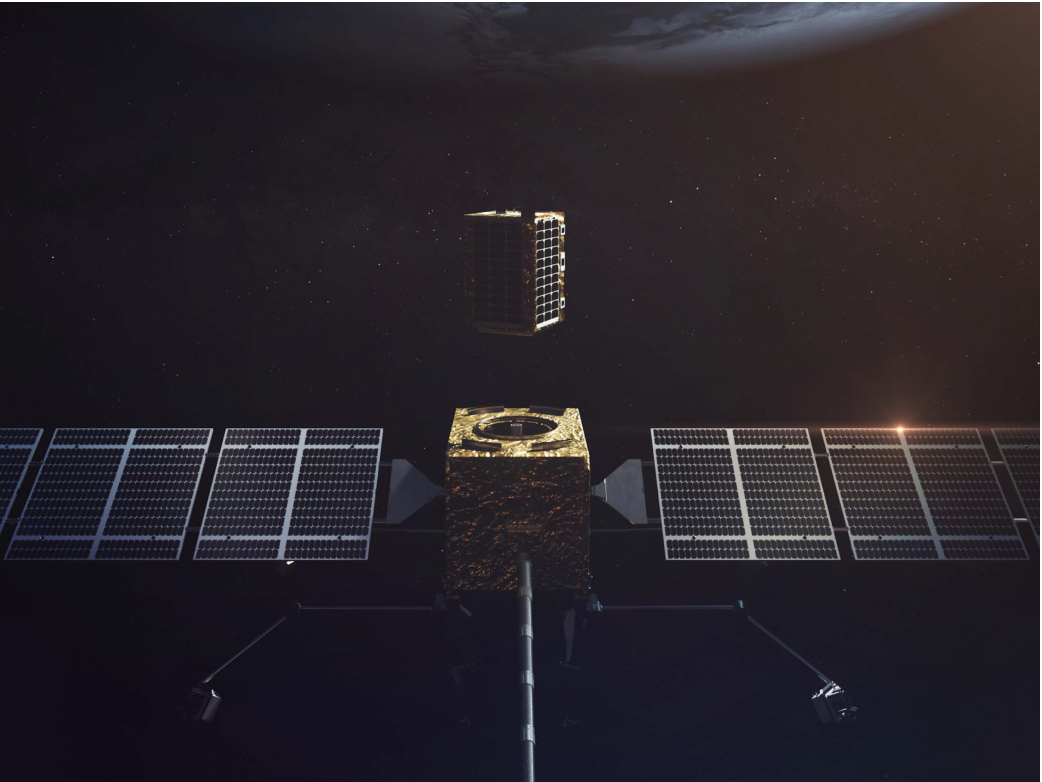


Chennai-based OrbitAID Aerospace plans to carry out India’s first in-orbit docking and refuelling demonstration in December, the company has told Business Standard. The OrbitAID refuelling test will use a small satellite carrying two fuel tanks to move green propellant between units inside the spacecraft.
The demonstration is a step toward a commercial mission by the end of 2027. Sakthikumar Ramachandran, the company’s founder and chief executive, said the December flight would be followed by a full life-extension mission. “This will be India’s first in-orbit docking and refuelling demonstration. We will have our commercial mission by the end of 2027,” he told Business Standard. The OrbitAID refuelling programme has two stages: the December demonstration and the two-satellite mission in 2027.
Satellites usually end their working lives when their fuel runs out, even when their other systems still work. Refuelling in orbit would let operators top up a satellite’s tank and keep it working longer. Only a small number of organisations worldwide have attempted the procedure, and OrbitAID says it wants to be the first Indian company to show it can be done. An OrbitAID refuelling service would sell extra years of operation to satellite owners.
OrbitAID refuelling demo follows a January setback
OrbitAID’s first attempt did not reach orbit. Its AayulSAT satellite flew on ISRO’s PSLV-C62 mission in January 2026, which suffered a launch failure. The company rebuilt its spacecraft within six months. The replacement satellite, AayulSAT-1A, weighs about 30 kg and carries two spacecraft buses, two tanks and the interfaces needed to test the transfer of fuel, power and data inside the satellite, along with inspection functions.
The satellite had been lined up for a November flight on ISRO’s Small Satellite Launch Vehicle, according to reports in mid-October, though the date was not final. The company now expects the demonstration in December. The OrbitAID refuelling test will move green propellant between the two tanks inside the satellite, using the company’s refuelling interface, which it calls SIDRP, short for Standard Interface Docking and Refuelling Port.
OrbitAID has said the SIDRP hardware was validated in microgravity during a zero-gravity flight test in Florida, reported in December 2024. The demonstration satellite also carries an inspection payload, which will observe the spacecraft during the test. The OrbitAID refuelling interface is the piece of hardware the whole plan depends on.
OrbitAID refuelling plan for two satellites in 2027
The larger test comes in the first quarter of 2027. OrbitAID plans to launch two satellites of about 70 kg each, AayulSAT-2A and AayulSAT-2B, together on an Indian rocket. Reports published in October point to February 2027 for the launch. AayulSAT-2A will act as the chaser and AayulSAT-2B as the target.
The planned sequence starts with the two satellites separating after launch and moving apart. The chaser then moves back toward the target and docks using ARCAS, OrbitAID’s docking mechanism. ARCAS is designed to grip a satellite’s standard launch adapter ring, the ring that attaches nearly every satellite to its rocket, so a future customer’s satellite would not need special docking hardware. Once docked, the chaser transfers fuel to the target through the SIDRP interface. The OrbitAID refuelling step is the third stage of the sequence, after inspection and docking. The mission will then raise the target satellite to a higher orbit.
The company describes the mission as an end-to-end satellite life-extension demonstration because inspection, rendezvous, docking, refuelling and orbital repositioning are combined in one flight. Payload reported in August that the company expects to conduct the demo in the first quarter of 2027. Ramachandran told Payload the hardware and lessons from the demo would carry over to work in geostationary orbit, which the company sees as the bigger market. “After this demonstration, we’re moving directly into a commercial life-extension mission in GEO, with commercial discussions already underway,” he said.
OrbitAID refuelling work and the funding behind it
OrbitAID has raised $2.5 million in a pre-seed round led by Unicorn India Ventures. The Tamil Nadu Startup and Innovation Mission, known as TANSIM, has also backed the company. The company plans to use the funds to conduct the in-space demonstration, expand facilities for on-orbit servicing, bring SIDRP to commercial readiness and grow its team.
If the December demonstration and the 2027 mission both succeed, OrbitAID would be the first Indian company to show that satellites can be refuelled in orbit. The OrbitAID refuelling story will be judged on those two flights.