
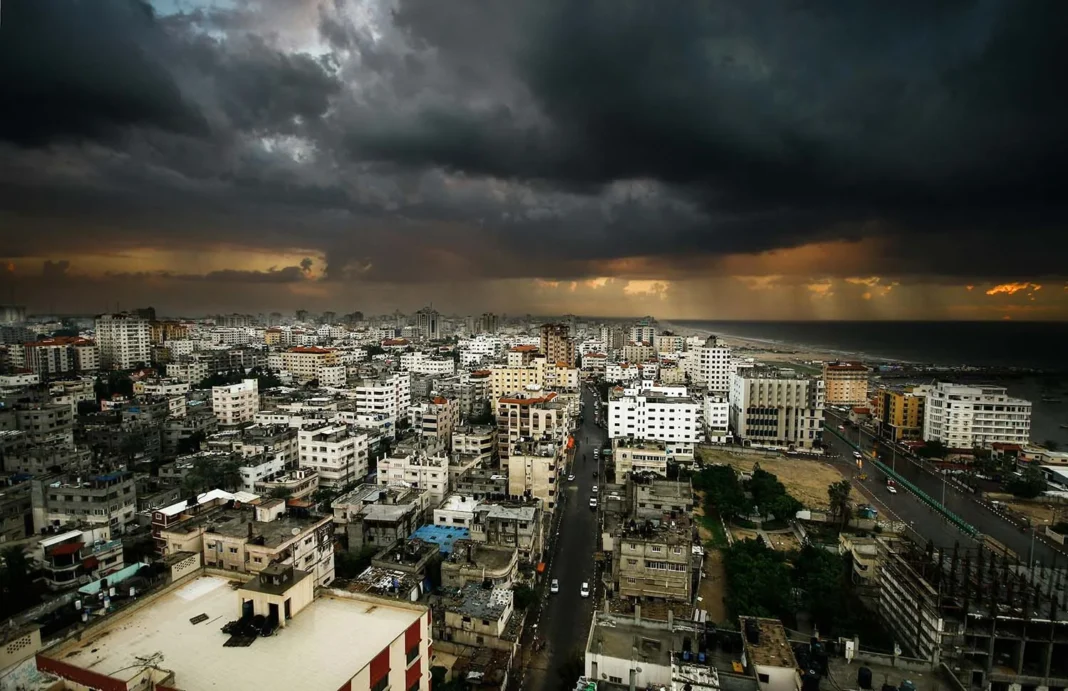


A Gaza storm has flooded tens of thousands of tents sheltering displaced Palestinians, killing at least five people, while in Israel the debate over a governing coalition with Palestinian citizens has moved to the centre of politics after an inconclusive election. The two events, days apart, show a region under strain from weather, war and a hung parliament.
The Gaza storm began late on Friday night, bringing heavy rain and strong winds to the strip. By the morning, water had flooded displacement sites, torn shelters apart and left families wading through mud and sewage. Civil defence teams received 2,166 distress calls but were able to answer only 218, as floodwater in some places rose to 1.5 metres.
At least five Palestinians, including three children and two women, died when a rain-soaked sand dune collapsed onto their tents at the Al Berka reservoir, west of Deir al-Balah, according to the United Nations aid coordination office. The dune gave way after days of rain, and one other person was injured. The Gaza health ministry later told CNN that 14 people, including three children, had died over 72 hours of severe weather in the Gaza storm.
How the Gaza storm hit displaced families
About 65 percent of Gaza’s population, close to 1.4 million people, live in tents or makeshift shelters. The Gaza government media office said about 70,000 tents flooded in the first 12 hours of the Gaza storm, and the city of Gaza received 60 millimetres of rain in that time, about 15 percent of its yearly rainfall. More than 26,000 households had asked humanitarian partners for help by November 8 after their shelters or belongings were damaged.
The United Nations agency for Palestinian refugees said 1.98 million people, about 94 percent of Gaza’s population, needed shelter and other essential supplies. More than 150,000 tents bought by humanitarian partners and member states are waiting outside Gaza ready to be sent in after the Gaza storm, including about 117,000 from the Egyptian Relief Committee in Al-Arish. The United States-backed Board of Peace called the flooding an immediate humanitarian emergency and urged Israel to allow winter supplies, heavy machinery and clearance work into Gaza.
The Gaza storm and the aid standoff
Since the Gaza storm, Israel says it has allowed large shipments of tents and thousands of aid trucks into Gaza, but it continues to restrict heavy machinery and other items it classes as dual use for security reasons. Aid agencies say the limits have slowed repairs to drainage and sewage systems, and the United Nations children’s agency and the World Health Organization warned that Israel had refused equipment to repair the Sheikh Radwan stormwater basin, leaving sewage-filled basins at risk of overflowing. The Gaza storm also raised fears that floodwater could move unexploded ordnance left by the war, according to mine action partners working in Gaza.
Hamas said Israel bore full responsibility for the deaths, arguing that its blockade and limits on aid and shelter materials had left displaced families without safe housing after the Gaza storm. Israel’s war, launched in October 2023, has destroyed homes and civilian infrastructure across Gaza, and more than a year after a ceasefire took effect on October 10, 2025, shelter and rebuilding needs still far exceed the aid getting in.
Arab parties hold the balance in Israel
In Israel, Palestinian citizens voted in record numbers in the general election on October 27, and Arab-led parties won 19 of the 120 seats in the Knesset. Neither Prime Minister Benjamin Netanyahu’s bloc, with 53 seats, nor the centre-right opposition led by Gadi Eisenkot, with 48, reached the 61 seats needed to form a government. Arab voter turnout reached about 80 percent, and Arab-led parties received 64 percent more votes than in the last election, according to the Central Elections Committee.
The Joint List won 11 of the 19 seats and Ra’am, a socially conservative Islamist party, won eight. Ra’am campaigned on joining a governing coalition, and its leader Mansour Abbas has said he could join an Eisenkot government if given the internal security portfolio. The Joint List has said it will vote with the opposition to remove Netanyahu but will not join a government while Israel occupies the West Bank. President Isaac Herzog has been consulting parties and is expected to name a candidate to try to form a coalition next week.
Eisenkot has set conditions for any cooperation, including acceptance of Israel as a Jewish state, support for army conscription and condemnation of Hamas. Netanyahu has warned that a government including Arab parties would be dangerous, and his Likud party has made claims of election fraud that the elections committee said were not backed by the reported irregularities. The talks will decide who governs Israel, and whether Arab lawmakers are treated as partners in that government.