
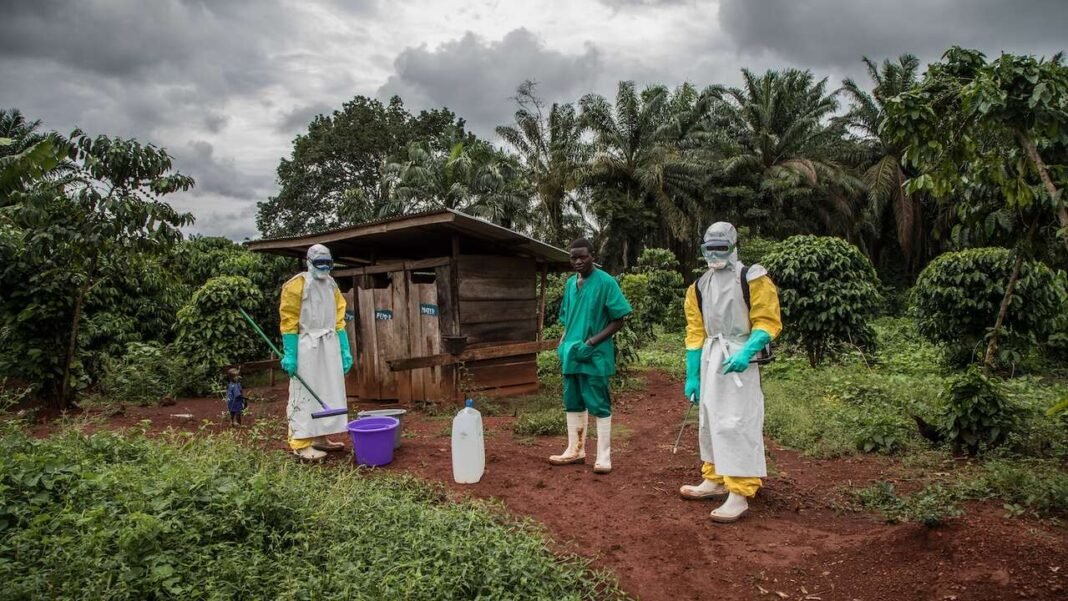


The Ebola outbreak in the Democratic Republic of the Congo is still out of control six months after it was declared, Africa CDC said on Sunday. Jean Kaseya, director-general of the Africa Centres for Disease Control and Prevention, said the response was still losing ground as cases continued to rise across the country.
Government data put the toll at more than 11,200 cases and 5,500 deaths since the Ebola outbreak was announced on 15 May. A World Health Organization situation report published on 6 November counted 10,668 confirmed cases and 5,198 deaths as of 3 November, a case fatality ratio of about 48.7 percent. Kaseya told Reuters: “We are all in agreement today to say that this outbreak is still serious, and is still not under control.”
Kaseya warned that the toll could grow far worse if transmission is not broken soon. “If we don’t stop this outbreak now, it would be the worst Ebola outbreak that the world will have,” he said. The 2014 to 2016 epidemic in West Africa remains the largest recorded, with more than 28,000 cases, and the current outbreak is now the second largest on record.
Ebola outbreak spreads across eight provinces
Eight of the DRC’s 26 provinces have confirmed cases, and the World Health Organization said 400 to 500 new cases were still being reported each week across 67 health zones. More than 80 percent of newly identified patients were not on existing contact lists, Kaseya said, a sign that surveillance teams are missing chains of transmission.
Many deaths in this Ebola outbreak have occurred outside treatment centres, which makes it harder for health workers to trace contacts and to give patients care early. The outbreak is caused by the rare Bundibugyo strain of the Ebola virus, which can trigger haemorrhagic fever. No vaccine or treatment has been developed for this strain, so care rests on supportive treatment and on isolating patients quickly.
Ebola outbreak funding falls far short
Donors have pledged about $2.9 billion to fight the Ebola outbreak and to support the wider response, but Kaseya said only $1.3 billion had been released. He called the gap a collective failure and asked donors to release about $1.6 billion more so that frontline teams could be paid, supplied and protected.
Unpaid staff and shortages of supplies have slowed the response in several areas, according to Africa CDC. Health workers have gone without pay in some districts, and teams have lacked the vehicles, protective equipment and laboratory support they need to reach remote communities and to test suspected cases without delay.
Attacks on health workers hamper the Ebola outbreak response
Attacks on health workers and treatment centres have also set back the response. Africa CDC described an armed attack in Cantine-Aloya that killed 66 civilians, including three health workers, and caused more than 1,000 contacts to be lost to follow-up. When contacts cannot be found and monitored, the virus can move silently from one community to the next.
Kaseya blamed attacks on health workers, unpaid staff and slow aid for the failure to bring the outbreak under control. Community mistrust has added to the strain in some areas, where teams have faced hostility when they arrive to trace contacts or to carry out safe burials for people who died of the disease.
What happens next
Two vaccine candidates made for the Bundibugyo strain, Oxford’s ChAdOx1 BDBV and Moderna’s mRNA-1469, are set to join the Tumaini trial in the DRC once national regulators sign off. Results are expected in early 2027, so vaccines are unlikely to change the course of the outbreak in the coming weeks.
For now, the response depends on finding cases early, tracing their contacts, and paying and protecting the staff who do that work. Africa CDC said the coming weeks would show whether the money pledged by donors reaches the front line in time to slow an Ebola outbreak that has already spread further than any before it on the continent.