
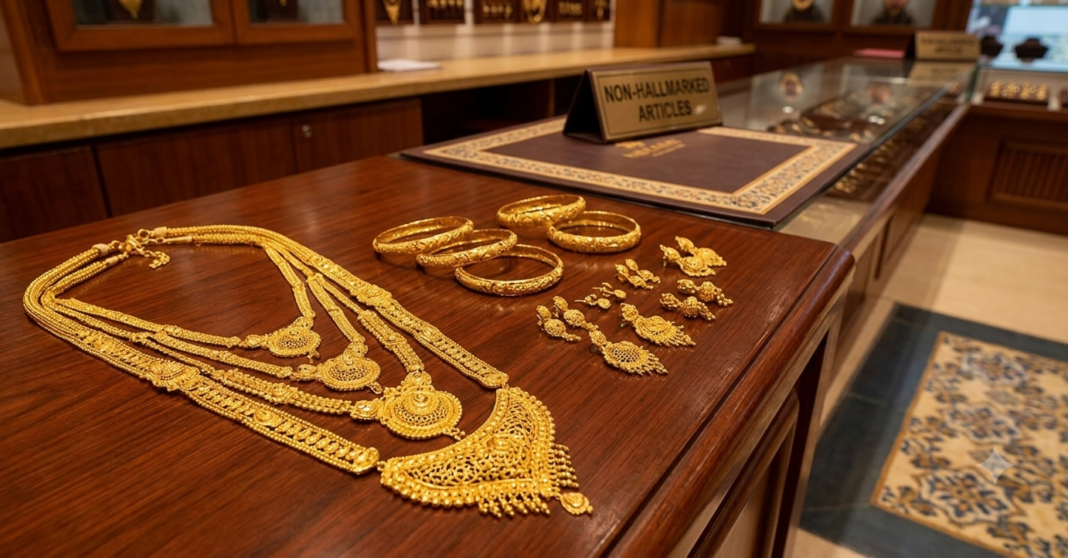


Gold jewellery mixed with a rare heavy metal passed routine purity tests and received a 22-carat gold hallmark in an experiment by a Hindi newspaper, raising questions about the checks Indian buyers rely on. The Dainik Bhaskar investigation, carried out in Jodhpur in Rajasthan, found that rhenium powder added to gold went undetected by the machines used in local showrooms.
The reporters worked with a local jeweller to test whether rhenium could be mixed into gold without being caught. They added one gram of rhenium powder to 7.830 grams of 24-carat gold, taking the combined weight to 8.830 grams. A testing machine then identified the mixture as 24-carat gold.
The jeweller then converted the mixture into a 22-carat ornament. A hallmarking centre issued the piece a 22-carat (916) gold hallmark, the stamp that tells a buyer the ornament holds 91.6 percent gold. By the newspaper's calculation, the finished piece held only about 81.7 percent actual gold, equal to roughly 20-carat purity.
How the gold hallmark checks were beaten
The ornament was taken to different testing centres and showrooms in Jodhpur. A machine at a jewellery showroom on New Road showed 93.70 percent gold, 5.39 percent silver and 0.90 percent copper, without identifying the rhenium. The readings treated the heavy metal as gold, so the piece cleared checks that buyers treat as proof of purity.
Dainik Bhaskar estimated the shortfall could cost a buyer around 14,700 rupees per tola, about 11.66 grams, at a gold price of 1.5 lakh rupees. The newspaper traced the suspected supply of the powder to a company in Shenzhen, China. The powder is known in the trade as "gold powder," according to the reports. The findings rest on the newspaper's own experiment and do not by themselves show that rhenium adulteration is widespread. The investigation has raised concerns about the reliability of the testing machines and the hallmarking procedures that buyers depend on.
Traders in Indore had already raised concerns about heavy metals being used to add weight to gold. A report in Mint quoted jewellery artisans in the city's Sarafa market who said ruthenium, iridium and osmium were being mixed into gold. Those metals are dense enough to add weight without changing the look of the metal.
What the gold hallmark is meant to guarantee
A gold hallmark on jewellery in India carries three marks: the BIS logo, a purity mark such as 22K916, and a six-character alphanumeric code called the Hallmark Unique Identification, or HUID. Buyers can enter the HUID in the "Verify HUID" option of the BIS Care app to see the details recorded for that piece.
Hallmarking became compulsory for gold jewellery in June 2021, after years in which it was voluntary. The Bureau of Indian Standards runs the gold hallmark framework, and its recognised assaying and hallmarking centres test jewellery and stamp it. A valid gold hallmark is the main assurance most shoppers have when they buy.
The Bureau of Indian Standards says X-ray fluorescence, or XRF, testing is a preliminary check that reads only the surface of a piece, and a purity certificate cannot be issued on XRF alone. Fire assay, which melts a sample and measures the gold left behind, is the most accurate method, but it destroys the sample, so it is used for bars, bulk buying and disputes rather than finished jewellery. A gold hallmark issued after a fire assay rests on a stronger test than one based on a surface reading alone.
Why the checks face wider questions
A draft report by the Comptroller and Auditor General found that 81 percent of registered jewellers were not inspected during 2024-25. It also found that the Bureau of Indian Standards had missed its surveillance targets for the centres that issue the gold hallmark by 43.7 percent.
Gold prices are high, and the wedding season is under way, so many families are buying jewellery, coins and bars. A gold hallmark remains the check most shoppers rely on, and the BIS Care app lets them confirm the code on the piece before they pay. The Bureau of Indian Standards guidance also says each piece is checked for prohibited elements such as iridium, ruthenium, cadmium and osmium.