
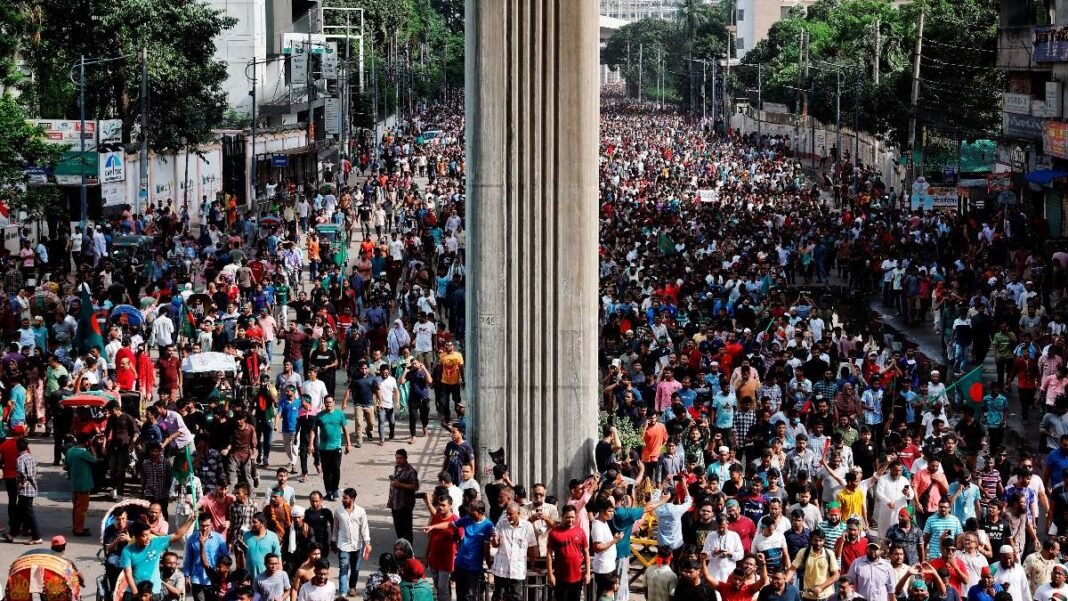


Fresh violence broke out in Bangladesh on Thursday as supporters of former prime minister Sheikh Hasina tried to bring businesses and public transport to a halt. The Bangladesh protests, called as a nationwide lockdown by her Awami League, had mixed success, and Prime Minister Tarique Rahman blamed India for the unrest.
The Bangladesh protests followed a week-long campaign of rallies by the Awami League, which called Thursday's nationwide lockdown. The lockdown followed the government's rejection of Hasina's request for a new passport and identity card that would allow her to return to Bangladesh. Hasina fled after a student uprising against her rule in August 2024 and lives in exile in India, and she has said she plans to return in December.
The Bangladesh protests turned deadly on Wednesday night. Police said two members of the ruling Bangladesh Nationalist Party were killed. The houses of two BNP lawmakers in Hasina's home district of Gopalganj were vandalised and set alight, and Awami League supporters attacked markets and vandalised shops in Gopalganj town.
How the Bangladesh protests spread
At least six buses and pickup vans were set on fire along with a section of railway line, and crude bomb blasts were reported across six districts overnight. A bus and a truck were set on fire on Thursday on the Dhaka-Chattogram highway, and police said the bus passengers had escaped unharmed. The Bangladesh protests have brought dozens of crude bomb blasts and vehicles set on fire in at least 28 districts over about 10 days, police have reported.
Unrelated protests by garment workers demanding higher wages also continued in some districts. Hundreds of workers blocked a highway into the capital, Dhaka, forcing factories to close. Bangladesh, a nation of 175 million people, is the world's second-biggest garment exporter after China.
To deter further violence in the Bangladesh protests, 97 platoons of the paramilitary Border Guard Bangladesh have fanned out across seven districts, including Gopalganj and Faridpur, which are considered to have many Hasina supporters, a Guard spokesperson said. In Dhaka, police arrested 107 people suspected of links to the Awami League and its affiliated organisations in 24 hours, including former education minister Nurul Islam Nahid.
What Rahman said about the country across the border
At a public event in the northern district of Lalmonirhat, Rahman said Awami League leaders "have not looked at the interests of Bangladesh and its people." He added: "At the same time, the country across the border, where they have fled to, is their master… To satisfy those masters, they have again started conspiring against Bangladesh, and its people." He did not name India, and the Indian foreign ministry did not immediately respond to a request for comment.
Rahman's government has accused Awami League leaders outside Bangladesh of fanning the Bangladesh protests and vowed action. Awami League leaders, most of them in hiding, could not be reached for comment. A court sentenced Hasina to death in absentia a year ago over the crackdown on protesters during the 2024 uprising, and she has rejected the proceedings and denied wrongdoing.
Why the Bangladesh protests threaten stability
The rising unrest threatens the fragile stability established since elections this year brought Rahman, a political opponent of Hasina's outlawed Awami League, to power. Muhammad Yunus served about 18 months as interim leader after Hasina left on 5 August 2024, and handed power in February to the elected government under Rahman of the Bangladesh Nationalist Party.
After Hasina was ousted, relations with India deteriorated sharply under the interim government of Yunus in Dhaka. Ties have improved slightly since Rahman took office in February, although tensions over Hasina's continued presence in India remain a major irritant.
Yunus's ancestral home in the port city of Chattogram, about 300 km southeast of Dhaka, was set on fire late on Wednesday. Police officer Mozammel Haque said flammable substances had likely been thrown into an unused ground-floor room, and Yunus's paternal family members, who live on the upper floors, were safe.
The lockdown called as part of the Bangladesh protests was successful mostly in the southern districts where the League is strongest.