
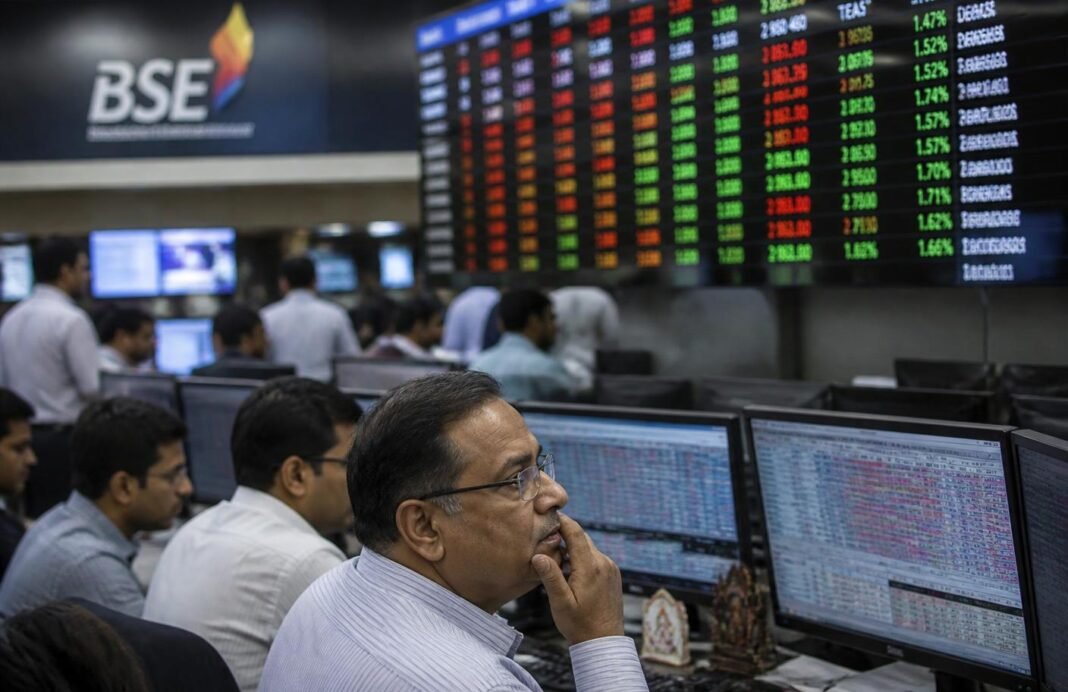


The Indian stock market has bounced back hard from its October low, but the rally now faces a test. With 10-year government bond yields near 7.4 percent, investors can earn a return close to that on offer from shares without taking equity risk. The question for the weeks ahead is whether company earnings can justify current prices, or whether money starts to drift toward bonds.
The Indian stock market rebound has been fast. The Nifty 50 rose about 13 percent from its 8 October low and closed at 25,514.30 on 19 November, up 1.14 percent on the day, while the Sensex added 1.21 percent to 83,021.75. Both closed at their highest in nearly nine months. Foreign investors bought Rs 84,291 crore of Indian shares in 13 days, and Bloomberg data put India back as the world’s fifth-largest stock market on 12 November, valued at about $5.4 trillion.
The rally followed a long slide. The Nifty 50 had fallen more than 11 percent in the first ten months of 2026, and foreign investors pulled more than Rs 2.8 trillion from Indian shares between January and October. BlackRock Investment Institute said in late October that it stayed cautious on Indian shares even after the correction, with Ben Powell, its chief investment strategist for the Middle East and Asia-Pacific, saying valuations had become more interesting but the firm wanted more evidence on earnings, crude oil, global bond yields and foreign flows before turning more positive.
Indian stock market valuations after the rebound
Valuations in the Indian stock market have come down from their peak even as prices recovered. Goldman Sachs said the MSCI India index now trades on a next-12-month price-to-earnings multiple near its ten-year average, down from a peak of 25 times. The bank expects MSCI India profits to grow 11 percent in 2026 and 15 percent in each of the next two years, a pace it calls the strongest in the region outside South Korea and Taiwan. Its Nifty target of 28,500 by end-2027 rests on earnings growth, with no valuation expansion built in.
Earnings are moving in the right direction. Nifty 50 companies reported year-on-year earnings growth of 4 percent in the March 2026 quarter, quickening to 18 percent in the June quarter, according to Motilal Oswal Financial Services. The September quarter review from the same house found the recovery spreading across more sectors. The Indian stock market needs that run of numbers to extend if prices are to hold.
Indian stock market bond yields and the pull of debt
Bonds have become a genuine rival for money in the Indian stock market. India’s 10-year government bond yield rose from 6.5 percent to 7.4 percent over the past year, pushed up by higher crude prices, inflation pressure and repo rate rises by the Reserve Bank of India. The US 10-year Treasury yield stood near 4.85 percent in early November, after touching 5.3 percent in the first week of October. When a near risk-free government bond pays more than 7 percent, investors ask for a higher return from shares to take on the extra risk, and that pushes down what they will pay for the same earnings.
The bond market has had its own wobble. The benchmark 6.94 percent 2036 bond yield fell almost 25 basis points in four sessions in early November, to 7.1710 percent, helped by cheaper oil and softer US Treasury yields. Traders then looked to a 360 billion rupee government auction of 15-year and 50-year bonds as the next check on whether the rally in bonds could last. A weak auction would push yields back up and make shares look dearer by comparison.
What the Indian stock market test comes down to
The test facing the Indian stock market is simple to state and hard to pass. Earnings must keep growing fast enough to close the gap between current prices and the return bonds now offer. Foreign flows have turned in November, with net buying for 12 straight sessions and inflows of $10 billion in the month, according to provisional data cited by Reuters. Brent crude is down 21 percent this month, which eases pressure on inflation and on company costs. Both give the Indian stock market room to hold its ground.
The risks are still there. The Sensex was down 14.16 percent in 2026 and the Nifty 50 down 13.5 percent when BlackRock set out its cautious view in late October, and foreign investors had sold shares worth Rs 4.55 lakh crore in the year. Goldman expects the Reserve Bank to raise the repo rate by a further 75 basis points to 6.25 percent by the second quarter of 2027, which would lift bond yields further and tighten the test for shares.