
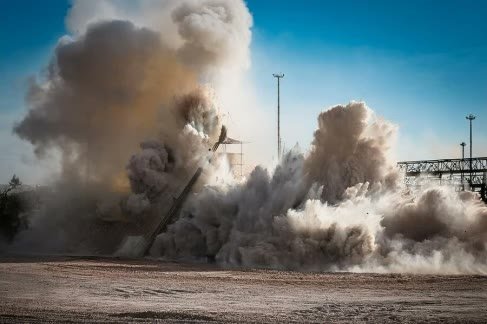


Illinois health officials are warning that lead dust from a planned blast at an Iowa ammunition plant could reach parts of the state, and they urge residents to take steps to limit exposure. The US Army plans to detonate degraded lead azide at the Iowa Army Ammunition Plant in Middletown, Iowa, on Friday, and the detonation is expected to send lead dust into the air.
The Army will set off two controlled blasts to destroy 68 barrels of degraded lead azide where they sit. The blasts are expected to throw lead dust into the air. A federal public notice said about five tons of hazardous material would be detonated at the plant between 11am and noon on Friday, 20 November. The Army says the material is too dangerous to move, and that in-place detonation is the only way to destroy it.
Current Army air modelling indicates the lead dust could affect Mercer County, Illinois. The Illinois EPA is reviewing the modelling to determine whether other local communities should take precautions, and the Army plans to update its maps leading up to the detonation. The latest modelling, which changes with the weather, carries airborne dust about 100 miles northeast, past Muscatine and toward Maquoketa, with lead settling on surfaces for about 40 miles downwind.
Lead dust poses a risk to children
Illinois Department of Public Health Director Dr Sameer Vohra said there is no safe level of lead in the body and that lead can pose serious health risks if inhaled or swallowed. The department says lead is especially dangerous to children six and younger, whose developing brains and nervous systems are most at risk. The Centers for Disease Control and Prevention says no safe blood lead level has been identified in children.
Residents in areas that may be affected by the lead dust are advised to stay indoors and keep windows closed for 24 to 48 hours after the blast. Vohra also advised washing hands before eating, leaving shoes at the door, and asking a doctor about a blood lead test, especially for children six and under. Washing outdoor surfaces with soap and water can also limit the risk of tracking toxic residue into homes.
The areas immediately next to the blast site will be temporarily evacuated. Those areas are in Iowa, according to the Illinois EPA, and the Army has warned of possible damage to nearby buildings, including shattered windows. Forecast guidance calls for gusty southerly winds of 20 to 30 miles per hour on Friday.
Illinois officials want more lead dust sampling
Illinois EPA Director James Jennings said the Department of Defense has an important responsibility to ensure its operations do not jeopardise the health of Illinois residents or the quality of their environment. He urged the department to conduct comprehensive post-detonation environmental sampling, and said air pollution does not respect state lines.
The Illinois EPA plans to monitor data from its northern Illinois air monitoring network and review federal modelling of the lead dust itself. It says the Army has shared nothing about the scope or methods of its monitoring, and Illinois officials say they heard nothing from EPA Region 7, the federal office in Kansas City that approved the operation. Iowa falls under Region 7 and Illinois under Region 5, so Illinois went to its own region for the modelling and sampling plans.
Iowa’s state government was also caught off guard. The office of Governor Kim Reynolds said the state learned of the plan only four days before the blasts, and Iowa Health and Human Services said it was made aware of the planned detonation only very recently. The Army told CBS News Chicago that operations like this near populated communities are highly uncommon.
What residents should do after the blast
Illinois residents can review the Army’s advisory and frequently asked questions, and updated maps will be posted on the Army’s public notice site. The Army must update its plume forecasts 48 hours before detonation, again six hours before the operation, and hourly until the detonations are completed.
The lead dust forecasts do not establish that harmful exposure will occur at every location within the projected plume, and sampling after the blasts will determine where lead actually lands. Patrick O’Shaughnessy, a professor at the University of Iowa’s Department of Occupational and Environmental Health, said it is encouraging that the Army and EPA are working to minimise the dust, but it is still unknown how much will end up in the air and on surfaces.
For now, the advice from Illinois health officials is simple: stay inside with the windows closed for a day or two after the blast, wash hands before eating, and keep shoes at the door. Officials say residents should follow the guidance until sampling shows where the lead dust landed.