
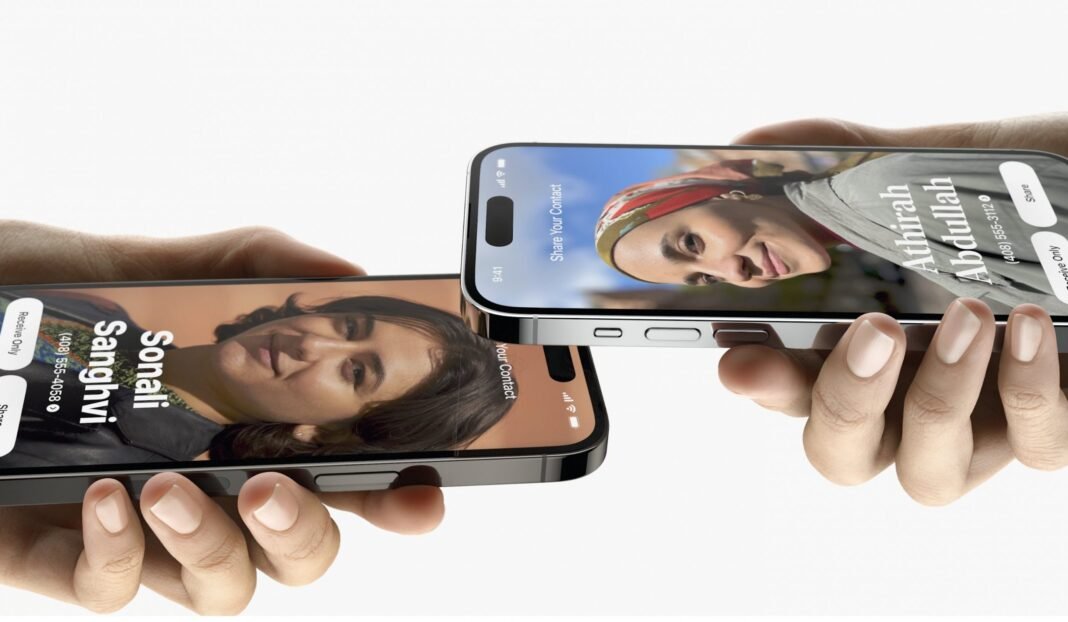


GG Technologies has sued Apple in the Bombay High Court, alleging that the iPhone maker’s NameDrop feature infringes its Indian patent for tap-to-share contact transfer. The NameDrop lawsuit seeks Rs 1,500 crore in damages, about $161.86 million, and asks the court to order Apple to switch off the feature in India while the case is heard.
NameDrop arrived with iOS 17 in June 2023. It lets two people exchange contact details by holding compatible iPhones close together, with no need to type a number or scan a code. The feature also works on Apple Watches. GG Technologies says the steps behind that exchange, from spotting a nearby device to asking the user for consent, are covered by its patent. The NameDrop lawsuit turns on whether the steps in that exchange copy the method GG patented.
The patent at the centre of the case is Indian Patent No. 546169, titled “Method and System for Proximity-Based Contact Transfer”. GG Technologies filed the application in 2021 and received the grant on 27 July 2024. The patent describes a system that detects nearby devices, exchanges identifying information and lets users accept or decline a contact transfer. GG says NameDrop follows the same sequence: proximity-based discovery, device identification, user consent and selective sharing.
NameDrop lawsuit rests on Indian patent 546169
GG Technologies is based in Santa Monica, California. Gaurav Goel, an IIT Delhi graduate, founded the company in 2018. Its contact-sharing app, StayTouch, was built around the same idea: two phones held close together exchange details without manual pairing. The company says it developed the technology years before Apple introduced NameDrop. A chartered accountant’s certificate filed with the case puts GG’s technical development and marketing spending between 2019 and 2025 at about $2.75 million. The NameDrop lawsuit puts that history before the court.
The company calls the Rs 1,500 crore figure a conservative estimate of the damages it says it has suffered. Beyond money, the 781-page filing asks the court to restrain Apple from selling or importing iPhones and Apple Watches equipped with NameDrop in India. It also asks for a direction that Apple disable the feature in India through a software update, to the extent technically feasible, while the proceedings continue. If the court grants the interim direction GG seeks, the NameDrop lawsuit would have an immediate effect on iPhone users in India.
NameDrop lawsuit follows failed mediation
The two sides tried to settle the matter before going to court. Mediation began in April 2026 and ended in September without an agreement. GG filed the suit in the Bombay High Court in October. The NameDrop lawsuit reached the court only after that mediation failed. The matter has not yet been listed for a hearing, and no date has been fixed for the court to take it up. The court will have to examine the patent claims and the technical evidence before deciding whether NameDrop infringes the patent, and the allegations remain unproven until then.
The sequence of dates matters to GG’s claim. The company was founded in 2018, filed its Indian patent application in 2021 and received the grant in July 2024, more than a year after Apple introduced NameDrop in June 2023. GG says it developed the underlying technology before Apple’s launch, and the patent application predates NameDrop by about two years. That chronology sits at the centre of the NameDrop lawsuit.
The dispute raises questions over patent ownership, technology imitation and whether independent startups can protect their inventions against features built into large technology ecosystems. That framing comes from Inc42, which reported on the filing after examining the plaint and accompanying documents. That question is the one the NameDrop lawsuit asks the Bombay High Court to answer.
NameDrop lawsuit is part of a wider fight with Apple
The Bombay High Court case is not GG’s only action against Apple. The startup filed a patent infringement suit in the United States in April 2026. That case has been stayed since September, pending an investigation by the US International Trade Commission, which began its inquiry in August after a complaint from the startup. GG is seeking restrictions on the import and sale of Apple devices in the US if they are found to infringe its patent. It filed a second US suit on 3 November 2026, citing a separate patent.
For iPhone users in India, nothing changes for now. NameDrop remains available on supported devices, and the restrictions GG has asked for are relief sought in the filing, not orders the court has granted. The NameDrop lawsuit will move forward only when the court lists it for hearing.