
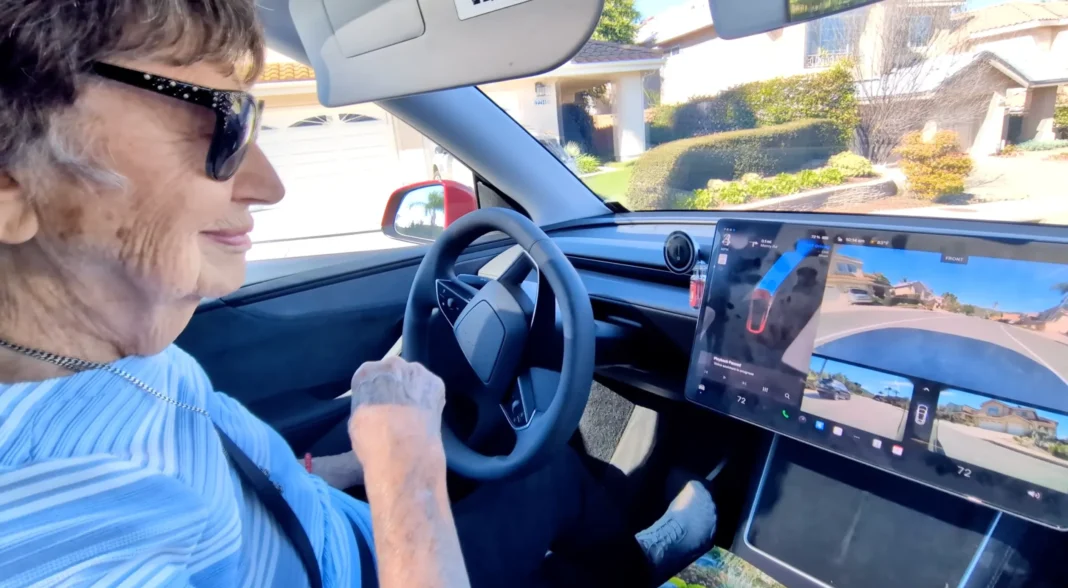


Joan Spalding has driven the steep, winding road to her house outside Denver for more than 50 years. These days, the 89-year-old barely touches the steering wheel or the pedals of her Tesla Model Y. Tesla Full Self-Driving, the system Tesla calls Full Self-Driving (Supervised), handles the turns while Spalding enters a destination and taps the dashboard touchscreen. "I just get in and go," she said.
Why Tesla Full Self-Driving appeals to older drivers
Spalding was skeptical at first. She pays about $99 a month for Tesla Full Self-Driving, and changed her mind after watching what it could do. "When I was driving," she said, "I saw that the kind of things that it did were safer than what I would do." Before she got the Tesla, Spalding had a number of minor fender benders, then a serious crash two years ago while making a left turn. "I made a wrong decision. I wasn't focusing on what I should be doing. I was lucky," she said. "But I realized then that my abilities were not where I wanted them to be."
Her son Mike Spalding, who already drove a Tesla, had watched his mother's driving get worse and suggested getting one for her. "It would be safer for mom if she was in a wreck because it's got all kinds of safety features. And then safer for people around her if we didn't have any more crashes," he said. "It's better than me."
How many seniors use the system
It is hard to know how many seniors use Tesla's automated driving system. Tesla says Full Self-Driving has more than 1.7 million active subscriptions, up 67 percent from a year ago, but has not said how many subscribers are seniors, or whether it tracks that. More older drivers are on the road than ever, and some are using Tesla Full Self-Driving to stay behind the wheel longer.
What safety researchers say about Tesla Full Self-Driving
Safety researchers worry Tesla may be over-selling what its cars can do. "It's not a technology that I would drive with. It's not a technology that I would suggest that my loved ones use. I think it has a few safety gaps that just make me uncomfortable," said Bryan Reimer, a research scientist at MIT who studies how drivers interact with technology. Tesla claims that Tesla Full Self-Driving is up to nine times safer than human driving, but releases little data, so the claim cannot be checked independently, Reimer said. He concedes the technology is impressive and improving, but not a replacement for a human driver, at least not yet. "Tesla has continually over-promised and under-delivered," Reimer said. "Full self-driving is not full self-driving, but yet the name feels so real."
The problem, safety researchers say, is that human drivers tend to get complacent with Tesla Full Self-Driving. "It's good enough, often enough, where people go, 'The next time I'm in this similar situation, I know how it's going to behave,'" said Alexandra Mueller, a senior research scientist at the Insurance Institute for Highway Safety. Mueller worries older drivers will not be ready or able to take control of the car in an emergency. "Ultimately it is very unsafe if you have drivers who are not fully competent due to age-related impairments or decline." Tesla did not reply to requests for comment.
Musk promotes Tesla Full Self-Driving for seniors
Tesla chief executive Elon Musk has encouraged the use of Tesla Full Self-Driving by seniors, posting on X that "Tesla self-driving gives mobility to seniors." He has also amplified a video of 98-year-old Larry Dimmock, who bought his first Tesla. "It has not made a mistake," Dimmock said in the video. He added that the car once stopped for a chipmunk crossing the road. The clip has been viewed more than 3.5 million times.
Dimmock, who has owned dozens of cars since a Ford Model A, says he is still a good driver at 98, but not as good as his Tesla. "I feel safer riding with this auto system than I do driving or riding with anybody. It's just been flawless," Dimmock said. "I'll get in the car and go somewhere, otherwise, I probably wouldn't."
Staying in the home she built
For Spalding, Tesla Full Self-Driving is about more than convenience. It lets her live independently in the house she and her late husband built more than 50 years ago. "I love the solitude of being in that place and being by myself," she said. Without it, she would likely have to move somewhere she would not need to drive. "I'd have to move," she said. "This way, I think I can drive it for as long as I want to. I don't see any reason why not."