
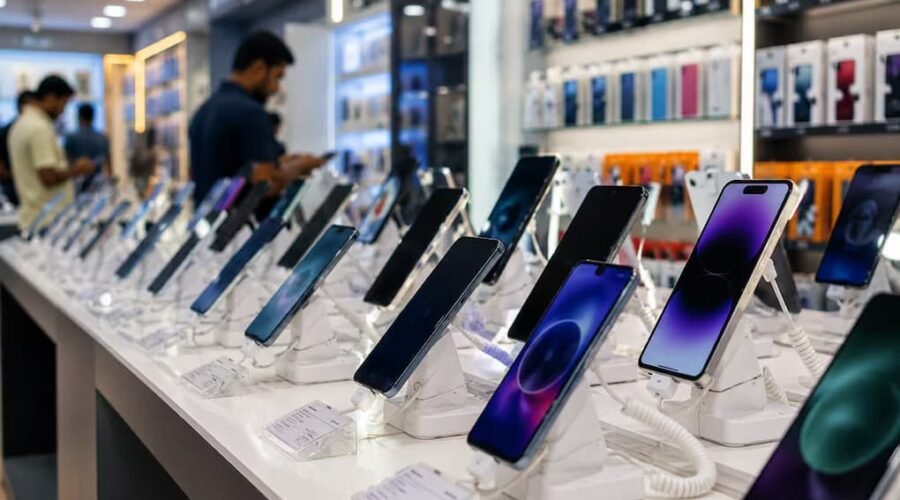


India’s phone market shipped 36.8 million units in the July-September quarter of 2026, a fall of 23.3 percent from a year earlier, according to data from research firm IDC. It was the steepest quarterly contraction since the final quarter of 2022, and the weakest festive quarter in a decade.
Memory chip costs, pushed up by surging demand from artificial intelligence, have stayed at record highs and tightened component supply, leaving vendors with little room to hold prices. With average selling prices at record levels and few festive offers on the table, price-sensitive buyers held back purchases this season, and IDC expects that pressure to carry into the final quarter of 2026.
The average selling price rose 26.1 percent from a year earlier to a record $371. Even so, the value of the phone market fell 3.3 percent, because the drop in volumes outweighed the gains from higher prices. Data from CyberMedia Research and Counterpoint Research put the contraction at about 20 percent, a smaller fall than IDC’s 23.3 percent figure.
Samsung leads a shrinking phone market
Samsung was the only brand among the top 10 to grow, with shipments up 7.9 percent. It returned to the top spot after 10 quarters, overtaking Vivo, with a 17.7 percent share of the phone market. Vivo slipped to second place with a 16.8 percent share as its shipments fell 29.9 percent, while OPPO held third place with a 13.3 percent share despite a 26.5 percent fall.
Apple fell to fourth place with a 10.1 percent share. Its shipments dropped 25 percent from a year earlier, to about 3.7 million iPhones from a record 5 million in the same quarter last year. IDC linked the fall to supply shortages across the iPhone 15, 16 and 17 ranges, smaller discounts on older models and price rises around the September launch. The iPhone 18 Pro and Pro Max models still accounted for more than 30 percent of Apple’s shipments, despite higher prices and no base iPhone 18.
Motorola took fifth place with an 8.8 percent share, followed by Xiaomi at 8.3 percent. Xiaomi’s shipments fell 31.1 percent, and Realme’s fell 39.8 percent. Among the top 10 brands in the phone market, only Samsung recorded growth. Chinese brands were hit hardest, IDC said, because their reliance on entry-level and budget volumes left them little room to absorb higher costs.
Prices rise as cheap phones vanish
The cheapest phones were hit hardest. Shipments of smartphones priced below $100 plunged 90.9 percent to 0.7 million units, and the segment’s share fell from 16.2 percent to 1.9 percent. The $200 to $400 band held flat, while the $400 to $600 band surged 79.8 percent. Together the two bands now account for 42.9 percent of shipments, up from 29.9 percent a year ago. The $100 to $200 mass-budget segment fell 21.3 percent but remains the single largest band, with a 40.6 percent share.
The premium end split in two. Shipments priced at $800 and above slipped only 0.4 percent, lifting that band’s share to 11 percent from 8.5 percent. The $600 to $800 band fell 52.4 percent, as supply constraints and scarcer offers on older devices weighed on that tier. Offline phone market shipments fell 26.7 percent, against an 18.9 percent fall online, trimming the offline share to 53.9 percent from 56.4 percent.
What the phone market faces next
IDC expects the phone market downturn to deepen in the October-December quarter, with shipments forecast to fall by more than 25 percent from a year earlier. For 2026 as a whole, it projects total shipments of 125 to 127 million units, a fall of 16 to 18 percent from 2025. Growth is expected to stay constrained through 2027, with any recovery unlikely before 2028.
“Q3 2026 shows how far the memory crisis has reset the economics of India’s smartphone market. ASPs rose 26.1 percent year on year to a record $371, yet market value declined 3.3 percent, as the volume contraction outweighed the price gains,” said Aditya Rampal, senior research analyst for devices at IDC Asia Pacific.
Upasana Joshi, senior research manager at IDC Asia Pacific, said: “India’s smartphone market is headed for a sharper correction in Q4 2026, with shipments expected to decline 25 percent or more year on year and full-year volumes settling at 125 to 127 million units, 16 to 18 percent below 2025. Higher ASPs, thin discounts and longer replacement cycles kept demand subdued even through the festive period.”