
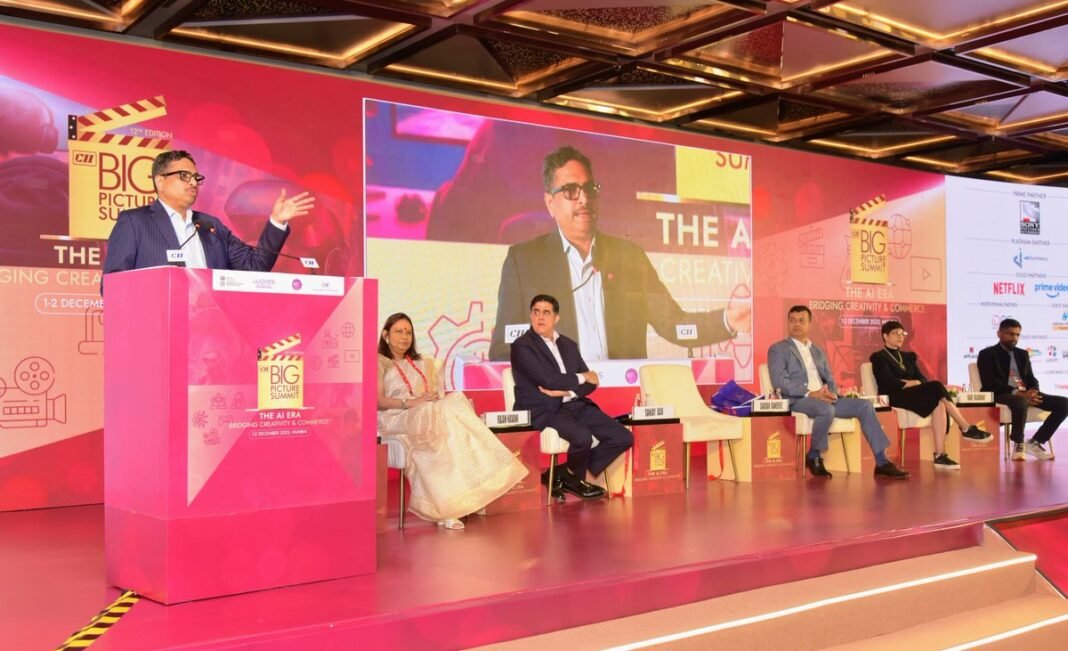


India’s media entertainment sector grew by 9 per cent to reach Rs 2.78 lakh crore in 2025, Information and Broadcasting Secretary Sanjay Jaju Kumar said on 15 October at the CII Big Picture Summit 2026 in Mumbai. Digital media revenues crossed the Rs 1 lakh crore mark, while the live events segment recorded 44 per cent growth, supporting more than one crore livelihoods across the country.
Addressing the two-day summit, themed ‘The New Economics of Media and Entertainment: Building India’s Future Global Media Companies’, Kumar said the industry must move beyond serving as a large content market and focus on building globally competitive companies, creating original intellectual property and supporting local creators. He called for sustainable business models, stronger IP protection and greater global market access.
“The next phase requires a strong intellectual property, sustainable revenues, disciplined investment, and the ability to build audiences across the markets all over the world,” Kumar said. He stressed that innovation and trust must go hand in hand, calling for a predictable policy environment and responsible business practices to tackle piracy and protect creative investments.
Media Entertainment Sector Eyes $100 Billion Ambition
CII used the summit to release its white paper, ‘The New Economics of Media and Entertainment’, outlining a roadmap towards a $100 billion Indian M&E sector. The paper’s priorities include stronger IP ownership, regulatory reform, investment in talent and technology, and greater access to international markets.
The scale of the challenge is significant. Valued at $32 billion in 2025, the industry could reach only about $64 billion by 2033 at its current growth rate, leaving a $36 billion gap against the $100 billion ambition for the early 2030s, according to the CII report. Annual growth needs to accelerate from 9 per cent to 15.3 per cent to close that gap. Digital media is expected to be a major contributor, with internet advertising projected to reach $47 billion by 2033, while OTT video is projected to touch $8.5 billion.
Media Entertainment Sector Reforms on the Table
The white paper puts a 36-month reform calendar at the centre of the transition, proposing named owners, implementation milestones and an annual public scorecard to turn policy recommendations into accountable delivery. Among the immediate priorities are market-led broadcasting, measurable action against piracy, and investment in regional markets and emerging businesses.
It also proposes reducing GST on television, OTT and music subscriptions to 5 per cent, alongside proportionate regulation and industry self-regulation. Gaurav Banerjee, summit chair and MD and CEO of Sony Pictures Networks India, said broadcasting reform was a central priority, adding that the industry seeks greater freedom over television pricing and packaging, removal of carriage fees and restored audience measurement.
Government Push: WAVES 2027 and Creator Support
Kumar said the government’s role is to create an ecosystem in which creativity can grow into scalable enterprises, under the vision of “Create in India. Own in India. Scale from India. Take it to the world.” Among the initiatives highlighted were WAVES and WAVES Bazaar, the Indian Institute of Creative Technology, India Cine Hub and an enhanced anti-piracy framework.
The next edition of WAVES is scheduled to take place in Mumbai in October 2027, with the second season of the Create in India Challenges also set to be announced following participation by over one lakh creators in its inaugural season. WAVES Bazaar has been positioned as a marketplace connecting creative businesses with investors and international customers.
At a time when media companies worldwide are reassessing their business models, Kumar said India holds a distinct advantage: a vast domestic market, rich storytelling traditions, cultural diversity and a young creative workforce. The question the summit left hanging is whether the industry can convert that audience scale into the sustainable revenues the $100 billion ambition demands.
The summit also heard that the second season of the Create in India Challenges will be announced shortly, following participation by over one lakh creators in its inaugural season. With WAVES Bazaar positioned as a marketplace connecting creative businesses with investors and international customers, the government’s message was consistent: the next phase of the media entertainment sector will be built on original intellectual property, disciplined investment and global ambition.