
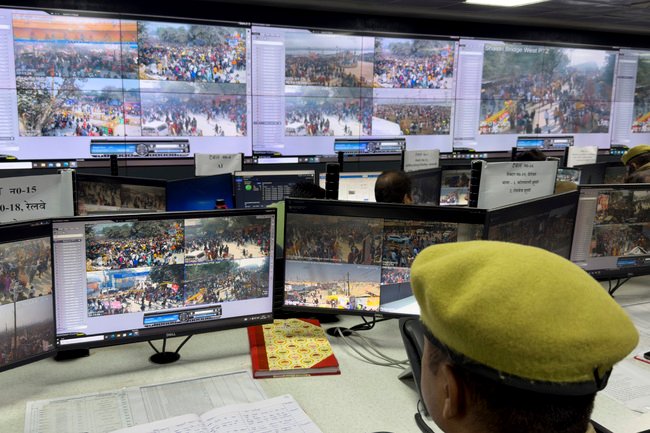


Nineteen people were killed and 25 injured in the stampede at Kolkata’s Chorbagan Durga Puja pandal on Saturday, bringing crowd management back into sharp focus. Heavy rain was said to have driven visitors toward the entrance, causing a crush in which people fell over each other. The tragedy raises an urgent question: can crowd monitoring technology identify the warning signs before a crowd turns dangerous?
The short answer from safety experts is that the tools exist, but they are rarely deployed as the early-warning systems they were designed to be. Digital ticketing, people counters and entry gates fed with live occupancy data can help organisers prevent a venue from exceeding its safe capacity. India has invested heavily in CCTV cameras in public places, transport hubs and mass gatherings, but cameras that merely record events are of little use in preventing a stampede.
Artificial intelligence can analyse live video feeds, estimate crowd density, track movement and flag sudden surges, so control rooms can identify trouble spots before conditions become critical. The challenge is to turn surveillance into an early-warning system that leads to action, rather than a recording system that documents disaster.
How Crowd Monitoring Technology Works
Modern crowd monitoring systems connect to existing cameras and use AI to estimate how many people are in each zone, how densely packed they are and which way they are moving. When density crosses a set threshold or movement turns abnormal, the system alerts staff in real time so they can act early, opening new exits, redirecting flow or pausing entry.
Such systems can count people entering and exiting a venue, map congestion at individual gates and identify areas where flow has slowed or reversed. Safety guidance, including India’s National Disaster Management Authority framework, references thresholds around six people per square metre as a danger point, and systems can be configured to alert teams well before that level is reached.
Crucially, the software works with most existing IP and CCTV cameras, so venues usually need no new hardware. Overhead or elevated wide-area views give the best density accuracy, and drone or thermal feeds can be added for large open sites such as festival grounds and pilgrimage routes.
Crowd Monitoring Technology Needs More Than Cameras
Technology alone cannot prevent stampedes. Narrow exits, poorly placed barricades and inadequate evacuation plans can worsen risks despite the most advanced monitoring, and real-time alerts are useless without coordinated emergency response systems to act on them. Prevention still depends on good camera coverage, trained staff and sound event planning; the software makes those people faster and better informed.
The pattern of recent Indian tragedies underlines the point. The Chinnaswamy Stadium incident in Bengaluru, which claimed 11 lives and injured 71, highlighted the same gaps: inadequate exit routes, poor crowd control measures and unclear roles for event organisers. Early warning tools such as the government’s SACHET mobile app, which can alert people to dangerous conditions, and predictive analytics using weather data and crowd behaviour analysis, remain underused.
What India Needs Next in Crowd Monitoring Technology
Experts argue for a national crowd management policy that ensures uniformity in safety protocols, training and planning for mass gatherings across states, with capacity planning, regulated crowd sizes and inter-agency coordination at its core. Technology would sit inside that framework: ICT systems, GIS mapping, CCTV, UAVs and AI analytics feeding unified control rooms.
Accuracy, vendors concede, depends on conditions: poor camera quality, extreme density or heavy occlusion reduce it, which is why deployments have had mixed results. The honest pitch is decision support, not a guarantee. But after Kolkata, the question facing organisers and authorities is no longer whether the technology works, it is why it was not watching when it mattered.
Policy experts also back a national crowd management policy to standardise safety protocols, training and planning for mass gatherings across states. Such a framework would focus on capacity planning, regulating crowd size, ensuring medical and security presence, and building inter-agency coordination between organisers, local authorities and emergency services, in line with National Disaster Management Authority guidelines. Technology, they argue, must be embedded in that system, not bolted on after the fact.