
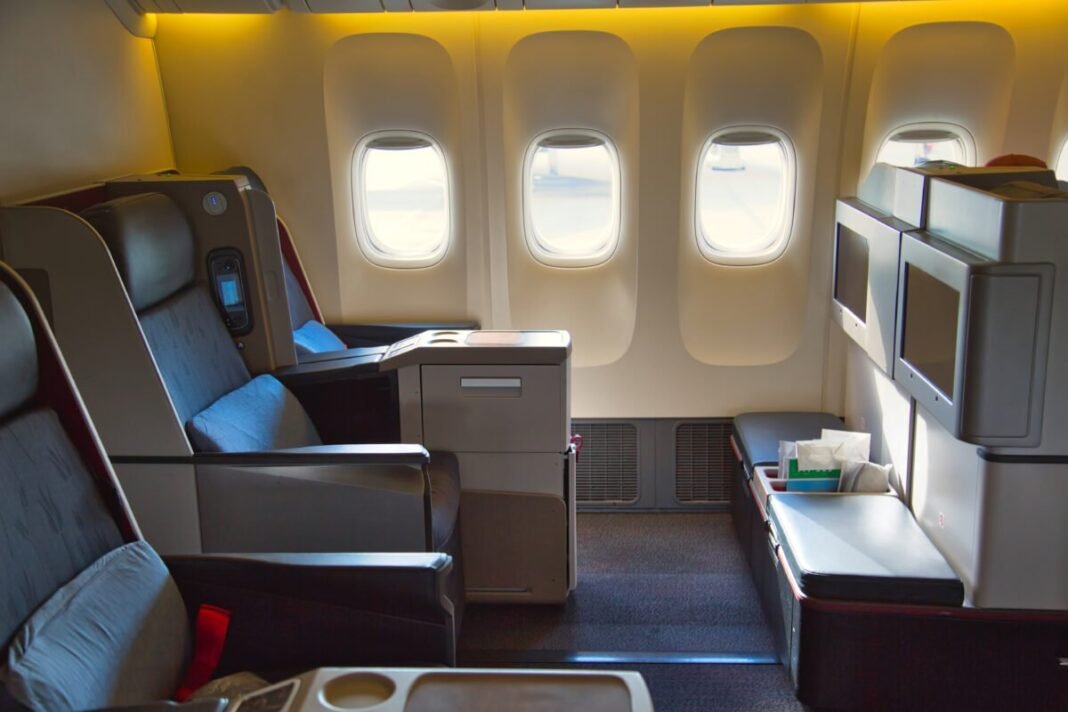


Board a long-haul flight, settle into a wide seat near the front, and the crew offers a cocktail or Champagne. Later come plush slippers, a cheese board, lobster thermidor and a lie-flat bed. It sounds like first class. These days, it may well be business class. Business class cabins now offer perks once reserved for the front of the plane, and the line between the two has grown hard to see.
Lie-flat beds, sliding privacy doors and chef-designed menus mean international business class cabins now deliver much of what first class used to keep to itself. Airlines now face an expensive choice: retire first class altogether, as major United States carriers have largely done, or spend billions remaking it. With no universal standard defining either cabin, travelers must work out what their money or air miles will actually buy.
“When airlines were flying recliners in business class and full-flat seats in first, the lines were clear,” Daniel Baron, founder and managing director of LIFT Aero Design, told CNN Travel. Baron blames “the advent of flat beds in minisuites with doors in business class.” Business class cabins caught up step by step, taking away one more reason to pay for the cabin in front.
How business class cabins caught up
Business class first appeared in the 1970s, when airlines including Pan Am, British Airways and Thai Airways began offering enhanced meals, preferential seating and other perks to passengers paying for full-fare economy tickets. In 1978, Pan Am introduced Clipper Class, a separate section for business travelers with much the same seats as economy. A year later, Qantas introduced what is widely seen as the world’s first official business class.
Through the 1990s, first class had fully flat beds while business class still offered recliners. British Airways was among the first to put lie-flat seats in first class in 1995. Around the turn of the millennium, lie-flat beds began appearing in business class too. In 2003, Virgin Atlantic introduced its Upper Class Suite, a business class seat with a lie-flat bed and direct aisle access. Other airlines followed, and 1-2-1 layouts giving every passenger direct aisle access became the standard for long-haul business class cabins.
Business class cabins and the end of American first class
Domestic flights add to the confusion. On many domestic routes, a first class ticket buys a wider seat, more legroom, priority boarding and complimentary drinks. Short hops such as Boston to Chicago usually offer no lie-flat bed or lounge access, except on transcontinental routes and flights to Hawaii. “You could almost argue that US airlines should stop calling their domestic premium cabins ‘first class.’ It’s not first class,” Henry Harteveldt, president and travel industry analyst at Atmosphere Research Group, said. “Domestic first class and international first class aren’t siblings. They’re more like second cousins once removed.”
United retired its international first class in the 2010s, and American Airlines has followed. American operated its final long-haul international first class flight on November 19, the last among major United States carriers. Its redesigned Boeing 777-300ER drops first class entirely for 70 Flagship Suite business class seats, up from 52 beside eight first class suites, plus 44 premium economy seats. Delta had already moved away from international first class.
Business class cabins and soft first class
Some airlines have answered with a more exclusive tier inside business class, what Harteveldt calls “soft first class.” United’s Polaris Studio suites, introduced in 2026, are 25 percent larger than standard Polaris seats and include 27-inch screens, upgraded amenities and caviar service. American’s Flagship Suite Preferred seats, in the front row of its business class cabins, offer roughly 20 percent more sleeping space. Qatar Airways’ Qsuite offers private suites with sliding doors and fully flat beds, with partitions that let couples make a double bed.
Singapore Airlines unveiled a $1.6 billion redesign of its premium cabins earlier this month, due to debut in 2027. Its fully enclosed first class suites form a queen-sized bed, 60 inches across and 80 inches long. Some business class cabins now rival first class on other airlines outright.
In 2025, international business and first class passenger numbers climbed 4.5 percent to 109.7 million, the International Air Transport Association said. Baron advises travelers to check the seat map when booking. “The fare differential can be massive, sometimes double,” he said. Business class cabins with a flat bed, a privacy door and direct aisle access may be all an overnight journey needs. “The longer journeys are the ones where the value proposition is greatest,” Harteveldt said.