
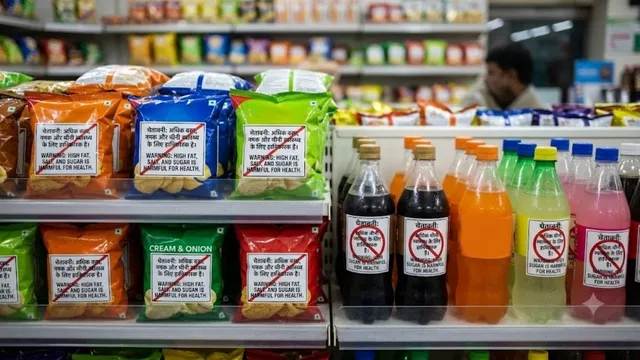


New Delhi: Packaged foods high in fat, sugar or salt will soon carry separate food warning labels on the front of the pack, after the Supreme Court on Thursday directed the food regulator to make the warnings prominent and easy to read. A bench of Justices J B Pardiwala and K Vinod Chandran told the Food Safety and Standards Authority of India (FSSAI) that each nutrient of concern must get its own red hexagon, with a standard picture of the nutrient and the words "High Fat", "High Sugar" or "High Salt". The order came in a case on front-of-pack nutrition labelling, a system meant to help shoppers judge a product at a glance instead of reading the small print on the back.
The court rejected the regulator's plan for a single combined symbol. Products that cross the limit for more than one nutrient will carry separate food warning labels for each one, so a shopper can see at once whether the problem is fat, sugar or salt. Each hexagon must take up at least 4 to 5 per cent of the principal display panel, the main face of the pack, unless the regulator records explicit reasons for a smaller size. Font sizes must stay legible under normal conditions of purchase and use.
What the food warning labels will look like
The new food warning labels will use a standard pictorial representation for each nutrient alongside the matching words. The bench said the design of the food warning labels should be uniform across brands. FSSAI had proposed red hexagonal warnings in an affidavit filed in August, but its plan put the nutrients inside one combined hexagon. The court said separate hexagons would serve shoppers better, because a single symbol hides which nutrient is the concern.
The directions came in a matter filed by the non-profit 3S and Our Health Society, which went to court over the absence of warning labels on packaged food. During the hearings, the bench questioned whether the regulator was giving in to pressure from companies on a public health matter, especially one affecting children.
How the thresholds will be set
The court also told FSSAI to rework the limits that decide which products carry food warning labels. The regulator must measure total sugars and saturated fat, rather than added sugar and added fat. The bench said this matched FSSAI's own consensus before the Dietary Guidelines for Indians, 2024. Thresholds in Table 15.1 of those guidelines should not be adopted as they stand, the court said, because they were calculated on added sugar and added fat.
The limits that trigger food warning labels must be evidence-based and neither too low nor too high, the bench said. Thresholds set too low would put a warning on almost every packaged product and desensitise shoppers, the court warned, a result it called label fatigue. Thresholds set too high would let most products escape the framework and leave shoppers unaware of harmful levels of saturated fat, sugar and salt.
What happens next
FSSAI has about four months to prepare and finalise the draft regulations, a process that includes publishing the draft amendments, inviting stakeholder comments for 60 days, examining the responses and completing regulatory approval. The new food warning labels will not appear on packets at once, since the amendments and the rollout that follows must be completed first. The court asked the regulator to stick to the implementation timeline it proposed and to take pre-emptive measures so the rollout is not delayed.
The regulator must also list the solid and liquid food products exempted from front-of-pack labelling, while making sure products that ought to carry warnings do not escape. If makers use artificial preservatives and other additives to get around the system, FSSAI must watch reformulation closely and revise regulations where needed.
The long road to food warning labels in India
The labelling plan has a long history. FSSAI first proposed a health-star rating system in 2022, but it never became mandatory. According to Reuters, the government shelved an earlier proposal after private objections from the industry. At a meeting on March 19, industry executives argued that warning labels confuse buyers and do little good, and pushed for a focus on portion control instead, Reuters reported, citing recordings of the meeting.
India's packaged food market is worth more than 100 billion dollars, according to Reuters. The court also directed the Centre to build nutrition literacy among children through changes in school curricula, interactive workshops and co-curricular activities.