
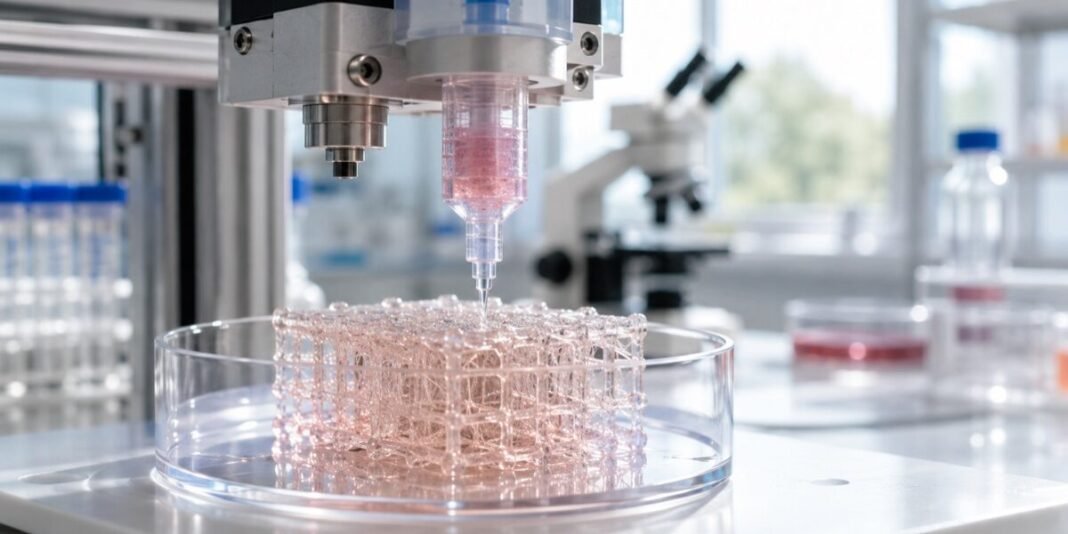


New 4D biofabrication technology is opening fresh possibilities for tissue engineering and wound healing, according to research reported by Phys.org. The emerging technique extends 3D bioprinting with a crucial fourth dimension — time — allowing printed biological structures to change shape or function after fabrication in response to their environment.
Conventional 3D bioprinting builds tissue scaffolds layer by layer from bioinks containing living cells. The 4D biofabrication approach adds stimuli-responsive materials that let those structures transform after printing: folding, swelling, releasing drugs or adapting their mechanics when exposed to body temperature, moisture or biochemical signals. For wound healing, that adaptability could be transformative.
The promise for tissue engineering lies in creating constructs that behave more like living tissue. A static scaffold can support cell growth, but a dynamic one can actively participate in healing — contracting to close a wound, releasing growth factors on a schedule, or remodelling itself as new tissue forms. Researchers describe the technique as a step toward materials that do not just sit in the body but work with it.
How 4D biofabrication could transform wound healing
Chronic wounds — diabetic ulcers, pressure sores, severe burns — remain one of medicine’s most stubborn problems, affecting millions of patients worldwide and costing health systems billions. Standard dressings protect wounds passively; advanced therapies such as skin grafts are limited by donor availability and rejection risk. 4D biofabrication offers a third path: engineered constructs that actively drive the healing process.
Imagine a printed dressing that, once applied, responds to the wound’s moisture by swelling to fill irregular cavities, then releases antimicrobial agents followed by growth factors in a timed sequence. That is the kind of programmed behaviour responsive bioprinting makes conceivable. By building the healing schedule into the material itself, the technology could reduce the need for repeated dressing changes and deliver therapies exactly where and when they are needed.
For tissue engineering more broadly, 4D biofabrication could help solve one of the field’s hardest problems: vascularisation. Printed tissues thicker than a few millimetres tend to die at their core because nutrients cannot reach the centre. Dynamic structures that reorganise themselves to form channels could one day support thicker, more complex engineered tissues — a prerequisite for printing functional organs.
The science behind 4D biofabrication
The “4D” in the name refers to smart materials — hydrogels, shape-memory polymers and other responsive substances — that change their properties over time when triggered. In biofabrication, these materials must clear an extra hurdle: they have to be biocompatible and cell-friendly, since living cells are printed alongside or within them. Developing bioinks that are both responsive and non-toxic has been a central research challenge.
Recent advances have expanded the toolkit. Researchers are now working with materials that respond to multiple stimuli — temperature, pH, light, enzymes — enabling more sophisticated programmed behaviours. Multi-material printing, which deposits different bioinks in precise arrangements, lets a single construct contain regions that respond differently to the same trigger, producing complex shape changes from simple signals.
The wound-healing applications reported by Phys.org build on this foundation. By engineering constructs that respond to the specific biochemical environment of a wound, scientists can create dressings that are effectively customised by the wound itself — a level of personalisation that static materials cannot match. The field is still young, but the underlying materials science is advancing rapidly.
From lab to clinic: the 4D biofabrication road ahead
As with all tissue engineering advances, the path from laboratory demonstration to clinical use for 4D biofabrication is long. Regulatory approval for implantable or wound-contact devices requires extensive safety testing, and scaling up from bespoke research constructs to manufacturable medical products is a formidable engineering challenge. Experts caution that clinical products are years, not months, away.
Still, the direction of travel is clear. The convergence of better bioinks, more precise printers and deeper understanding of wound biology is steadily closing the gap between what 4D biofabrication can do in principle and what it can do in practice. Each advance in stimuli-responsive materials brings programmable healing a step closer to the clinic.
For patients with wounds that will not heal, that progress cannot come fast enough. If 4D biofabrication delivers even part of its promise — dressings that actively heal, scaffolds that build themselves into tissue — it will represent one of the most significant advances in regenerative medicine in a generation. The research reported this week suggests that future is beginning to take shape.