
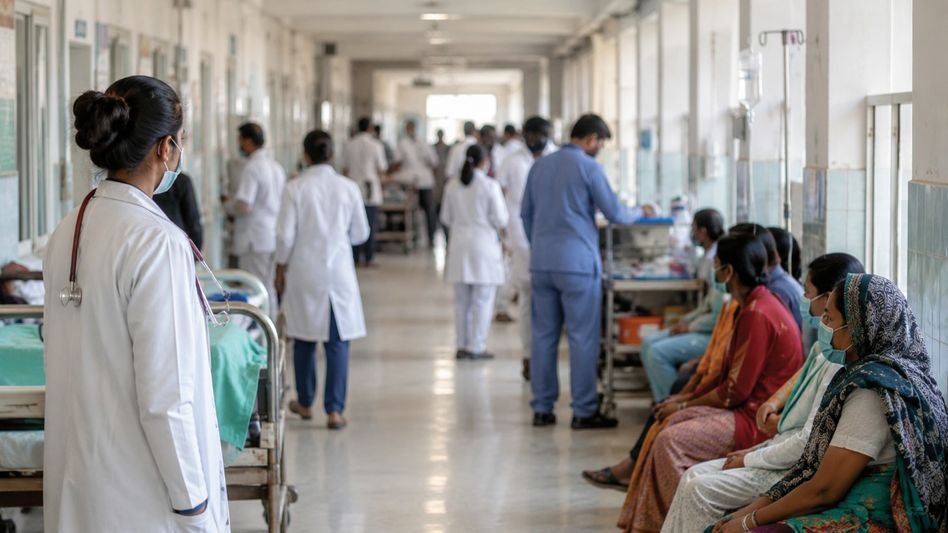


Uninterrupted hospital services in both government and private hospitals have been ordered by Health Minister K G Arunraj, in a directive reported by The New Indian Express. The instruction puts hospital administrators across the board on notice: patient care must continue without disruption, regardless of holidays, staff shortages or administrative hurdles.
The call for round-the-clock care addresses one of the most persistent anxieties around healthcare delivery — that care quality dips when it is needed most. Festival seasons, public holidays and year-end periods routinely strain hospital staffing as personnel take leave, while patient demand often rises at exactly those times. A ministerial directive for uninterrupted hospital services is designed to close that gap before it opens.
Notably, the directive covers private hospitals as well as government ones. Continuous care cannot be a public-sector-only obligation when a large share of patients depend on private facilities. By addressing both sectors together, the minister’s order acknowledges that the healthcare system functions as one ecosystem in the eyes of patients.
What uninterrupted hospital services require in practice
Delivering uninterrupted hospital services is an operational challenge, not just a slogan. It means ensuring that emergency departments are fully staffed around the clock, that operation theatres have anaesthetists and support teams available, that pharmacies and laboratories run without gaps, and that senior doctors remain reachable for critical decisions. Each of these is a rostering and management problem that must be solved in advance.
Hospitals that take the directive seriously typically prepare holiday rosters weeks ahead, designate on-call teams for every critical department, stock essential medicines and consumables beyond normal levels, and establish clear escalation chains so that junior staff on duty can reach senior decision-makers instantly. The minister’s directive effectively demands this level of preparedness as the baseline, not the exception.
For government hospitals, it also means keeping outpatient departments functional and ensuring that referral chains — from primary health centres upward — do not break down. A patient turned away from a primary facility because “the doctor is on leave” experiences the system as interrupted, whatever the tertiary hospital’s roster says.
Why the minister ordered uninterrupted hospital services now
Such directives often precede periods of known stress on the health system. The timing of the order, reported on 21 October, suggests anticipatory action — ensuring that the administrative machinery is geared up before demand peaks rather than scrambling after it. Preventive administration of this kind is far cheaper, in both money and lives, than crisis management.
There is also an accountability dimension. When a minister publicly orders uninterrupted hospital services, every subsequent disruption becomes a visible failure rather than an accepted inconvenience. Hospital administrators know that the directive creates a paper trail: if services falter, the question will be asked why the order was not implemented. That is precisely the point.
Patient advocacy groups have long demanded exactly this kind of explicit commitment. For families, round-the-clock hospital care is not an administrative nicety but the difference between a medical emergency handled and a tragedy compounded by delay. The directive gives patients and their families a standard to hold facilities to.
Making uninterrupted hospital services the norm
The real test of the order for uninterrupted hospital services will be in its enforcement. Directives are easy to issue; sustained compliance requires monitoring — surprise inspections, public reporting of staffing levels, grievance mechanisms for patients who encounter disrupted services, and consequences for administrators who treat the order as optional.
Health systems that have successfully institutionalised continuous service share common features: transparent duty rosters, empowered nursing leadership, backup staffing pools and, crucially, a culture in which raising a staffing gap is rewarded rather than punished. Building that culture takes longer than issuing a circular, but the circular is where it starts.
For now, the minister’s message is unambiguous: hospitals exist to serve patients continuously, and uninterrupted hospital services are a non-negotiable obligation. Patients across the state will be watching — and hoping — that this time the promise holds.