
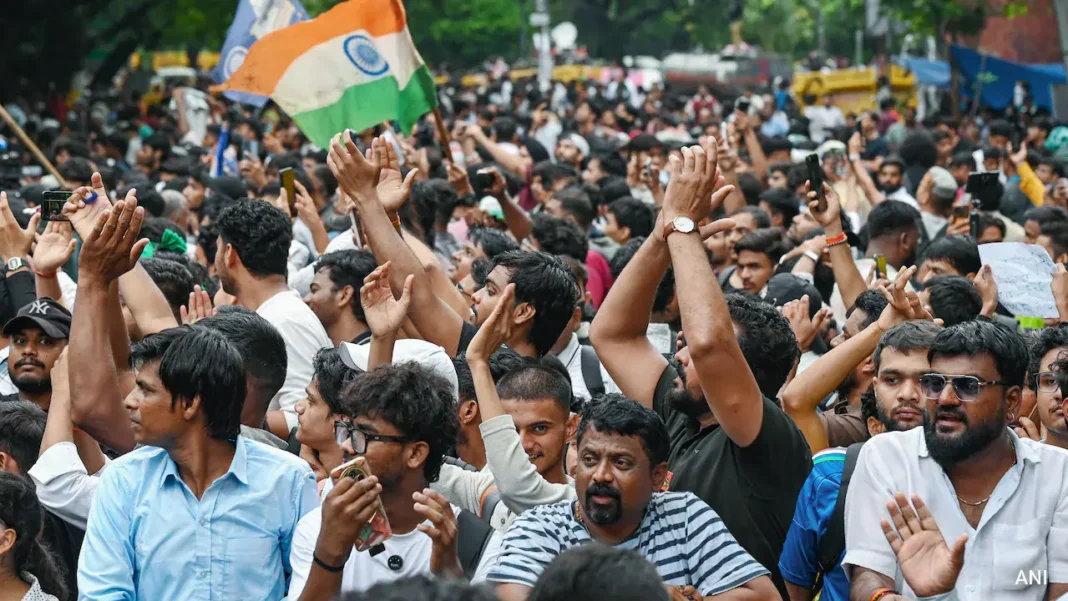


A woman who made crude remarks about Prime Minister Narendra Modi at a “Cockroach” protest in India is now being harassed and is afraid to leave her home, The Guardian reported on Tuesday. Her ordeal has thrown a harsh light on the backlash facing participants in one of India’s most unusual protest movements — and on the shrinking space for dissent around the demonstrations.
The Cockroach protests began with a six-word social media post. Political strategist Abhijeet Dipke, 31, born into a Dalit family, shot to prominence after his viral response to Supreme Court Chief Justice Surya Kant’s remarks likening unemployed youth to “cockroaches”. The post spawned the satirical “Cockroach Janta Party”, an online movement that rapidly evolved into a genuine political force, mobilising mass street protests that culminated in the July resignation of education minister Dharmendra Pradhan — a rare exit from Modi’s cabinet following sustained public pressure.
The Cockroach protests’ second round has been even more confrontational. On October 10, Dipke called for a fresh protest in New Delhi demanding the resignation of Chief Election Commissioner Gyanesh Kumar, following reports in the Indian Express in late September that he had pushed through a purge of voter rolls. Critics allege the changes dropped about 130 million voters from a draft roll — a figure larger than the population of Japan — while the election panel says the entries were flagged during draft revision and that voters wrongly removed can enrol again.
Cockroach protests: a woman’s ordeal after the rally
It is against this charged backdrop that the woman’s case, reported by The Guardian, has emerged. According to the report, crude remarks she made about the Prime Minister at a Cockroach protest drew a wave of harassment, leaving her effectively confined to her home. The episode illustrates the personal cost the Cockroach protests are exacting on ordinary participants — particularly women — who find themselves targeted long after the slogans fade and the crowds disperse.
Cockroach protests and the backlash over Modi remarks
The harassment case is not unfolding in isolation. Police met Dipke’s aircraft as it landed in New Delhi on October 10 and detained him ahead of the rally, in television images that showed officers assuring him he was not being arrested but that his cooperation was sought. Other detentions followed: YouTuber and Modi critic Dhruv Rathee, AISA national president Neha Bora, CPI(ML) general secretary Dipankar Bhattacharya, senior Supreme Court lawyer Prashant Bhushan, and politicians Yogendra Yadav and Mamata Banerjee were among those picked up, according to reports. Journalists trying to cover the protests were also detained and taken away in police buses. The treatment of protesters has drawn criticism from the UN and Amnesty International.
Observers say the Cockroach protests have exposed a double standard in how dissent is policed. Supporters of the movement argue that crude remarks at rallies are part of a long tradition of political satire in India, while critics of the government say the harassment shows how quickly the machinery of trolling and intimidation descends on ordinary citizens. Either way, the Cockroach protests have moved far beyond their meme origins into a confrontation the establishment can no longer ignore.
The movement’s leaders have vowed to return to the streets, and student groups say more demonstrations are planned in the coming weeks. But for the woman harassed over her remarks at the rally, the cost of a single protest has already proved life-changing — a private ordeal behind a very public movement.
Cockroach protests test the limits of dissent
What began as satire has become a serious test of India’s democratic space. As one Guardian commentator noted, the movement’s first round ended with the BJP sacrificing the education minister; the second round, targeting the election chief, allows for no such scapegoating — “if Kumar goes, Modi must go too.” Whether the Cockroach protests sustain their momentum will depend on whether participants like the harassed woman can speak without fear. For the woman at the centre of The Guardian’s report, the Cockroach protests are no longer a distant political drama — they are the reason she cannot walk out of her own front door.