
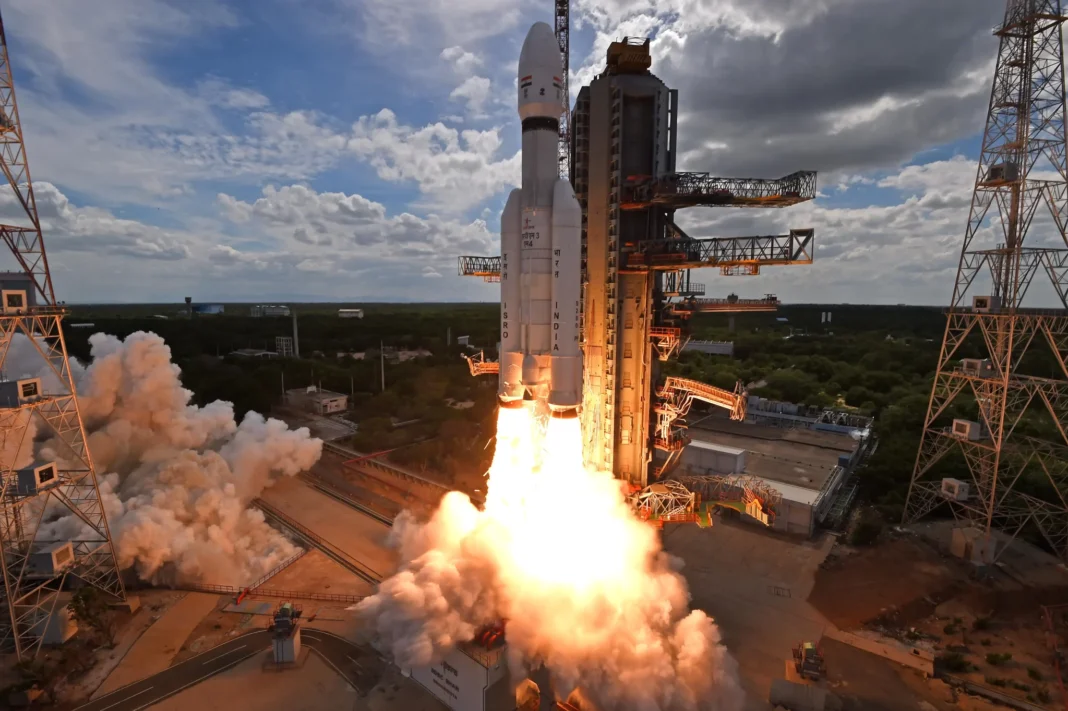


India's domestic space industry is valued at approximately $13 billion and could reach $40 billion by 2030, which would make India the third-largest spacetech economy in the world, according to a new report by Arkam Ventures India. The report is a sector study of India's spacetech industry. The report says the industry is growing at twice the pace of the global market, as space startups scale up across launch vehicles, satellite manufacturing and earth observation. Third place would put India behind only the two biggest spacetech economies.
More than 300 space startups emerged in India over the past five years, moving from prototypes to market entry in satellite manufacturing, earth observation, launch vehicles and in-space solutions, the report says. By mid-2026 nearly 400 space start-ups were active, one of the fastest-growing segments of India's innovation economy. The five-year window roughly matches the period since the 2020 space-sector reforms. The mid-2026 figure shows entry continuing into this year.
Union Minister of State for Science and Technology Dr Jitendra Singh said in June 2026 that more than 400 space startups are driving the sector. He projected growth from around $8-9 billion today to nearly $40-45 billion over the next decade. His figures differ slightly from the report's: $8-9 billion today against the report's $13 billion, and nearly $40-45 billion over a decade against $40 billion by 2030. The two projections agree on the order of magnitude: roughly $40 billion.
Cumulative private investment in the sector has reached approximately $600 million, according to the report. Space startups raised nearly $256 million in 2026, part of that cumulative total, and a further $3.5 billion in venture capital and private equity investment is forecast over the next five years. The five-year forecast is close to six times the amount invested to date. Private money in the sector remains small next to the target: $600 million invested to date against a $40 billion goal. The five-year forecast window runs to 2031, a year past the 2030 target.
How space startups took shape after the 2020 reforms
The report cites cost-efficient engineering, deep manufacturing capability, access to ISRO facilities and technology transfers, and the 2020 space-sector reforms as the main drivers of growth. The reforms redistributed roles among ISRO, IN-SPACe and NewSpace India Limited. The list combines domestic strengths with public support for private firms.
NewSpace India Limited has executed 83 technology-transfer agreements with private companies, the report says. The 83 agreements transfer technology to private firms. Support schemes for the sector include the Seed Fund Scheme and the Pricing Support Policy. The combination gave space startups formal access to ISRO facilities and to technologies developed under the public programme.
What space startups have built so far
Skyroot Aerospace is among the world's top three private launch vehicle players, according to the report. It executed India's first private suborbital mission in 2022. In August 2025 it test-fired the Kalam-1200 solid booster ahead of the maiden orbital launch of Vikram-1. The maiden orbital launch of Vikram-1 is still to come.
At ISRO facilities, Astrophel Aerospace is testing an indigenously developed cryogenic pump. Bellatrix Aerospace is developing propulsion and space-mobility technologies. GalaxEye has launched its OptoSAR Earth-observation satellite. Pixxel is building hyperspectral Earth-observation constellations.
Agnikul Cosmos developed a single-piece 3D-printed rocket engine. Dhruva Space was the first private Indian company to integrate a commercial satellite onto a launch vehicle. The report also names SatSure, Digantara and TakeMe2Space among the firms entering the market. Many of these space startups now span launch hardware, satellite manufacturing and the data their spacecraft collect.
Why space startups may still miss the 2030 target
The reports caution that the $40 billion target is not guaranteed. For space startups, reaching it will require sustained investment, regulatory certainty, infrastructure development and technological innovation. The conditions span money, policy, infrastructure and technology.
The remaining conditions named are global customers and long-term capital. The $3.5 billion is a forecast, not money already committed. At the 2026 pace of $256 million a year, the $3.5 billion forecast equals nearly 14 years of funding.