
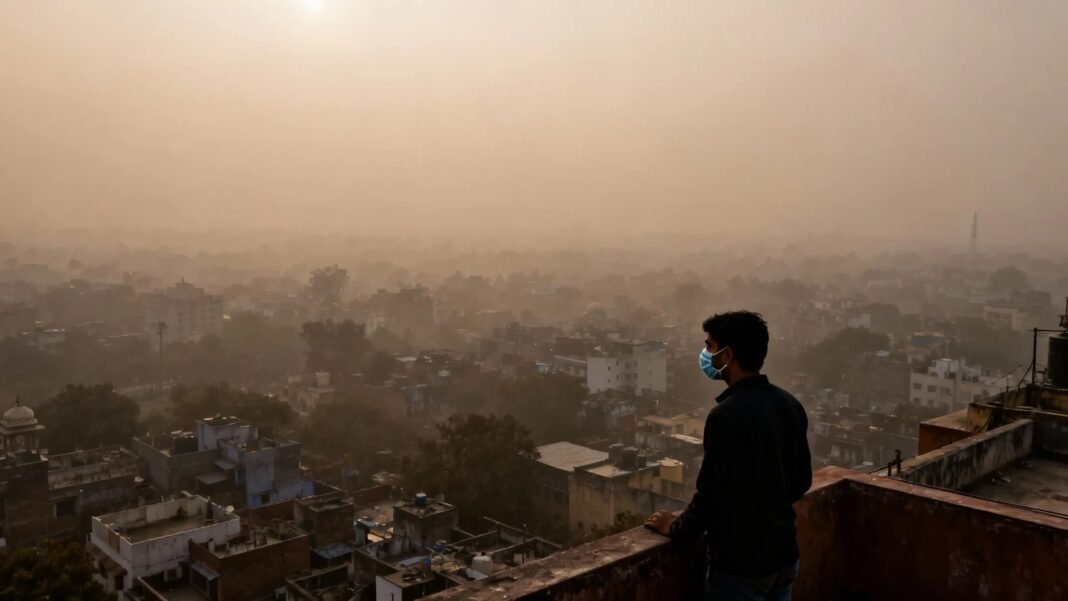


Each rise of 10 micrograms per cubic metre in annual PM2.5 was linked to 8.6 percent higher mortality in a nationwide study of air pollution in India, putting a number on a health burden that extends well beyond coughing and breathlessness. The research, published in The Lancet Planetary Health in December 2024, examined mortality and estimated exposure across India from 2009 to 2019. It estimated 3.8 million deaths over those 11 years linked to exposure above India’s national standard.
India’s annual limit for PM2.5 remains 40 micrograms per cubic metre, eight times the World Health Organization guideline of 5. Using the lower WHO guideline as the comparison, the researchers estimated about 1.5 million additional deaths each year. The two estimates answer different questions about meeting India’s standard and reaching the WHO recommendation.
PM2.5 refers to airborne particles measuring 2.5 micrometres or less across, roughly 30 times smaller than the width of a human hair. Their small size allows them to travel deep into the lungs.
How pollution affects the heart and kidneys
The study found that the link between pollution levels and mortality was stronger for increases starting below India’s annual limit of 40 micrograms per cubic metre. That finding gives health authorities a reason to pursue reductions even in places already meeting the national benchmark, because harm was seen at levels below that limit.
Petter Ljungman, a study coauthor from Sweden’s Karolinska Institute, said the results show that current guidelines in India are not sufficient to protect health, and that stricter regulations and measures to reduce emissions are of utmost importance. Joel Schwartz, a study coauthor and environmental health faculty member at Harvard T.H. Chan School of Public Health, called for controls at coal power plants and limits on crop burning, and said the problem extends across India, not only Delhi.
Doctors quoted in recent reporting describe prolonged exposure as a cardiovascular concern even for young adults who do not smoke. Pollution exposure can act alongside high cholesterol, diabetes, undiagnosed high blood pressure and a family history of early heart disease.
Kidneys may also be affected through inflammation, damage to their blood vessels and changes in their ability to filter blood. Doctors say pollution exposure may harm kidneys indirectly by worsening high blood pressure, insulin resistance and cardiovascular health. People with diabetes, hypertension or existing kidney disease, along with older adults, need particular attention.
Pollution levels in Delhi and other Indian cities
Delhi’s annual average PM2.5 concentration was 96.4 micrograms per cubic metre in 2025, about 2.4 times the national limit and more than 19 times the WHO guideline. Yet pollution reaches far beyond the capital. A January 2026 assessment by the Centre for Research on Energy and Clean Air found that 1,787 of 4,041 cities exceeded the national annual PM2.5 standard in every assessed year from 2019 to 2024, excluding 2020.
Delhi shows both progress and the distance still to travel. Its annual PM2.5 average fell from 131.3 micrograms per cubic metre in 2016 to 96.4 in 2025, a reduction of about 26.6 percent. PM10 fell from 284.2 to 197.3 over the same period, about 30.6 percent, but remained approximately 3.3 times its national annual limit.
A northern India study published on 1 March 2025 examined Delhi and five neighbouring states. It estimated deaths linked to PM2.5 from five disease groups rose from 171,551 in 2019 to 175,140 in 2022, with Uttar Pradesh accounting for the largest share in 2022.
Why pollution control has not yet delivered clean air
India continues to apply the National Ambient Air Quality Standards notified in 2009. The Central Pollution Control Board began a review in 2020. A reply under the Right to Information Act, dated 26 October 2026, said a revised technical report remained under review.
The National Clean Air Programme began in January 2019. Across 130 participating cities, Rs 16,824 crore was released and Rs 12,087 crore spent over seven years, about 72 percent of the money released. A Centre for Research on Energy and Clean Air analysis found that 117 of those 130 cities, or 90 percent, remained above the national annual PM10 standard in the financial year 2025 to 2026. Only 13 met it.
Forty-three cities recorded higher PM10 levels than in 2019 or 2020 despite spending a combined Rs 2,857 crore. Reported increases included 59.3 percent in Navi Mumbai, 40.4 percent in Nashik, 24.7 percent in Pune and 20 percent in Chennai. Transport, industry, power generation, construction, household fuel use and open burning all contribute to pollution. Winter weather can trap emissions close to the ground, while annual measurements show action is needed throughout the year.