
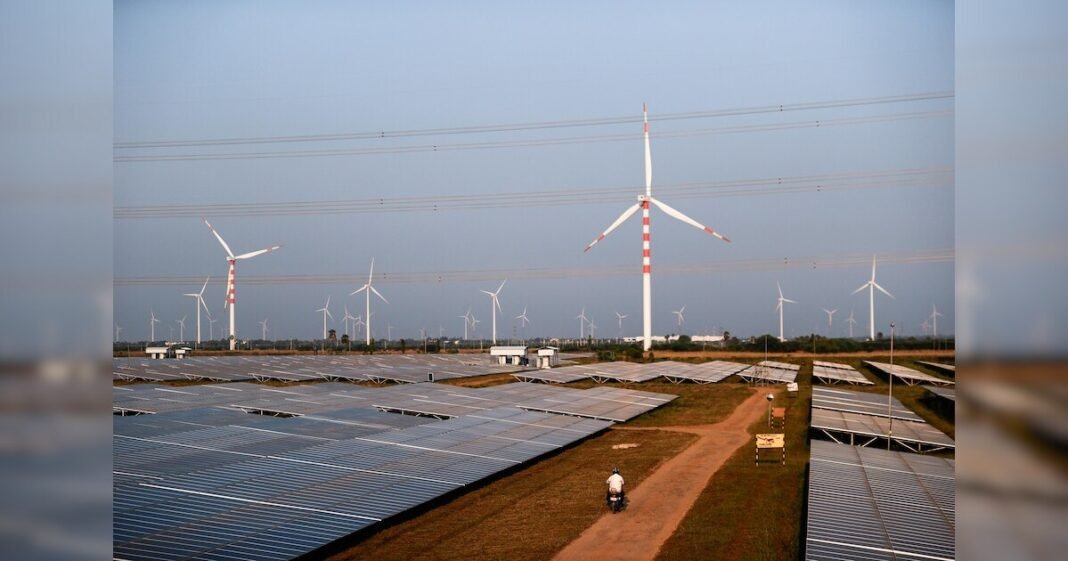


India needs $220 billion in clean energy investment between 2027 and 2030 to reach its target of 500 GW of non-fossil fuel capacity by 2030, the Ministry of New and Renewable Energy (MNRE) has said. Santosh Kumar Sarangi, secretary of the ministry, put the figure to reporters in New Delhi on Wednesday, October 28, ahead of a clean energy summit in the capital next week. India now has about 308 GW of non-fossil fuel capacity, leaving a gap of roughly 192 GW to the 2030 target.
The clean energy investment will be required across solar and wind power, battery energy storage, green hydrogen, transmission infrastructure and manufacturing, Sarangi said. A sector breakdown of the planned requirement puts solar power at about $70 billion, transmission infrastructure at $40 billion to $45 billion, wind power at $25 billion to $30 billion, green hydrogen at $20 billion to $25 billion and energy storage at about $20 billion. Manufacturing is expected to need $15 billion to $20 billion, while hydropower and bioenergy need $12 billion to $15 billion and $3 billion to $5 billion respectively. The figures represent planned investment needs, not money already committed to approved projects.
India aims to reach 500 GW of non-fossil fuel capacity by 2030 and net-zero emissions by 2070. Non-fossil fuel sources now account for over 54 per cent of India’s total installed power capacity.
Where clean energy money has come from so far
Between 2024 and 2026, India attracted about $64 billion in private clean energy investment, including $6.2 billion in foreign investment, while the government invested an additional $6 billion, Sarangi said. Private entities account for nearly 74 per cent of India’s renewable energy capacity. Policy stability, 100 per cent foreign direct investment under the automatic route and payment security mechanisms have supported private participation in the sector, the ministry said.
Two measures are aimed at making projects easier to finance. A 500 MW Contract for Difference pilot run through the Solar Energy Corporation of India is designed to improve project bankability and revenue certainty. The reduction in Goods and Services Tax on renewable energy equipment from 12 per cent to 5 per cent is also expected to support the sector. J.V.N. Subramanyam, joint secretary at MNRE, said the private sector remains the largest participant in India’s power sector transformation, while the government provides the policy framework.
The country has also developed a market for about 550,000 tons of green ammonia demanded by overseas buyers, including Japan and South Korea.
The gap India still has to close
About 40 GW of clean energy projects remain without buyers after a large number of project tenders awarded in recent years, Sarangi said. The federal government is working with state governments to encourage greater adoption of clean power and expand battery storage capacity.
Sarangi said the clean energy build-out needs accelerated deployment of energy storage, stronger transmission networks and expanded domestic manufacturing capability. “India’s clean energy transition is entering a decisive phase. With 308 GW of installed non-fossil fuel capacity, we are firmly on course to reach our 500 GW target by 2030,” he said. He added that realising the ambition will require approximately $220 billion in investment between 2027 and 2030.
India will meet investors at a clean energy summit in New Delhi next week to discuss potential investment from several countries, including Canadian pension funds, Sarangi said. The ministry is also formulating a financing roadmap through 2030 to guide how the $220 billion requirement is met.
Clean energy summit to open in New Delhi on November 2
Prime Minister Narendra Modi will inaugurate the Bharat Renewable Energy Summit and Expo (BRESE) 2026 on November 2 at Bharat Mandapam in New Delhi. The four-day event runs to November 5 and is expected to bring together participants from more than 130 countries, including ministers, policymakers, industry leaders, investors, financial institutions, manufacturers and researchers.
Nine countries, Australia, Denmark, France, Germany, Netherlands, Norway, Sweden, the United Kingdom and the European Union, will take part as country partners. Thirteen states and union territories will also take part, including Andhra Pradesh, Assam, Bihar, Chhattisgarh, Delhi, Gujarat, Karnataka, Madhya Pradesh, Maharashtra, Odisha, Rajasthan, Uttar Pradesh and West Bengal. The summit is alongside the 9th session of the International Solar Alliance Assembly and the 4th International Conference on Green Hydrogen, and it carries the theme “Invest. Innovate. Inspire.”
Sarangi said the summit will provide a platform to connect global capital, technology and industry expertise with India’s growing clean energy opportunities. The summit is where the government hopes to start turning that estimate into signed projects.