
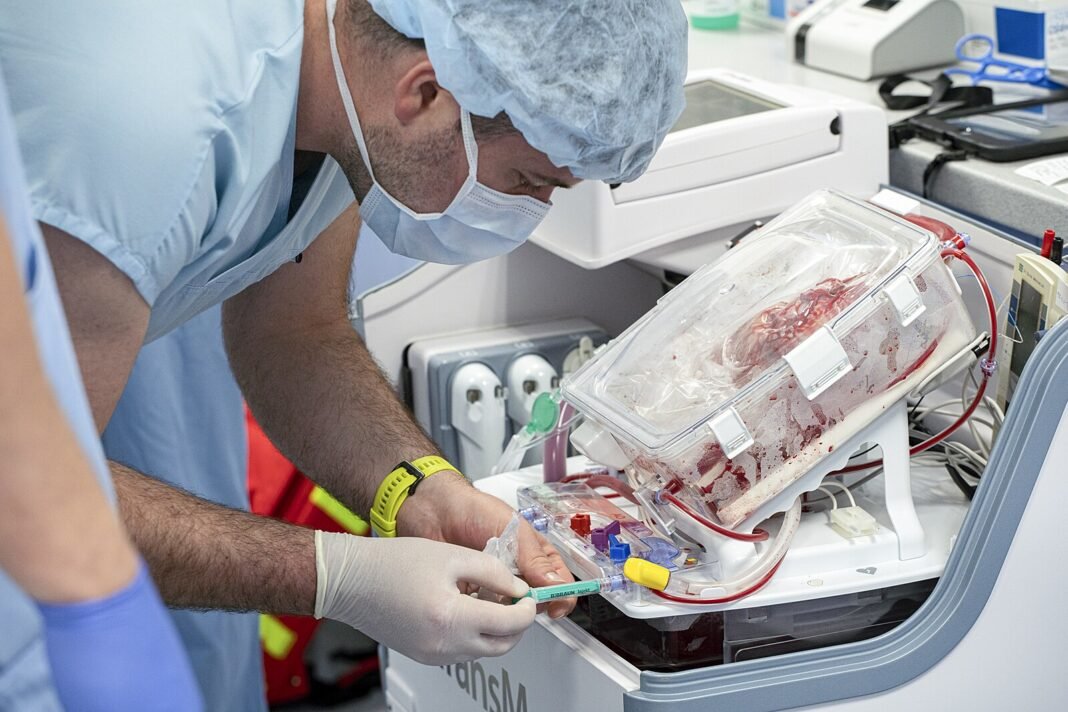


Researchers in Sydney kept a donated human liver alive outside the body for seven weeks, a record for an organ on life support. The team, led by transplant surgeon Carlo Pulitano, connected the organ to an automated system of pumps and sensors that fed it nutrients and blood and carried away waste. Pulitano, a professor at the University of Sydney who operates at the Royal Prince Alfred Hospital, called the system “an artificial body”. Its formal name is the Extended Organ Perfusion System.
Most organs for transplant last only a few hours in cold storage. Perfusion systems changed that over the past decade by pumping warm or cold fluid through an organ, which can double the time it can be held. Pulitano said automation was the step that broke the record. His team described perfusing 55 human livers at a meeting in Switzerland earlier this year. Some ran on a system that needed manual adjustment, while the ones on the automated system lived for about four weeks on average, three times as long, and one of them reached seven weeks.
The previous record for keeping an internal organ alive outside the body was set in Switzerland several years ago. That organ, also a liver, lasted about two weeks. Pulitano said his group is the only one in the world to have held a human liver under fully normothermic, physiological conditions for seven weeks. Normothermic means the organ is kept at body temperature, about 37 degrees Celsius. The details are still awaiting formal publication.
Liver perfusion and the path to transplant
Perfusion has already changed transplant practice. Surgeons have restarted hearts from dead donors and kept them beating outside the body, and about half the kidneys transplanted by Paulo Martins at the University of Oklahoma are now perfused, even though the process can add 100,000 dollars to the cost. In 2022 a Swiss team transplanted a damaged liver kept on perfusion for three days, the longest an internal organ had stayed outside the body before a successful transplant, according to Waldemar Hoffmann, chief executive and co-founder of Apersys, a startup formed to sell the technology.
Pulitano’s own startup, Aeternum Life Technologies, will help run a trial in Sydney to transplant low-quality livers kept on perfusion for four days. The trial is a shorter, practical test of the same idea: if organs can be held longer, surgeons gain time to check them, treat them and match them to the right patient. Perfused organs also appear to start repairing themselves after a day or so.
Liver research beyond transplant surgery
What a seven-week perfusion is actually for remains an open question. Hoffmann said people in the field accept that Pulitano’s record is real, but they do not know how healthy the organ was at the end. “The key question is what the purpose for a seven-week perfusion would be,” he said. Martins, the Oklahoma surgeon, said the value lies in what long-term life support makes possible, including artificial wombs and the chance to test treatments directly on a human organ outside the body for long stretches.
Pulitano has already tried adding gene therapies to organs on the machine. “It gives us a living human organ model for translational research that no animal system can match, because the biology, the immunology, and the drug responses are human from the outset,” he said. In Silicon Valley, patents filed by Altos Labs, a longevity startup backed by billionaires, describe putting reprogramming genes into animal livers kept outside the body. Altos scientists have speculated that doctors might one day disconnect a failing organ, connect it to a perfusion machine and give it strong genetic treatments without risking the rest of the body.
Pulitano also sees a way to multiply donor organs. In living donation, surgeons commonly take half of a person’s liver and give it to someone else, and after about two months both parts grow back to almost full volume. He said he has tried dividing one and attaching the sections to the machine, and if that works, one donor organ could become several full-size organs. A United States company, Bexorg, has been reanimating human brains with perfusion pumps to study experimental drugs, perfusing them for about a day and aiming to reach two weeks.
Doctors working on the limits of organ life support have formed two new scientific societies to study the idea. One, founded by Martins and called the International Society for Organ Preservation and Perfusion Therapy, will hold its first meeting this year in Italy. The other, based in China, was launched in August to advance what doctors at the First Affiliated Hospital of Sun Yat-Sen University call “organ medicine”.