
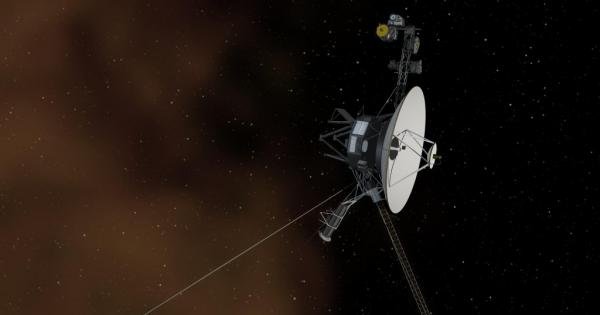


Voyager 1 reached one light-day from Earth on Wednesday 18 November, the first human-made object ever to travel that far. At 5:16 a.m. Eastern time the probe stood about 16.1 billion miles from home, a distance so great that a radio signal takes a full day to reach it. It is still in touch, and part of the reason is hardware built in western New York in the 1970s: Moog-manufactured valves that keep the spacecraft’s antenna pointed at Earth.
The probe launched from Cape Canaveral in Florida on 5 September 1977, sixteen days after its twin, Voyager 2, and quickly overtook it on a faster route out of the solar system. Voyager 1 flew past Jupiter in 1979 and Saturn in 1980, then kept going, crossing into interstellar space in August 2012. Moog Inc, based at Elma near Buffalo, designed part of the liquid rocket engine propulsion systems on the Voyager probes and supplied the thruster valves that steer the spacecraft.
The valves matter because the spacecraft has to stay pointed the right way. Voyager 1 carries 16 hydrazine thrusters and three-axis stabilisation gyroscopes, with Sun sensors and a Canopus star tracker, to keep its 3.7-metre high-gain antenna aimed at Earth. The attitude and articulation control subsystem holds the antenna on target while the probe rolls about its axis, firing small thrusters attached to the bus. Without that pointing, the faint signal from its 22-watt transmitter would never reach NASA’s Deep Space Network dishes in California, Spain and Australia.
Voyager 1 and the one light-day milestone
NASA marked the week with an event called Shine Bright for Voyager’s Light-Day, held as Voyager 1 closed on the mark. After sunset on Tuesday 17 November, people around the world were invited to flash VGR, the mission’s call sign, in Morse code with phones, flashlights and buildings. The gesture was symbolic: the probe’s cameras were switched off decades ago, after the Pale Blue Dot image, and it cannot see the lights.
The milestone arrived with a problem still open. On 14 November the mission team found Voyager 1 had stopped sending science and engineering data after a Deep Space Network antenna in Canberra, Australia, locked on and received a carrier signal but no data. Engineers are working to find the cause and the next steps. The team said it could still confirm the light-day crossing on Thursday 19 November using the carrier signal and trajectory calculations, since the probe travels on a known path at a steady speed and has no way to change it.
It was the second communications scare in weeks. In October the mission lost all contact with Voyager 1 for about 48 hours before the signal returned, and engineers are checking whether the two events are connected. In 2023 a failed memory chip in one of the probe’s computers sent back unreadable data, and the team spent months moving the affected code to other parts of memory.
Voyager 1 instruments still returning data
Only two of the probe’s science instruments are still operating: the magnetometer and the plasma wave subsystem. The plasma wave instrument was designed and built at the University of Iowa under the late physicist Donald Gurnett, and it confirmed in 2012 that the probe had crossed into interstellar space. Its principal investigator is William Kurth, a research scientist at Iowa who watched the launch at Cape Canaveral in 1977 and has worked on the mission ever since.
Voyager 1 is running out of power. Its three radioisotope thermoelectric generators lose about four watts of output each year, and engineers have switched off heaters and instruments one by one to keep it alive. NASA expects at least one instrument to keep running on each Voyager into the early 2030s. The two probes will each reach 50 years in space in the summer of 2027, on 5 September and 20 August respectively.
Both Voyagers carry a Golden Record, a 12-inch gold-plated copper disk with sounds and images chosen to portray life on Earth. Voyager 1 also carries the record of its own journey: more than 16 billion miles travelled, two planets visited up close, and a signal that still arrives, a day late, at dishes on Earth.