
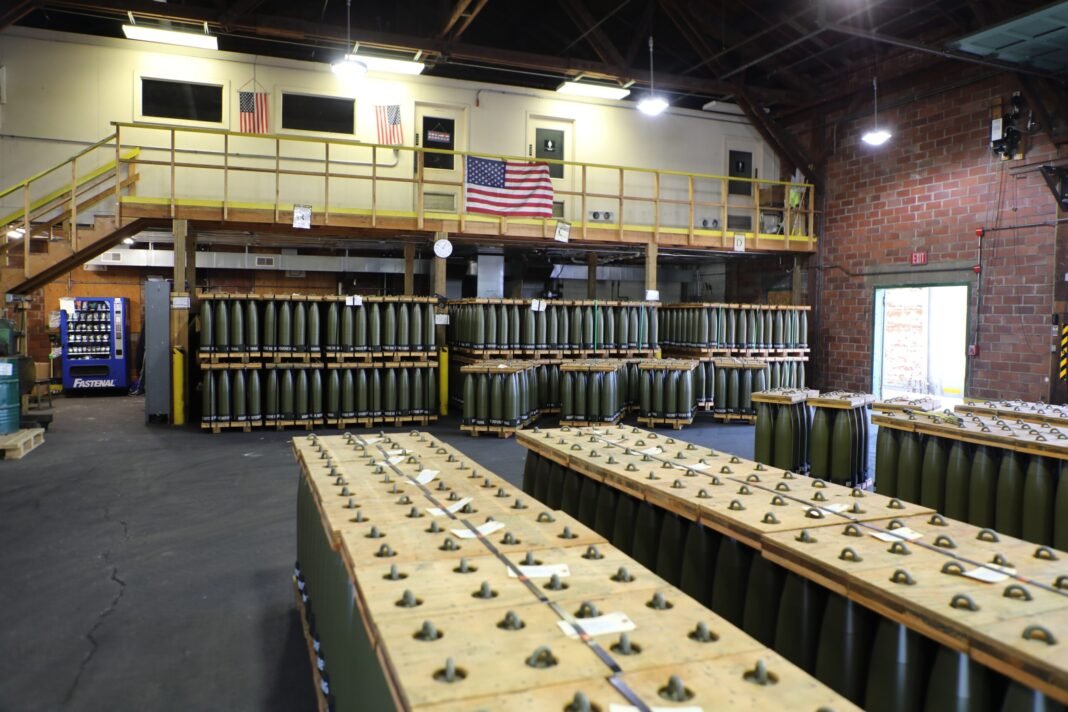


The United States Army has delayed the controlled detonation of about 9,500 pounds of deteriorated lead azide in Iowa until Monday, after public health experts warned that a plume of lead dust could put nearby residents at risk. The two blasts at the Iowa Army Ammunition Plant in Middletown were set for Friday, but Acting Secretary of the Army Adam Telle announced late on Thursday that they would move to 23 November, the latest date possible before a forecast drop in temperature that could further destabilise the material.
The material, about 68 barrels of lead azide, had degraded in storage and grown too unstable to move, according to the Army and the Environmental Protection Agency. The agency issued an emergency permit on 13 November. Inspections found the compound had dried out and formed crystals, and moving it carried an unacceptable risk of an accidental explosion.
Lead azide is used to set off military munitions. The Army’s advisory said the detonation would produce a plume of lead-containing particles that would disperse in the air and settle on the ground. “Lead is toxic to humans and animals,” the advisory said, and it urged residents to take steps to limit their exposure.
Lead azide and the health warnings
Patrick O’Shaughnessy, a professor of occupational and environmental health at the University of Iowa, said the plume was among the main concerns. He said the lead azide detonation could send lead particles into the air, where they would travel with the wind before settling on soil, buildings, vehicles and other surfaces, and people could breathe them in, swallow them, or absorb them through skin contact.
Young children face the highest risk: lead is a neurotoxin that can damage the developing brain and nervous system, and health authorities say there is no safe level of exposure. O’Shaughnessy pointed to toddlers in particular. “Maybe the most concerning thing is, say, 2-year-olds that just have this habit of, right, of touching everything and then everything goes right into their mouth, right,” he said.
The Iowa Department of Health and Human Services published guidance on 19 November saying the department had only very recently been made aware of the planned lead azide detonation. It advised residents in areas that could be affected to stay indoors with windows and doors closed for 24 to 48 hours after the blast, and to consider using air filtration. People worried about lead exposure were advised to ask a healthcare provider about a blood lead test.
Lead azide testing questions remain
Peter Thorne, a University of Iowa public health expert, told Iowa Public Radio there was too little time left to organise a formal study comparing residents’ blood lead levels before and after the detonation. He suggested people who already had blood lead results could consider follow-up testing in the coming months, and acknowledged that the cost could stop some people from doing so.
University of Iowa researchers also warned that washing lead dust off playground equipment does not remove the lead. The particles can be rinsed into the surrounding soil, where they remain a concern for young children who play in dirt and put their hands in their mouths. O’Shaughnessy and Drew Latta, of the university’s Center for Health Effects of Environmental Contamination, are preparing independent air and soil monitoring around the site, with locations chosen from forecasts and the expected path of the plume. The Army said it would place air monitors along the plant perimeter and at off-site locations chosen by wind direction, and the Environmental Protection Agency planned a command centre in Mediapolis to sample air, soil and water. The dust was expected to linger for no more than an hour, depending on wind speed.
Lead azide delay follows public pressure
Middletown has about 400 residents and sits about 160 miles south-east of Des Moines. Schools in Mediapolis, West Burlington and Danville had already cancelled classes for Friday, and the public library in Mediapolis was set to close.
Iowa Governor Kim Reynolds was among those who called for a delay, and her office said she spoke directly with Telle as the clock ran down on Thursday. Senator Chuck Grassley said the Army was delaying the lead azide detonation to further educate the public. Environmental groups filed a lawsuit on Thursday seeking emergency court action to halt the plan. Wally Taylor, legal chair for the Sierra Club, said the detonation should be cancelled outright rather than delayed.
Officials in Illinois raised concerns of their own. The state’s public health director, Dr Sameer Vohra, advised residents who could be affected to stay indoors with windows closed for 24 to 48 hours and to wash hands before eating and drinking. James Jennings, director of the Illinois Environmental Protection Agency, urged comprehensive sampling after the lead azide detonation, with the results made public.