
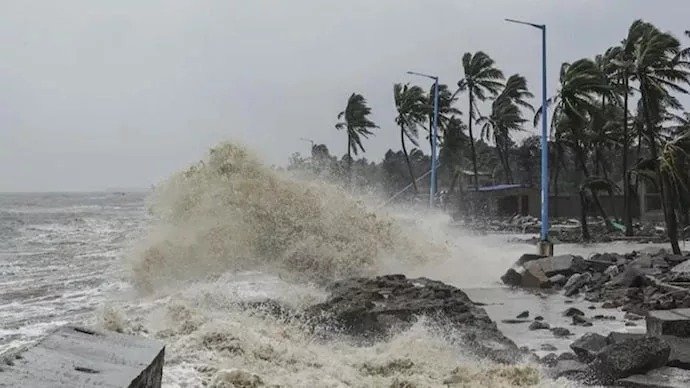


Severe Cyclonic Storm Murasu began its landfall on the south Andhra Pradesh coast near Ongole at 1 am on Tuesday, November 3, the India Meteorological Department (IMD) said. The Murasu landfall brought heavy rain and gale winds to Prakasam district, with sustained winds of 100 to 110 kmph and gusts reaching 120 kmph at the point where the storm came ashore. Coastal towns had braced for the Murasu landfall through Monday night, after the IMD forecast the storm would move between Nellore and Narsapur, close to Ongole, between 11.30 pm on November 2 and 4 am on November 3.
At 1.30 am, the cyclone was centred over the west-central Bay of Bengal, close to the south Andhra Pradesh coast, about 40 km southeast of Ongole, 60 km northeast of Kavali and 70 km south of Bapatla. The IMD said in its official release that the forward sector of the wall cloud, the ring of fierce wind and rain around the eye, was entering the coast, while the wall cloud region was very close to the shore. Gale winds of nearly 110 kmph, gusting to 120 kmph, were likely to prevail along and off the coast until morning during the Murasu landfall.
Murasu landfall brings gale winds to the coast
Rain picked up as the Murasu landfall progressed, before the eye arrived. Kothapatnam in Prakasam district had recorded 74.7 mm of rain by 1 am, while Ongole city had recorded 18 mm, The Hindu reported. Strong winds and rain through Monday night scattered pushcarts and shop signboards along Kothapatnam Beach Road in Ongole, according to a BusinessLine photo report from the town. The IMD said heavy spells of rain were likely across south coastal Andhra Pradesh during the 12 hours after landfall began.
Murasu is the second cyclone to hit Andhra Pradesh in about a week, after Cyclone Arnab in late October. The repeat blow has put the same stretch of coast under strain again, with officials watching low-lying areas and roads that flood often. The IMD asked people in affected areas to stay indoors, people in huts near the coast to move to safer places, and everyone to avoid weak structures and roads that often flood. The state disaster helpline number is 1070.
Murasu landfall and the storm surge warning
With the Murasu landfall under way, the IMD forecast a storm surge of 1 to 1.5 metres above the astronomical tide, likely to flood low-lying areas of south coastal Andhra Pradesh until the morning of November 3. The maximum peak surge was expected over Bapatla, Krishna and Prakasam districts. Extremely heavy rain was forecast for Prakasam, Bapatla and Krishna, and the IMD issued red alerts for those districts. A red alert for isolated extremely heavy rain was also issued for Telangana districts close to the Andhra border.
The Andhra Pradesh State Disaster Management Authority urged residents in vulnerable areas to stay indoors and follow safety advisories. District administrations listed mandals in Prakasam facing severe rain, including Chinaganjam, Ongole Rural, Kothapatnam Beach, Ongole Urban, Naguluppalapadu, Vetapalem, Tangutur, Singarayakonda, Ulavapadu, Maddipadu, Gudluru, Jarugumalli, Santhanuthalapadu and Kandukur. Fishing was halted along the coast. The IMD told fishermen not to venture out along and off the Andhra Pradesh coast until the afternoon of November 4, and said the west-central Bay of Bengal and the south Odisha coast were covered by the same warning until the afternoon of November 4.
Murasu landfall: what officials are watching next
Andhra Pradesh Chief Minister N Chandrababu Naidu directed officials to remain on high alert and ensure there is no loss of life. Officials told Naidu at a 3.30 am review that the storm would finish crossing the coast by about 6.30 am, The Indian Express reported. At 5.30 am the landfall process was still under way and was expected to complete within about two hours. By 5.08 am, the IMD said most of the wall cloud had moved onto land and the eye was entering the coast near Ongole.
The IMD said sea conditions along the Andhra coast should start improving after the morning of November 3 and settle further by November 4. Rain was still expected through the morning after the Murasu landfall, and the surge warning ran until the morning of November 3. The Murasu landfall closed a forecast window that had put the crossing between Nellore and Narsapur, and the storm came ashore inside that window and inside that stretch of coast. The IMD will keep issuing bulletins as the storm moves inland and weakens, and the fishing warning stays in force until the afternoon of November 4 for most of the affected waters.