
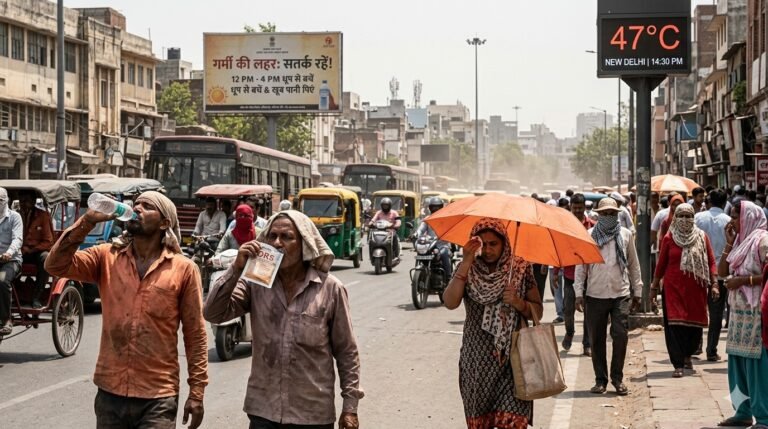


The Lancet Countdown 2026 report finds that climate change is raising health risks in India through longer heat exposure, lost sleep and widening conditions for mosquito-borne disease. The report, the tenth annual assessment from the Lancet Countdown collaboration, was released on 28 October, ahead of the COP31 climate summit. It brings together 146 researchers from more than 100 institutions across over 30 countries and tracks 54 indicators of climate change and health.
Globally, the report estimates that annual average heat-related deaths rose by nearly 36 per cent in the decade after the Paris Agreement came into force, compared with the previous decade. In 2023 alone, heat was linked to a record 710,000 deaths worldwide, with more than 70 per cent of that toll attributed to human-caused climate change. The Lancet Countdown authors call for climate change to be formally recognised as a global health emergency, with health considerations built into mitigation, adaptation and financing decisions.
For India, the report estimates that about half of the heatwave days experienced between 2016 and 2025 were attributable to climate change. Indians faced more than 2,600 hours each year when temperatures posed a moderate or higher risk of heat stress during outdoor activity such as brisk walking. That was over 200 hours more than the average recorded in the 1990s.
Lancet Countdown findings on heat and sleep in India
Night-time temperatures add a second strain. The Lancet Countdown estimates that people in India lost about 64 hours of sleep each year between 2021 and 2025 because of hotter nights, around three hours more each year than during 1986 to 2005. Hot nights make it harder for the body to cool down, and the report links that sleep loss to the wider health burden of rising temperatures.
The work burden is large. The Lancet Countdown India data sheet puts heat-related lost work at an estimated 193 billion potential hours a year between 2016 and 2025, about 75 per cent more than the yearly average in the 1990s. Farm work carries most of the loss. The sheet also puts the 2025 earnings hit from heat at 174 billion US dollars, or 4.2 per cent of India’s GDP.
Lancet Countdown findings on disease risks in India
The Lancet Countdown also tracks disease risks. The transmission potential of Aedes albopictus, a mosquito that spreads dengue, was 84 per cent higher in 2016 to 2025 than in 1951 to 1960, moving from below 1 to above 1 on the reproduction number scale. Conditions favourable to malaria transmission also expanded, with environmentally suitable months rising by 19 per cent for Plasmodium falciparum and 18 per cent for Plasmodium vivax between 2016 and 2025, compared with 1981 to 1990.
Coastal risks grew as well. The environmentally suitable length of India’s coastline for Vibrio transmission increased by about 27 per cent compared with 1982 to 1991, reaching around 2,740 kilometres in 2025. The report also notes that extreme drought affected nearly 52 per cent of the world’s land for at least one month in 2025, the second-highest level on record.
India is among the countries with the highest heatwave exposure for infants and older adults, alongside China, the United States and Russia, the report says. Older adults worldwide experienced an average of 12.8 heatwave days per person in 2025, compared with 8.7 days for infants, and the report counts 10.8 billion person-days of heatwave exposure for older adults globally in the same year.
What the Lancet Countdown says must happen next
The report records some progress alongside the risks. Global investment in clean energy reached a record 2.1 trillion US dollars in 2025, and countries that reduced fossil fuel-related air pollution are estimated to be preventing thousands of premature deaths each year. National health adaptation plans and climate-informed early warning systems have also become more common.
Dr Diarmid Campbell-Lendrum, Head of the Climate Change, Air Quality and Energy and Health Unit at WHO, said, “Climate action is a health intervention. Cleaner energy, stronger health systems and early warning systems are saving lives today.” The World Meteorological Organization has forecast above-average temperatures across large parts of the world in 2026, with a strengthening El Nino expected to alter rainfall patterns and raise the risk of drought in some regions and floods in others.