
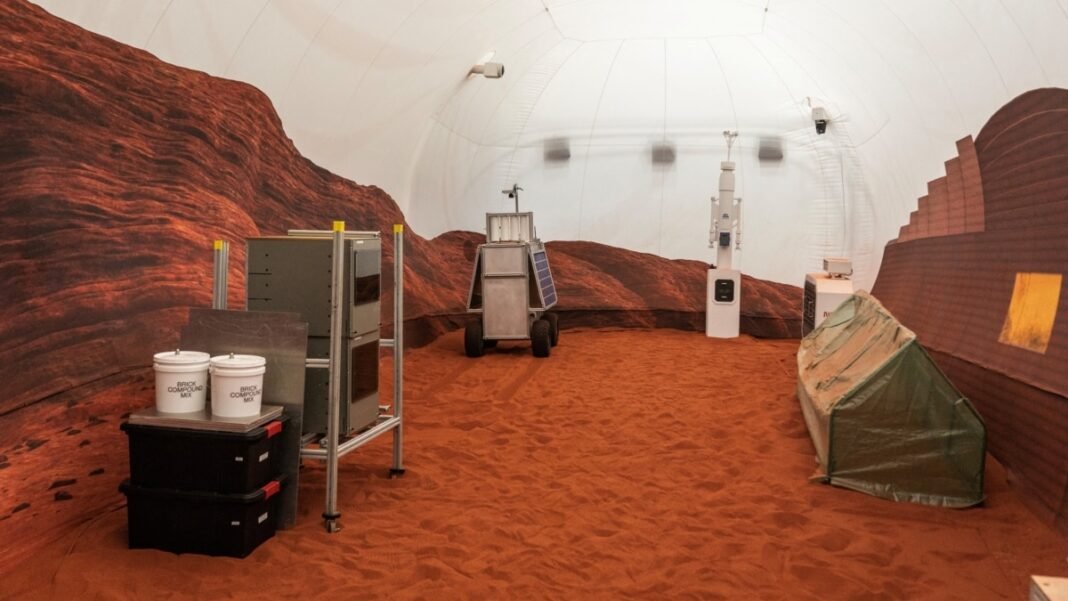


Four volunteers walked out of a simulated Mars habitat in Houston on Saturday after 378 days inside, closing NASA’s second yearlong test of life on the Red Planet. The NASA Mars simulation crew left the 1,700-square-foot habitat at Johnson Space Center on 31 October, more than a year after they entered it on 19 October 2025. The mission, known as CHAPEA, was designed to show how people cope with isolation, limited supplies and long communication delays.
The NASA Mars simulation crew was mission commander Ross Elder, medical officer Ellen Ellis, science officer Matthew Montgomery and flight engineer James Spicer. None of the four is a professional astronaut. They lived and worked inside Mars Dune Alpha, a 3D-printed structure built to stand in for a habitat on Mars, and they followed a schedule of simulated spacewalks, exercise, crop growing and maintenance.
NASA Mars simulation tested the crew’s daily routine
The volunteers grew crops in simulated Martian soil, carried out suited extravehicular activities and kept the habitat running. They exercised, grew plants and carried out routine maintenance on the habitat and its machinery. They used virtual reality headsets for simulated spacewalks in a small outdoor enclosure next to the habitat. Messages to and from the outside world were delayed by up to 45 minutes each way to copy the time signals take to travel between Earth and Mars. Contact with family was limited to email, and even that arrived late. The NASA Mars simulation copied the routines of a real mission as well as its isolation.
The crew also tested medical equipment meant for deep space. During their stay they worked with a device NASA Glenn designed as an ambulance in a box, a Multi-functional Integrated Medical device that could help astronauts handle medical emergencies on long missions to the Moon or Mars without real-time help from Earth. The NASA Mars simulation put the device through a year of use in a closed habitat. Ellis described Montgomery as a Swiss army knife for his ability to fix technical problems inside the facility.
NASA Mars simulation crew steps out after a year
The exit ceremony took place on 31 October, with live coverage from NASA Johnson and remarks from Johnson Space Center Director Vanessa Wyche and NASA astronaut Jack Hathaway. Hathaway welcomed the crew as they stepped out of the habitat and greeted them with a call of trick-or-treat. Ellis told reporters after the exit that it had been a hell of a year, describing the four as analog astronauts living in captivity of their own free will. The crew will now spend two weeks in post-mission evaluations and debriefings with NASA scientists. The NASA Mars simulation ran for 378 days, the same length as the first CHAPEA mission.
CHAPEA stands for Crew Health and Performance Exploration Analog. The first mission ran for 378 days across 2023 and 2024 with a different crew of four. The habitat was built with 3D printing and lava concrete, a method NASA expects to use for future settlements on Mars and the Moon. The NASA Mars simulation will run again, with NASA planning to send another group into the habitat for an extended period next year. Data from the mission will feed into planning for the Artemis lunar program, including food system design, use of crew time and bandwidth on NASA’s Deep Space Network. The data will also help NASA plan for how limited communication through the Deep Space Network affects missions on Mars and farther out.
What the NASA Mars simulation means for future missions
The experiment does not mean a crewed flight to Mars is close. NASA has explored Mars with robotic rovers and orbiting spacecraft, and it aims to send people there as early as the 2030s, after returning astronauts to the Moon for the first time since 1972. The NASA Mars simulation gives the agency a year of data on how a crew handles confinement, scarce supplies and delayed messages. That record is now in the hands of the scientists who will plan the next mission.