
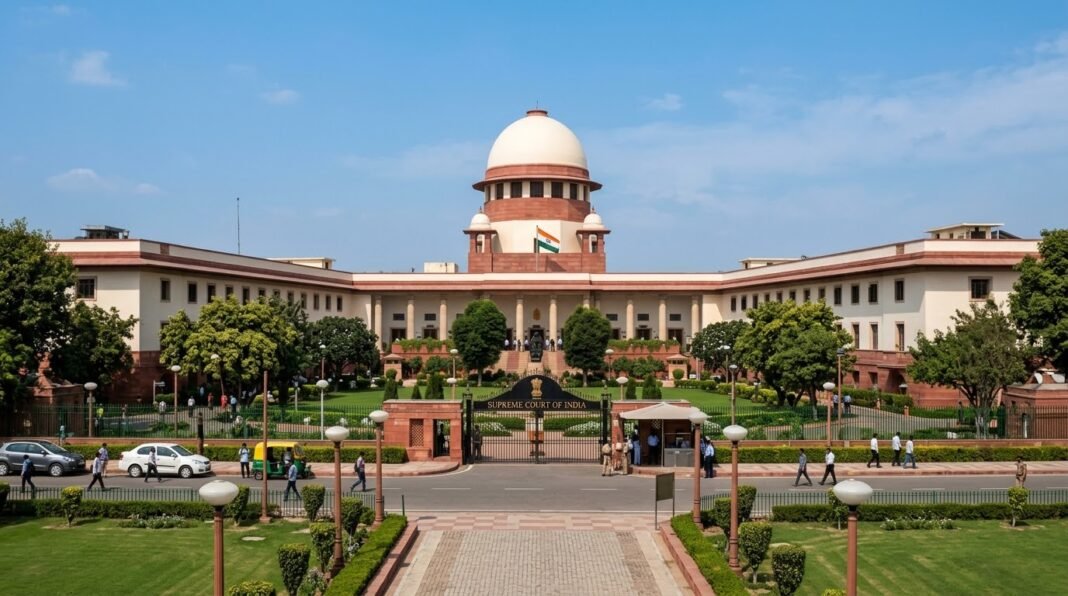


In a judgment delivered on 3 November 2026, the Supreme Court refused to quash criminal proceedings against a doctor who married another woman in the United Kingdom after obtaining a divorce from a British court. The bench of Justices Prashant Kumar Mishra and Shree Chandrashekhar heard the case of Dr N. Sridhar Reddy, who had married N. Geetha Prasanthi in Andhra Pradesh in 2003 under Hindu customs. The British court granted the divorce on the ground of irretrievable breakdown of marriage, in proceedings the wife opposed. The ruling turns on whether a foreign divorce decree can end a marriage solemnised in India, and it has drawn attention from couples living abroad.
Why the foreign divorce decree failed
The court held the foreign divorce decree could not automatically be recognised in India because irretrievable breakdown is not a ground for divorce under Section 13 of the Hindu Marriage Act, 1955. That section lists grounds including cruelty, adultery and desertion. The bench said: “In our view, the foreign divorce decree was passed in contravention of the existing matrimonial law in India and on a ground that is not even recognised statutorily. This violates the legal threshold of Section 13 of the CPC, which every foreign decree has to pass through.” The case is N. Sridhar Reddy v. State of Andhra Pradesh, and the bench tested the British decree against Indian law before reaching its view.
What the ruling means for remarriage
The court held that acquiring foreign citizenship does not remove the legal consequences of a marriage solemnised in India. A person who remarries on the basis of a foreign divorce decree may face prosecution for bigamy, since the first marriage continues to subsist under Indian law. Bigamy can attract imprisonment under Section 82 of the Bharatiya Nyaya Sanhita, 2023. The case against his parents and the second wife was quashed. The court drew a line between the man, who remarried, and the others named in the complaint, and only the proceedings against him will go on. The bench tested the British decree against Indian law, and the ground of irretrievable breakdown did not pass that test. The wife had opposed the proceedings in the British court, and that opposition formed part of the background to the case.
When a foreign divorce can be recognised
The ruling does not mean Indians cannot divorce abroad. A foreign divorce can be recognised if it meets Indian legal requirements, including a ground recognised under Indian law and the other spouse’s genuine participation or consent. The test is the ground on which the decree rests and the part the other spouse played in the proceedings. A decree that rests on a ground Indian law recognises, and in which the other spouse took a genuine part, stands on different footing from the decree in this case.
The ruling follows the 1991 landmark judgment in Y. Narasimha Rao v. Y. Venkata Lakshmi, which set the frame for when a foreign divorce decree counts in India. That judgment has guided courts on foreign decrees for more than three decades. In January 2026 the Court dealt with a similar question in Kishorekumar Mohan Kale v. Kashmira Kale and used Article 142 to dissolve a marriage that had broken down since 2008. The two cases show the Court dealing with broken marriages in different ways, through recognition of decrees in one and through its own powers in the other.
The ruling is relevant to NRIs and couples who move abroad. A marriage solemnised in India keeps its legal consequences even after one spouse moves overseas and takes foreign citizenship. Couples who live abroad and seek to end a marriage will need a foreign divorce decree that meets Indian legal requirements, or they will need to seek relief in an Indian court. The judgment in N. Sridhar Reddy v. State of Andhra Pradesh was delivered on 3 November 2026. The bench that delivered it was made up of Justices Prashant Kumar Mishra and Shree Chandrashekhar.